Cote d'Ivoire, Burkina Faso, Ghana & Togo
/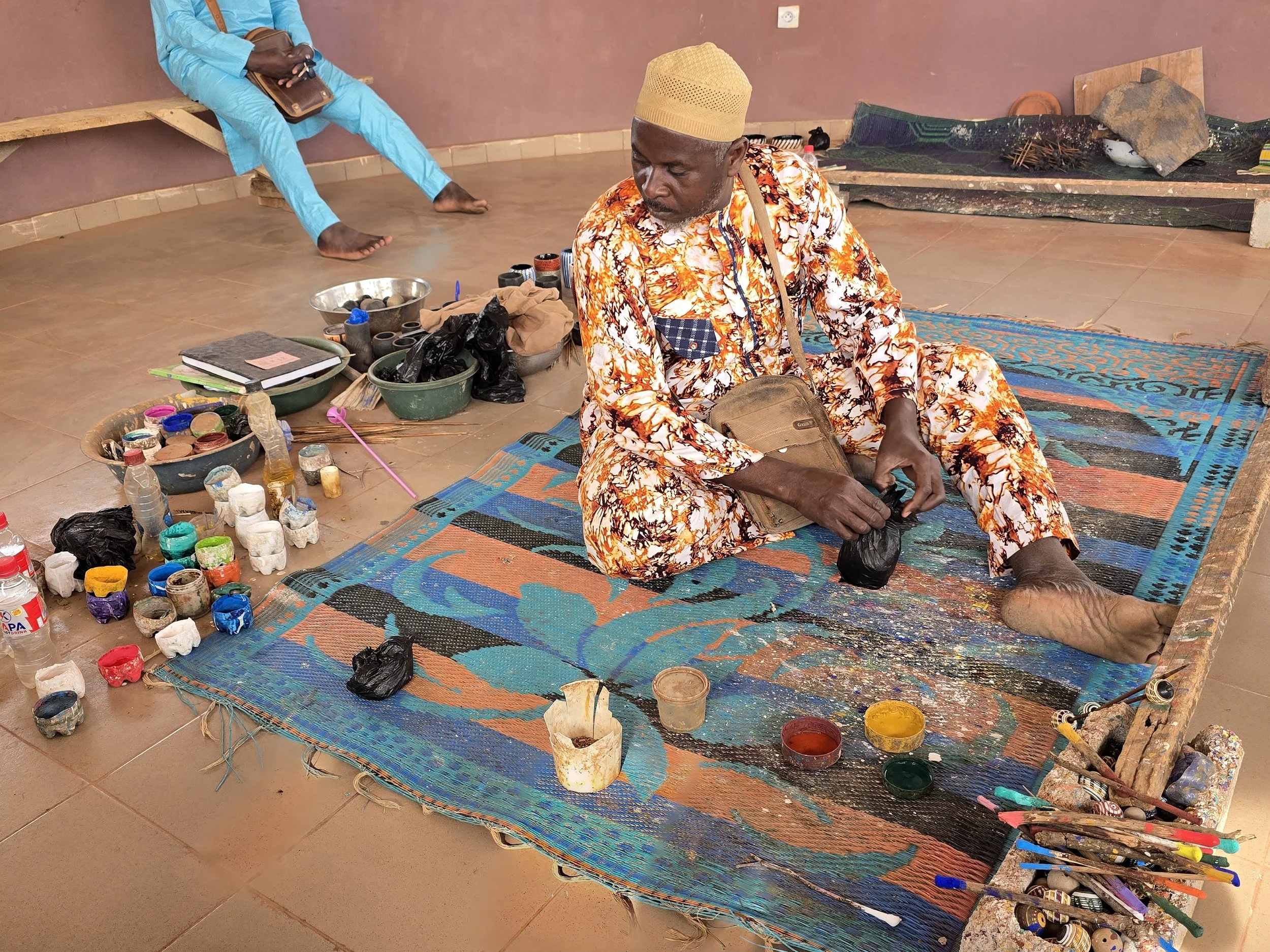
bead making, korhogo
Despite its alluring name, we hadn’t planned to visit the coast of Cote d-Ivoire, preferring instead to travel north to the town of Korhogo, a hub of artisan crafts including bead making and shea butter production. It is also where the Boloye (panther) dance is performed by the Senufo people. One small issue: no brakes. Five or six vigorous pumps on the pedal produced a faint bite but nowhere near enough force to stop a 3,000 kg vehicle.
Overlanding in West Africa is notoriously tough: extreme heat, poor or absent roads, border bureaucracy, police checks, chaotic cities, and a glaring lack of infrastructure – especially when you need repairs. African bush mechanics are remarkable, but without modern tools or parts, even they couldn’t help us.
So, once again, we were online ordering parts. After consulting UK garages, we gambled on a faulty brake servo and arranged delivery to Ghana. English speaking and home to a recommended mechanic in Accra via iOverlander, this seemed our best bet. Aborting current plans and heading directly to Accra would be an 800 km drive; via our planned route, nearly double that. What to do? If we changed plans every time Bob needed attention we were in danger of passing through large parts of the continent just hopping from one garage to the next; press on and it was 1,500 without brakes. We left it to fate: if our Burkina Faso evisas arrived, we’d continue as planned.
The next day we reached Korhogo. With few tourists around, finding a guide was easy and after an afternoon visiting the various cottage industries, he took us to the village of Waraniene. Young Senufo men undergo a forest rite of passage where, whether to keep forest spirits at bay or to alleviate boredom, they develop acrobatic skills which are later performed at ceremonies and funerals.
Children dominated the village – thrilled by visitors and unstoppable once the musicians began on their peculiar bolons. They tumbled into the arena – somersaults, handsprings, cartwheels – effortless, aside from the challenge of keeping their threadbare trousers up.
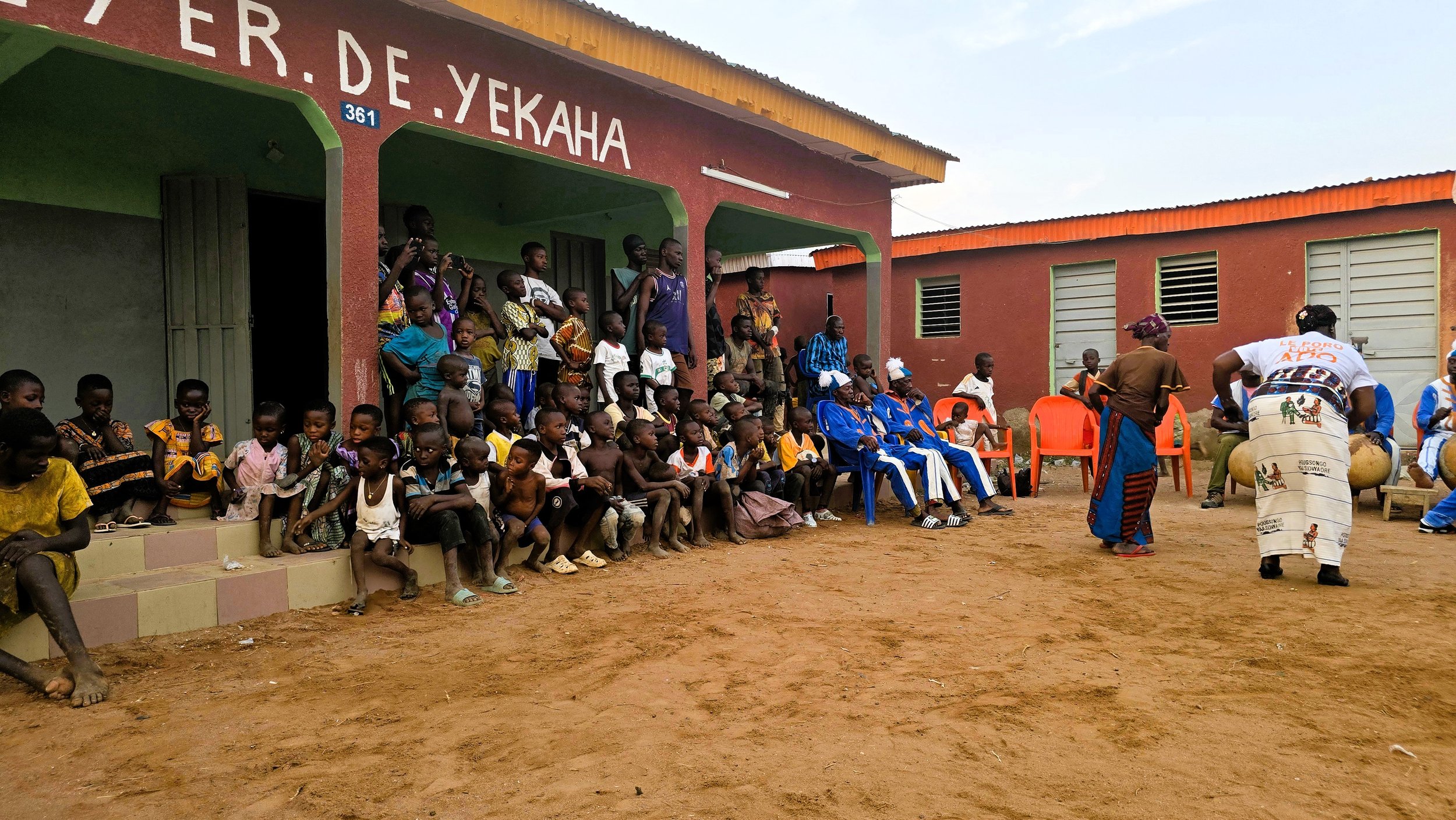
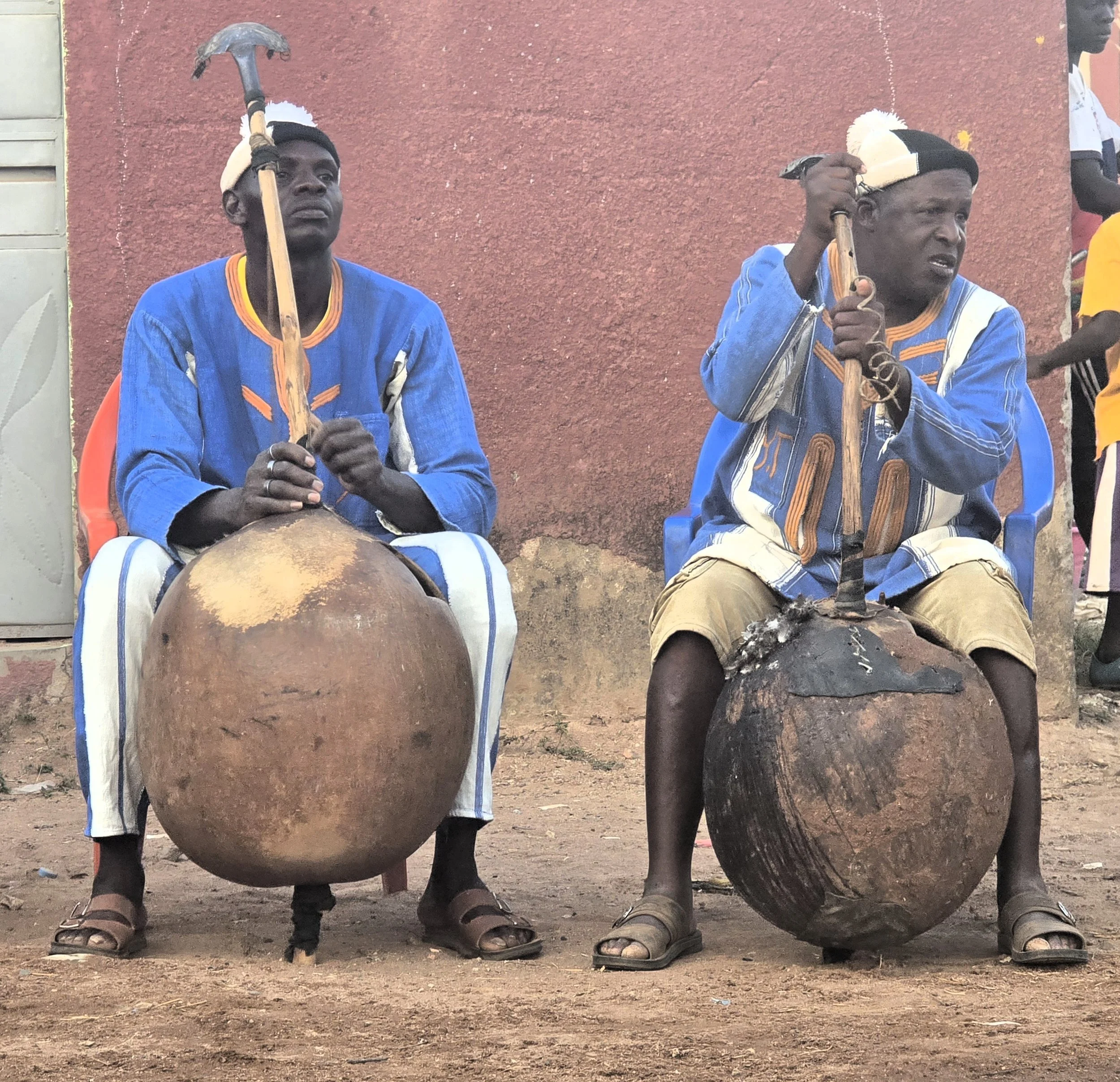
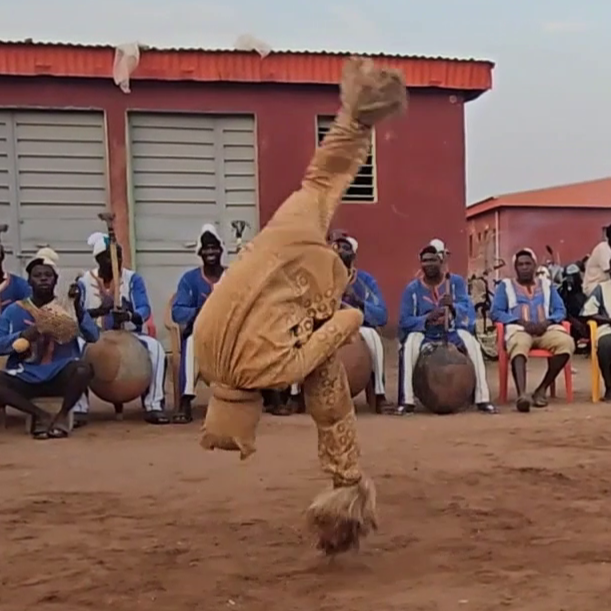
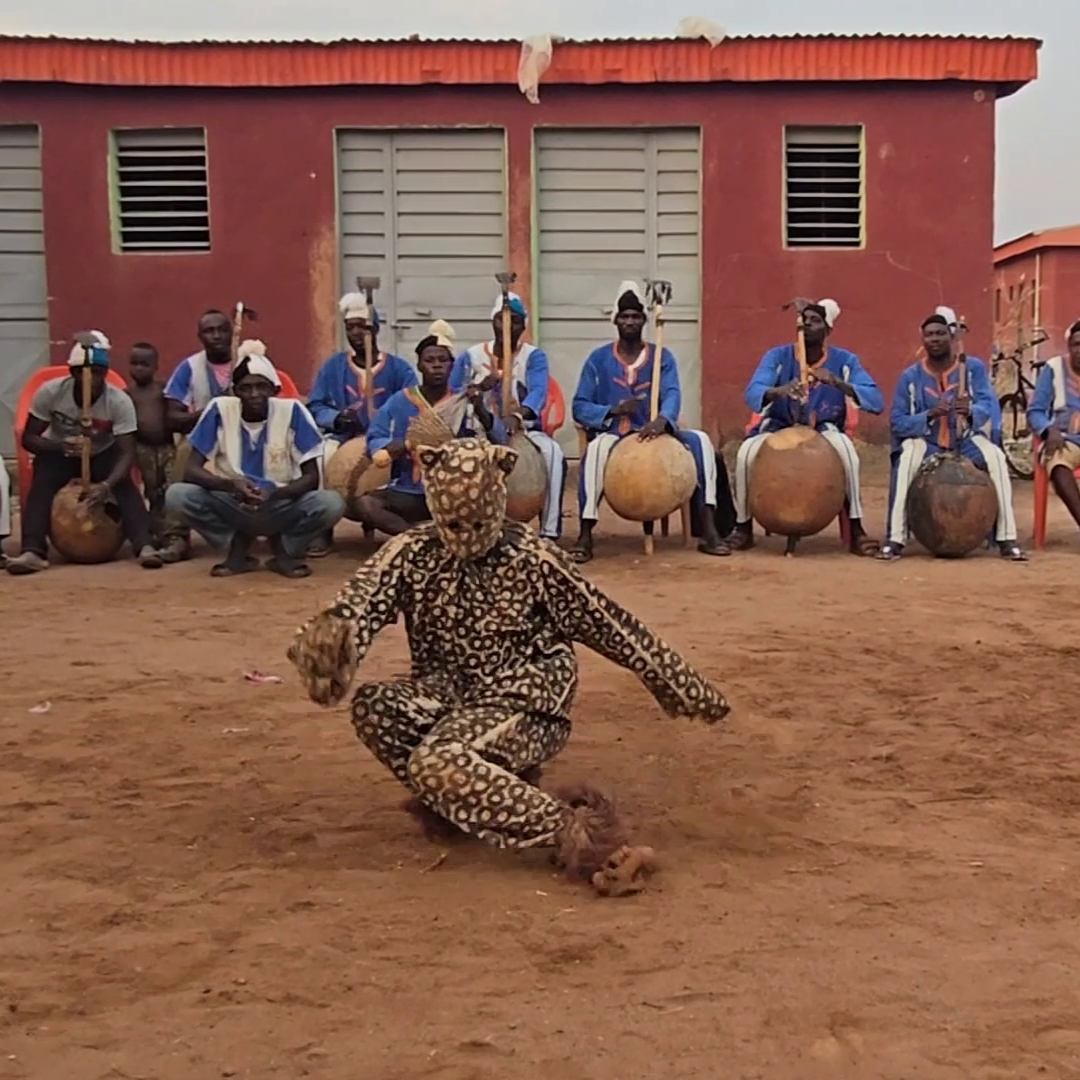
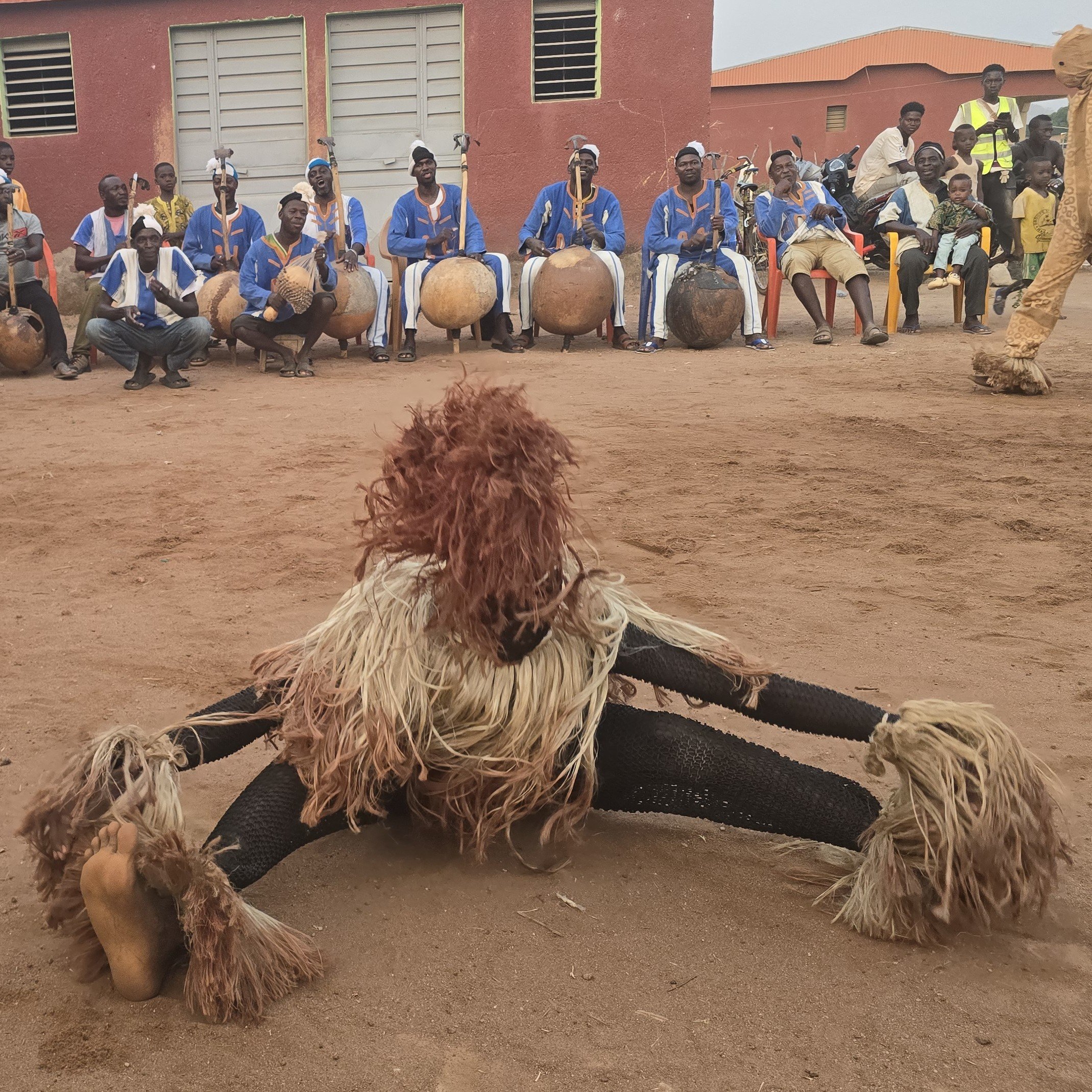
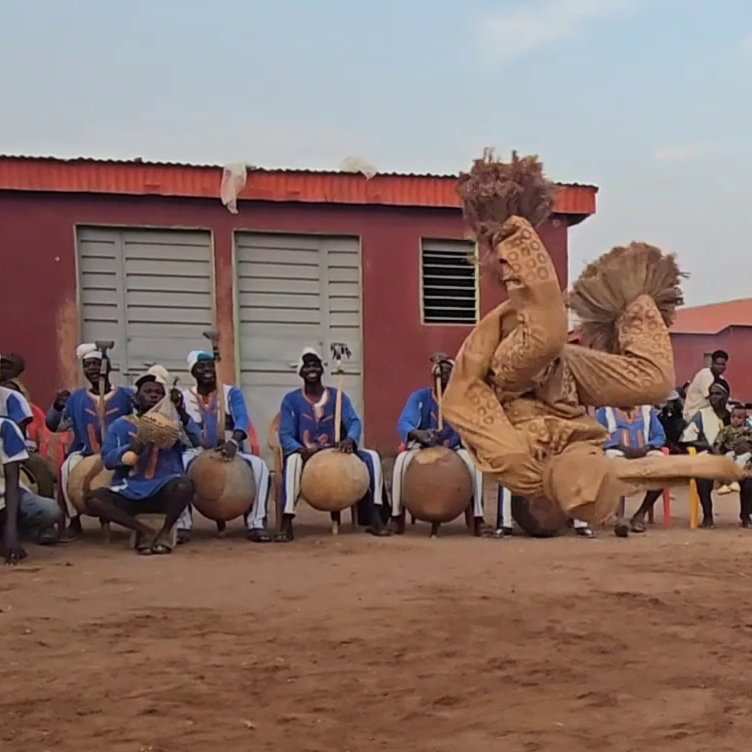
All too soon, the Boloye dancers arrived in brown, ear-topped onesies, feet and the occasional eye visible behind feline masks. After greeting the musicians, they delivered a sharper, faster version of the children’s display – leaps, spins, backflips – that had us debating whether to applaud or move our chairs back.
Ceremonies like this have been a highlight of our time in Cote d’Ivoire. The warmth and inclusion extended to us have left a strong impression and as we headed towards our next country we were in high spirits.
no-man’s land, burkina faso
Burkino Faso sits landlocked in the heart of West Africa. Independent from France in 1960, its first president lasted six years before the army intervened – the start of what was to become a national habit. The standout chapter came in 1983 when 33-year-old Thomas Sankara seized power, launching sweeping reforms: rejecting aid dependency, pushing vaccination, land reform, anti-corruption, women’s rights and reforestation. He sold off government Mercedes, put civil servants on bicycles, and renamed Upper Volta to Burkina Faso, “Land of the Upright People”.
He was assassinated in 1987 by a former ally who ruled for 27 increasingly unpopular years before fleeing amid protests. Elections followed in 2015, but a jihadist insurgency spreading from Mali eroded security. Attacks on military, police, schools and religious sites left thousands dead and large areas of territory beyond state control. More coups followed, and in 2023 Captain Ibrahim Traore took power. Unsatisfied with counterinsurgency support from resident French troops, western alliances were replaced with support from Moscow, a security partner willing to provide weapons, training and paramilitary support without lectures on governance or human rights. A similar model already adopted by other militarised African countries including Mali, Niger and Central African Republic.
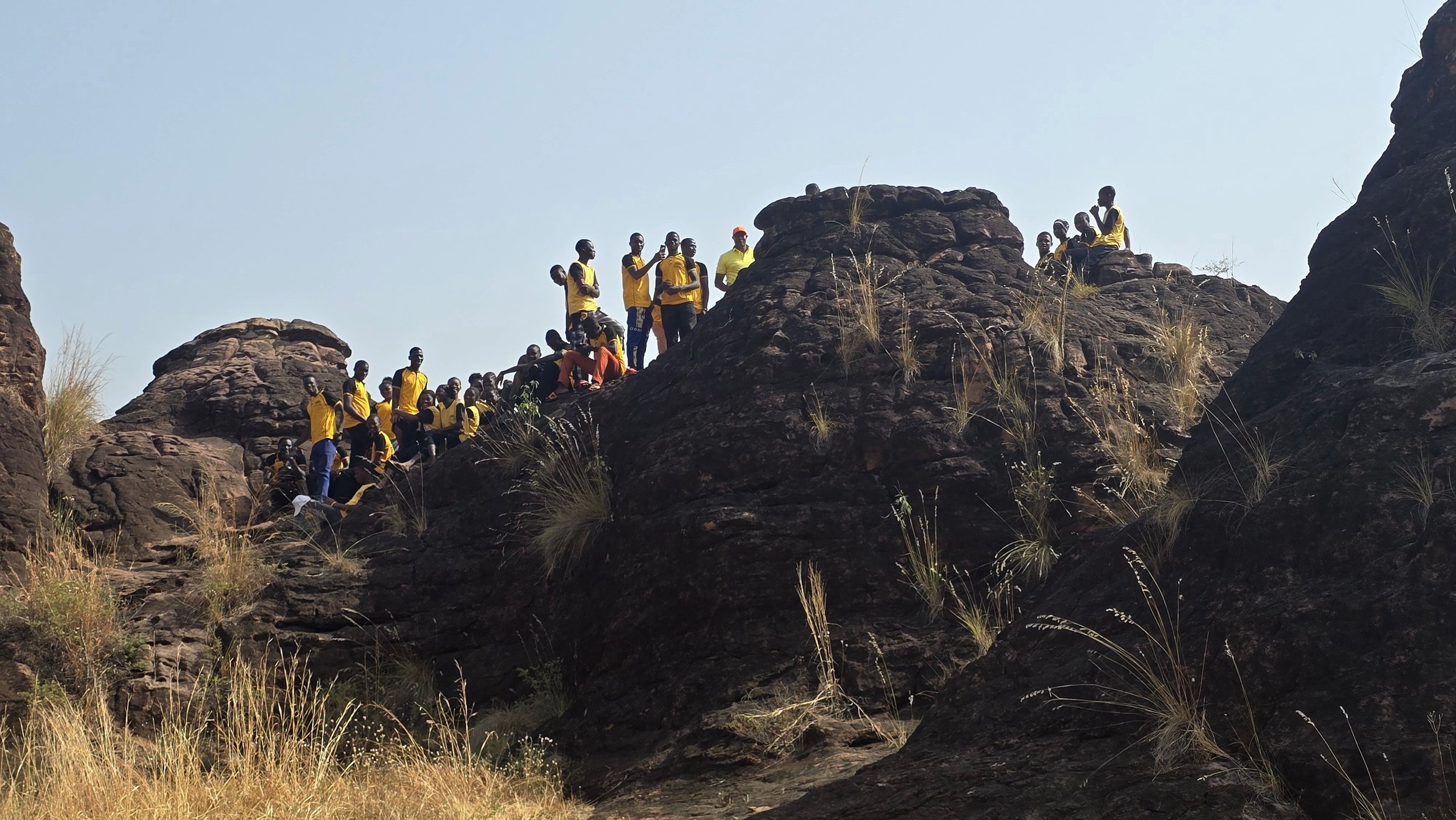
sindou peaks
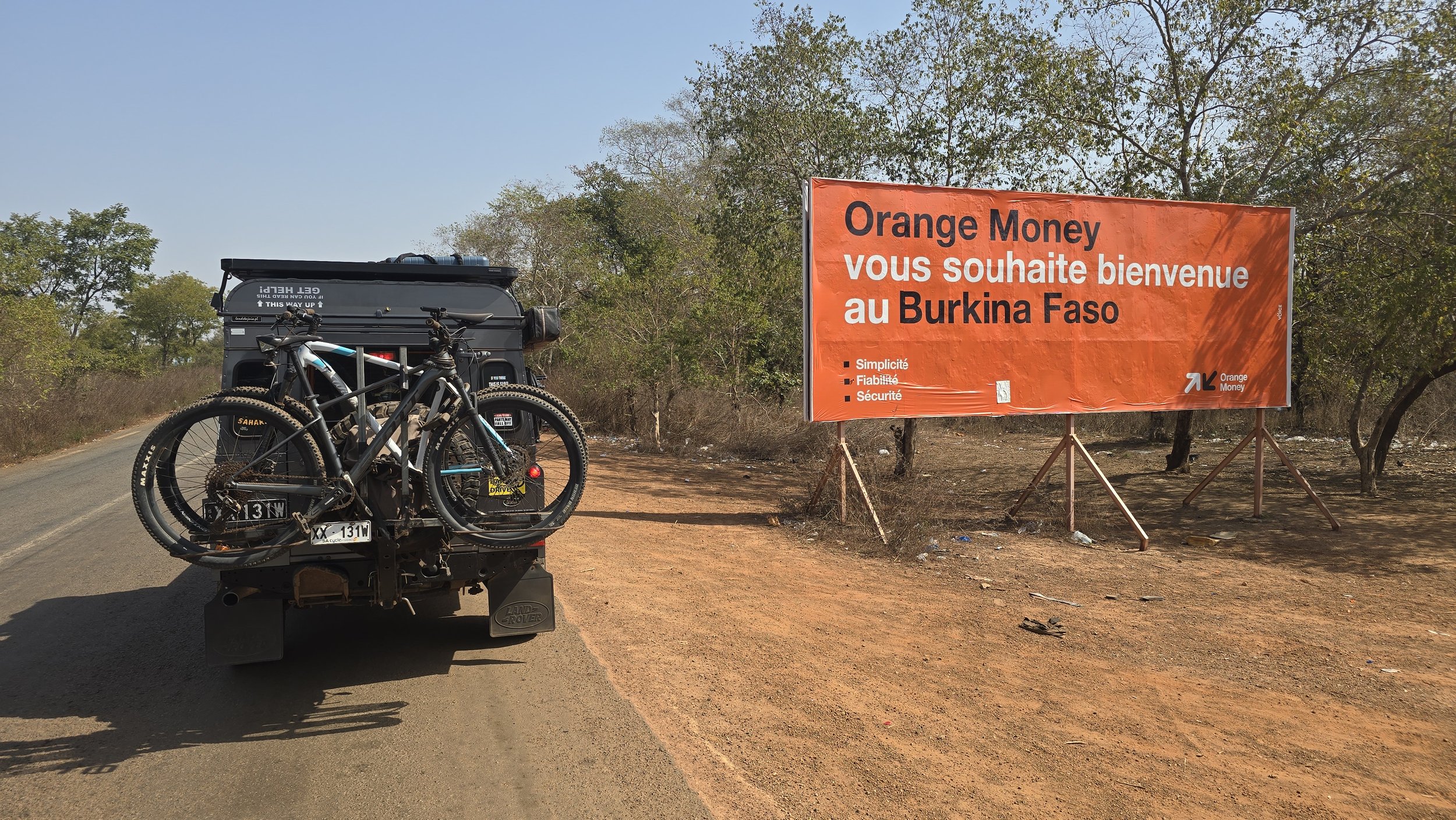
Nearing the Leraba border crossing, checkpoints multiplied - police then soldiers - each stop more imposing with tougher looking men sporting bigger guns. There was no suggestion that we should turn back. Exiting Cote d’Ivoire the Douane (customs) compound was huge and finding the right stamp for our Carnet took time, tourism clearly thin. Immigration, 5 km down the road, meant a tent, a portacabin and a long line of around 100 people waiting under a burning sun to be processed. Resigned to the same fate, we went to join them but were instead waved into the tent where it took over an hour to enter our details into various ledgers, although we were offered lunch!
No-man’s land stretched for 35km, most of the traffic consisting of trucks, and once we reached Burkina immigration and customs we went through at a similarly sluggish pace. It took most of the day and we didn’t progress far before finding a suitable spot to wild camp.
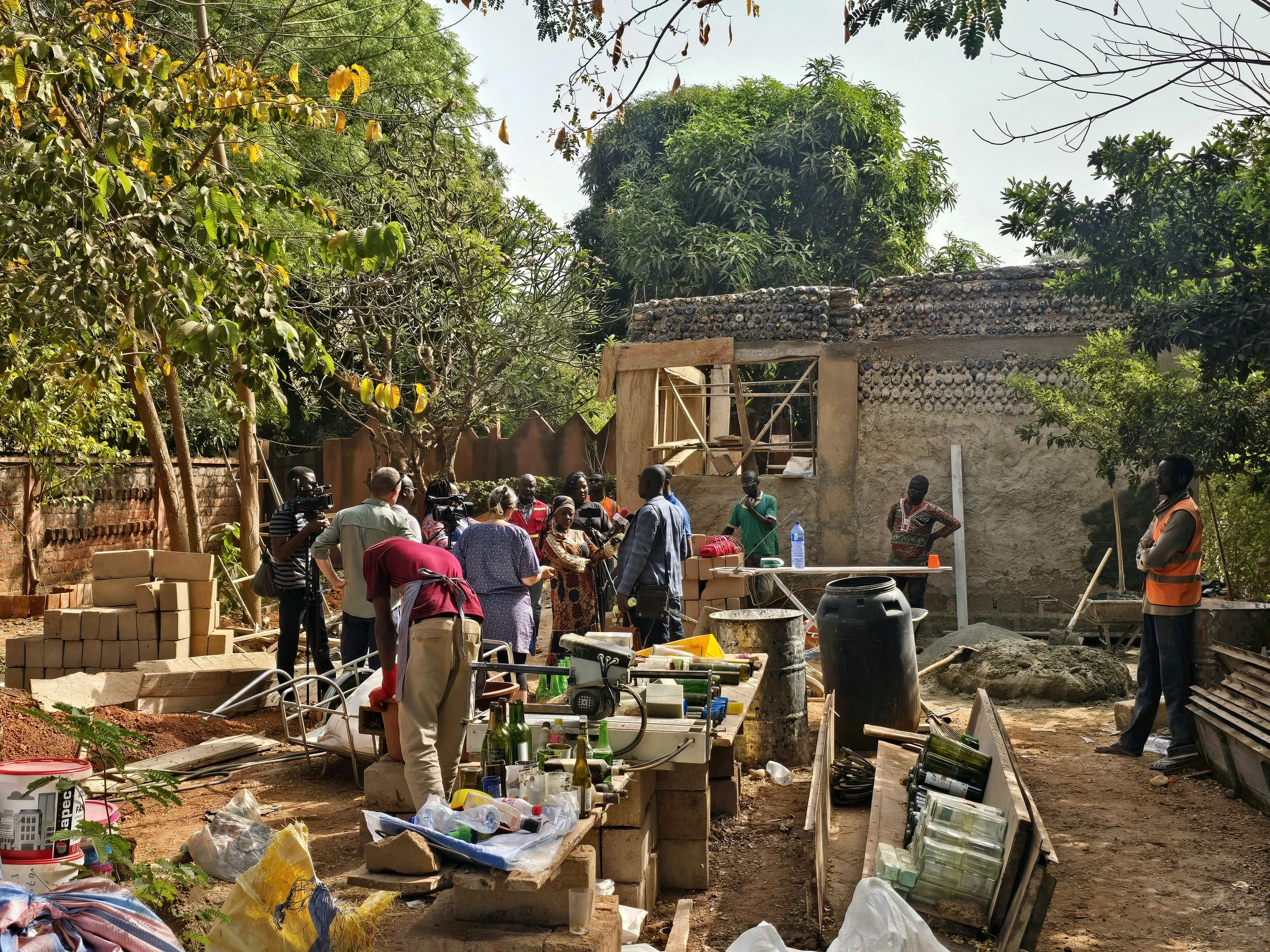
the house of plastic bags and glass bottles
Despite its troubles, Burkina felt calm and somehow softer than its neighbours. There was noticeably less trash, the villages were tidy with extensive vegetable plots and the people were busy. Being naturally reserved, there was no hassling or begging and the novelty of personal space was striking.
We continued to the country’s second largest city, Bobo-Dioulasso, stopping at the Sindou Peaks and Domes of Fabedougou, striking landscapes of ancient, weathered sandstone. Clambering onto the top of one of the towering formations, we surprised (and were surprised by) 30 teenagers in bright “Friends of the Earth” shirts. Shy at first, they soon started practicing their English and walked partway back with us, curious about our journey.
This easy friendliness carried to Bobo, where we camped in the garden of a guesthouse run by a Dutch woman. A group of Swiss volunteers were also in residence, overseeing the building of a house utilizing plastic bottles and bags. Construction was being carried out by a group of local lads and whilst it was an interesting concept, garnering a lot of interest from the media, its long-term progress once the volunteers returned home seemed optimistic.
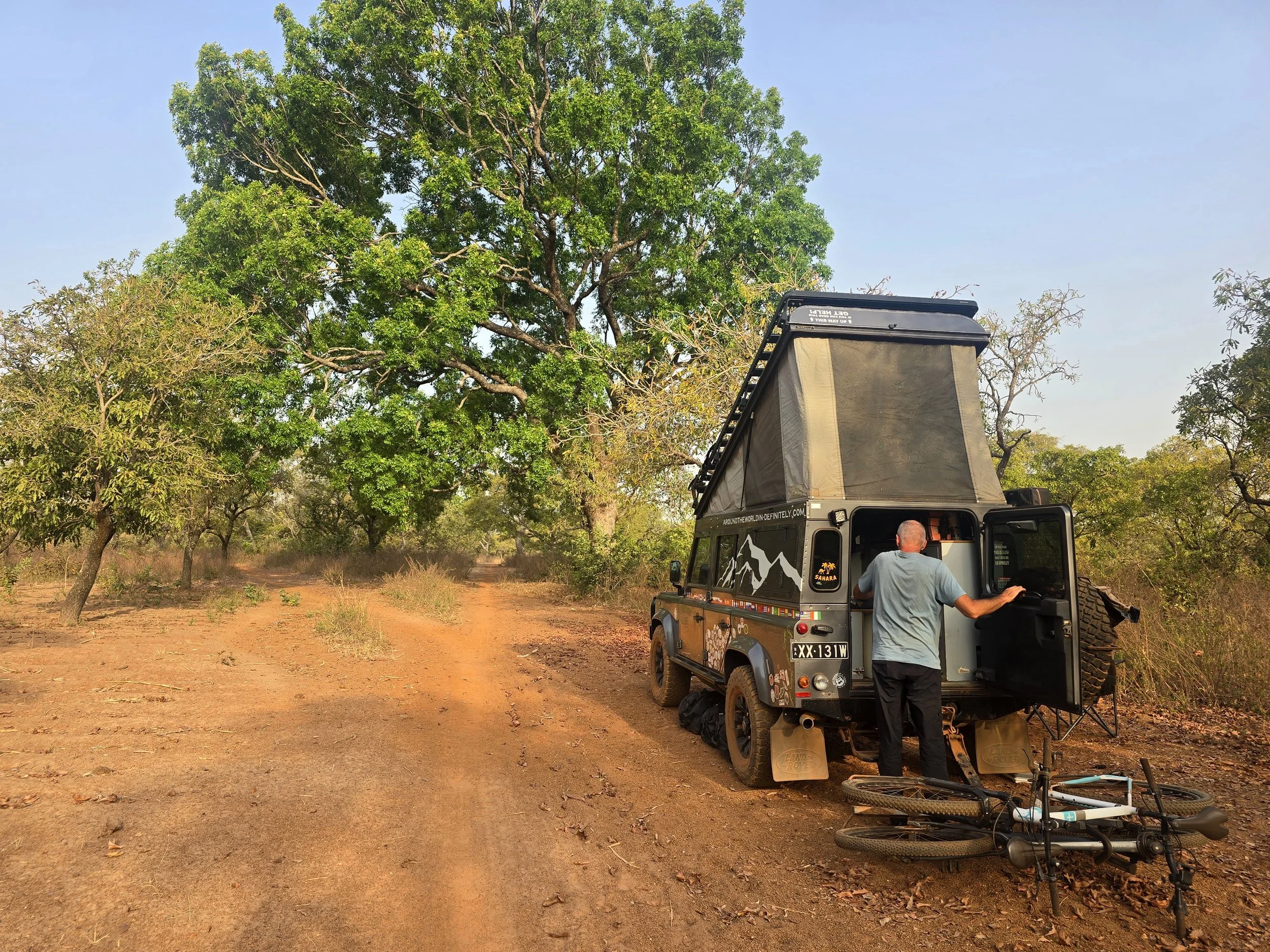
wild camping, burkina faso
Bobo was as far into the country as we intended to go; we would exit via the Ouessa/Hamile border crossing into Ghana. The “upright people” had shown themselves to be quietly dignified, unfailingly courteous and entirely true to their name, and we were glad we’d made the detour despite the risks.
Our final wild camp, just 40km from the Ghana border, passed quietly. As we were leaving, four men on motorbikes arrived. After brief greetings, one flashed an ID – not in uniform but indicating he was police. Struggling to understand what he was saying we gathered that we were to wait for colleagues from a nearby town to check our documents. Reasonable enough, until one of the other men (no ID) demanded to see our passports. We were alone on scrubland, 100 m off the road, facing four ununiformed men asking for documents. Ian offered photocopies which caused some agitation, a situation that was further aggravated by my getting into Bob and starting the engine. Keen not to get left behind, Ian jumped in but just missed closing the door before the guy – now extremely angry - grabbed it. My attempts to calm things failed, and the one word that cut through any communication issues “ambush” ended any attempts at further discussion.
With the man still clinging to the door, I accelerated. We moved as one – him running alongside, apparently trying to wrench the door off its hinges. The scrub land in Africa is not unlike that in Australia, sparse but wickedly thorny, and just in front of us was a particularly spiky specimen. I drove straight at it. It was touch and go for a few seconds as the man considered his options, but with a loud shout he admitted defeat and let go. With just enough space for a wide turn, we bounced across the scrub and rejoined the road towards the border.
Unsurprisingly, we were soon being pursued and then overtaken. Having pulled over, one guy was loading a catapult with stones while another hefted a large rock above his head. The shot hit the rear wheel; the rock struck the driver’s door. Whether from choice or inability, we didn’t stop….
….. until we were pulled over at a checkpoint 20km down the road. They were expecting us, suggesting at least one of the men was indeed police. We were told to return with our documents which we refused to do and after an hour-long standoff, they escorted us to the border instead. More delays followed while our phones were checked for photos that we had apparently been taking??? Being labelled spies, we suspected, helped justify the earlier theatrics.
It was an unfortunate incident. Even with the benefit of hindsight, it’s unclear if we handled it correctly. Fortunately, there were no serious consequences, just a chipped back wheel and a long gouge across the driver’s front door.
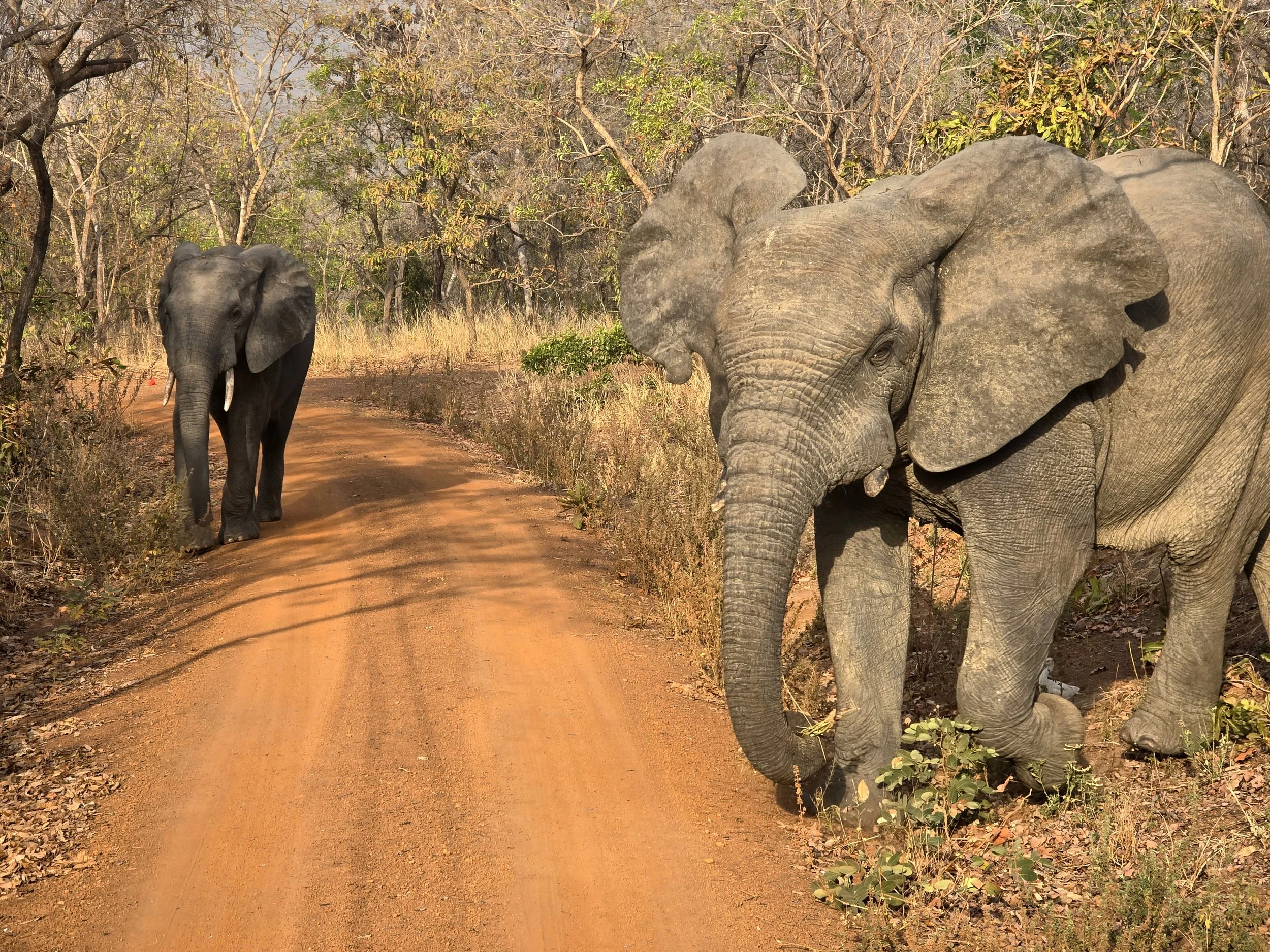
walking with elephants
By the time we reached immigration in Ghana immigration it was mid-afternoon. A heaving, loosely ordered queue waited for passport stamps, but once again we were waved to the front – nearly triggering a riot. Control seemed minimal, and after the morning’s drama, it felt like a very long day. Still, we were processed and sent across the road for the Carnet, where we again waited for the elusive man with the right stamp – this time with chairs and Jerry Maguire on TV, which helped
After a night on a rural petrol station forecourt, we aimed for Mole National Park. West Africa can’t rival East or Southern Africa for safari – too many people, too much hunting – but Mole offers something rare, walking safaris among forest elephants, antelope and warthogs. As Ghana’s largest reserve, it’s still lightly visited, adding to the appeal. Game drives were on offer, but with the lodge perched above a waterhole, watching wildlife from the verandah with a cold drink was also an option.
volta region, ghana
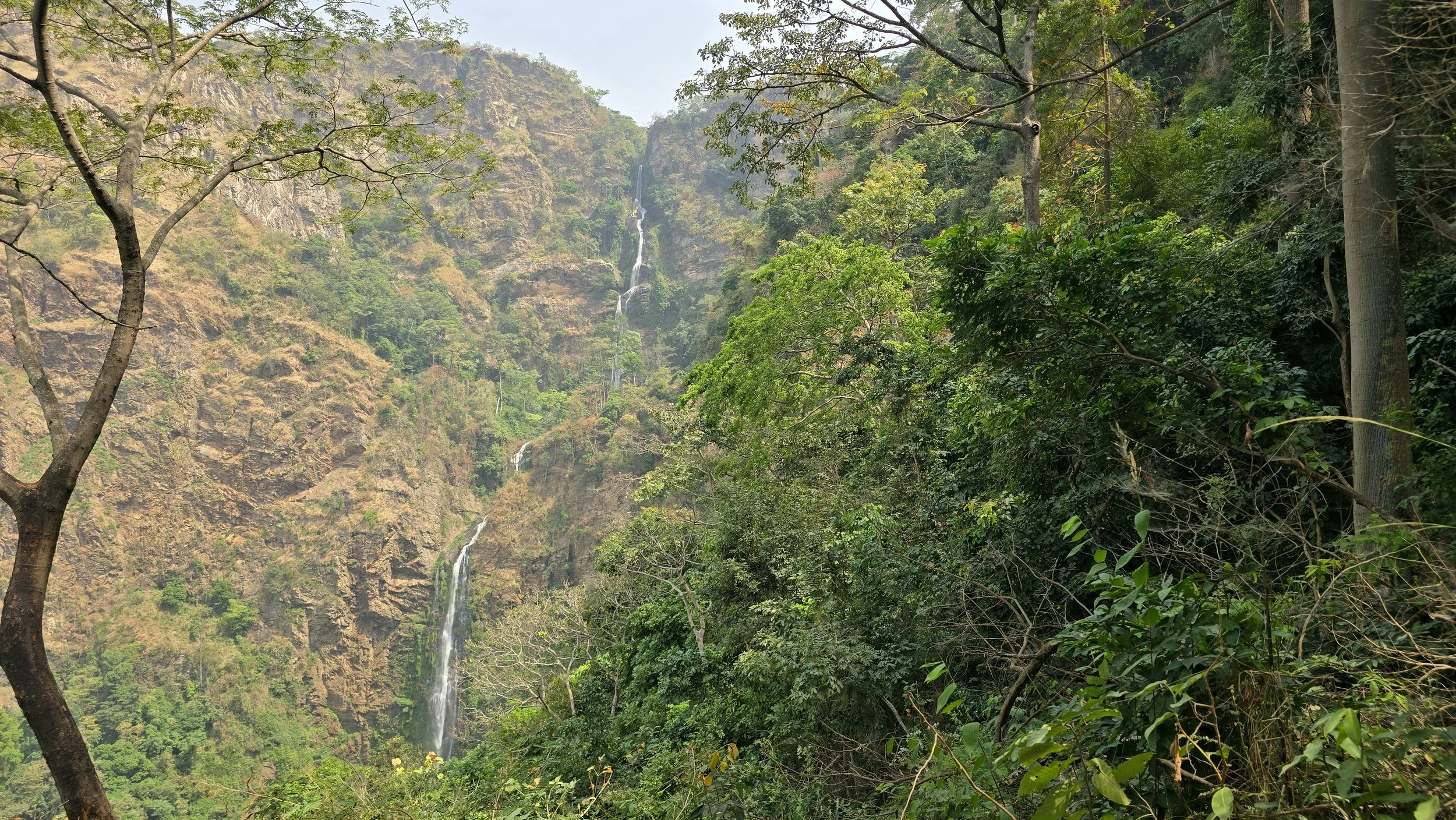
Soon it was time for Accra. We split the 710 km journey in the Volta Region – green hills, waterfalls and accessible hiking. Failing to book ahead, we couldn’t get a room at Tagbo Falls Lodge, but they let us camp on the lawn where, a few days later, we noticed the flat tyre – coincidentally the same one that had taken a catapult hit days earlier.
bilal’s legendary workshop
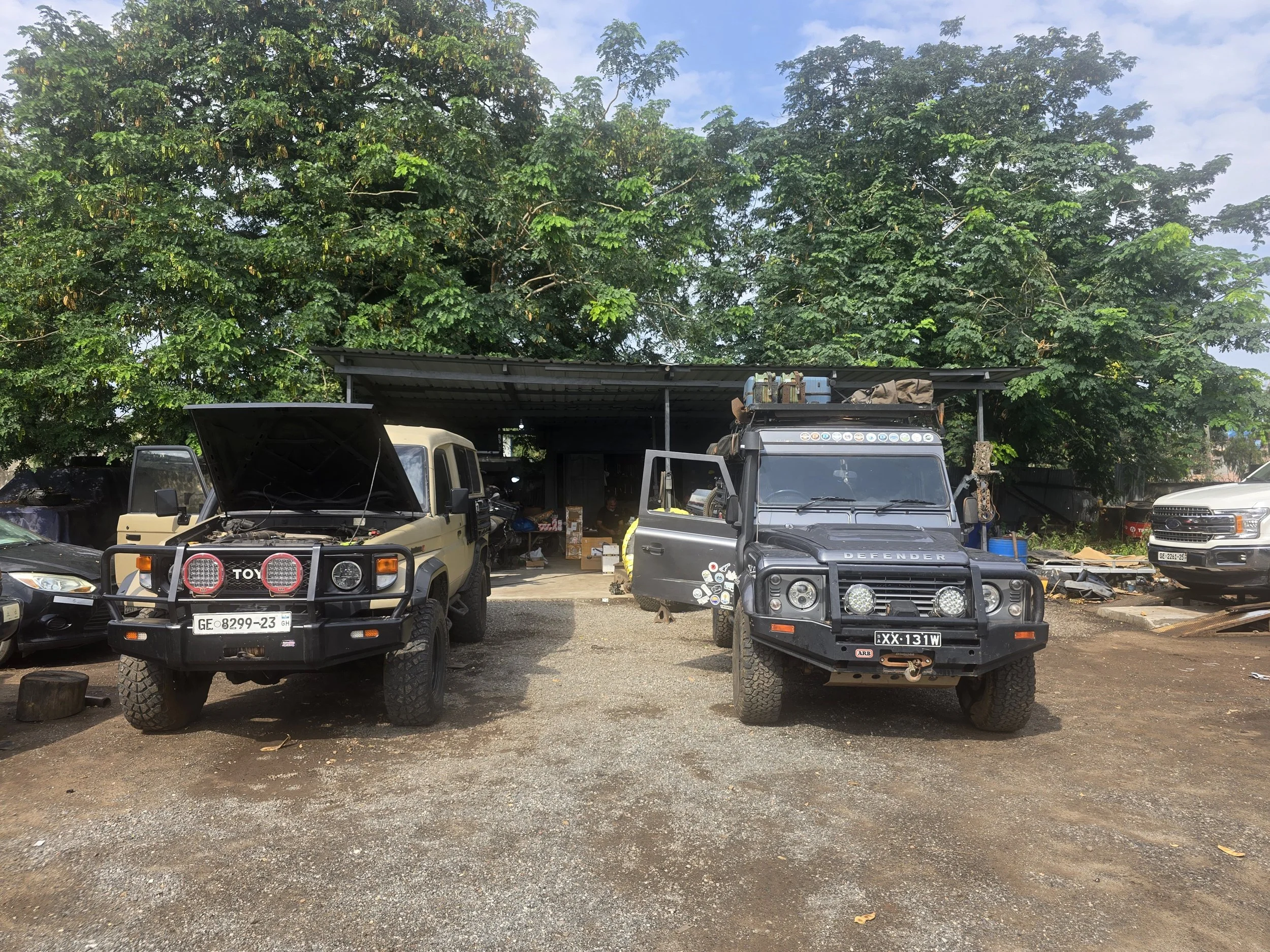
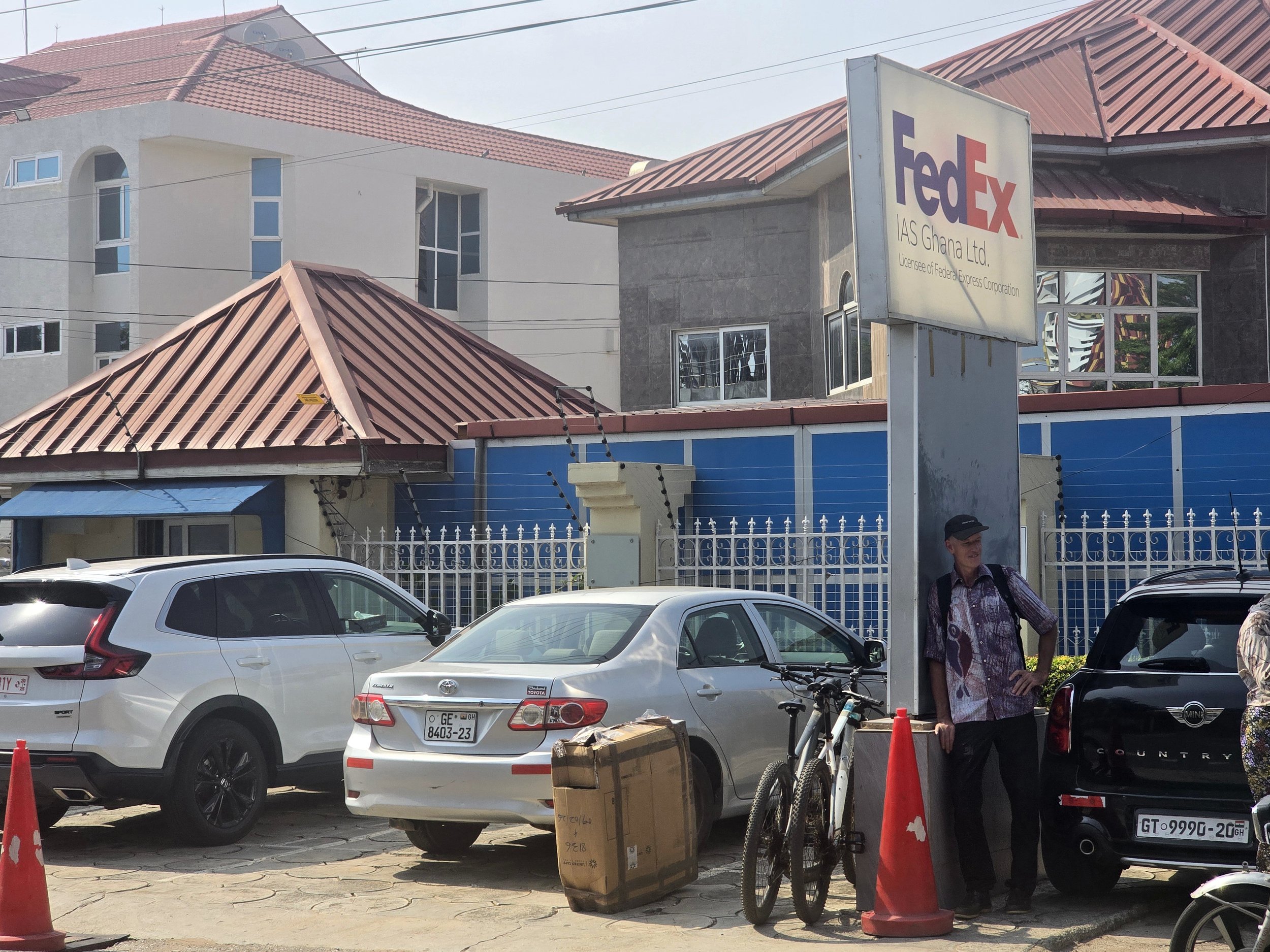
With the mis-matched spare on, we rolled into Accra and straight into Bilal’s Legendary Workshop. Handing Bob over was a relief; the diagnosis wasn’t. The brake servo was fine – the master cylinder had failed. So: find somewhere to stay, order parts and wait. Importing those parts – plus a BF Goodrich tyre – proved eye-watering. Duties and VAT were just the start; health, education, regional and development levies, plus processing and inspection fees, nearly doubled the cost. In Freetown we’d paid none of this, and everything had been delivered. In Accra, we cycled endlessly between UPS and Fedex trying to locate our parcels. Retrieving the tyre from Fedex took most of the day, a cavernous warehouse, teetering piles, crowds hunting parcels and the same details copied into multiple ledgers. Storage fees, tips – everyone stuck in the same slow grind.
tyre collection from fedex
Yet beyond the postal chaos, we loved Accra: unmistakably African yet well set up for visitors – aircon, hot water, proper coffee, good bars, a lively music scene and friendly people. Two weeks later we left. Bob now sporting 4 matching tyres, a working compressor, sealed front diff plus a functioning camera and reversing light. We’ll enjoy it while it lasts!
Given how much of our recent schedule had been dictated by Bob and his appetite for imported parts, Togo wasn’t somewhere we planned to linger. Rather than the main coastal crossing to the capital of Lome, we briefly ducked back into the Volta region and crossed inland at the Shia border crossing, continuing north to Kpalime.
chateau viale, togo
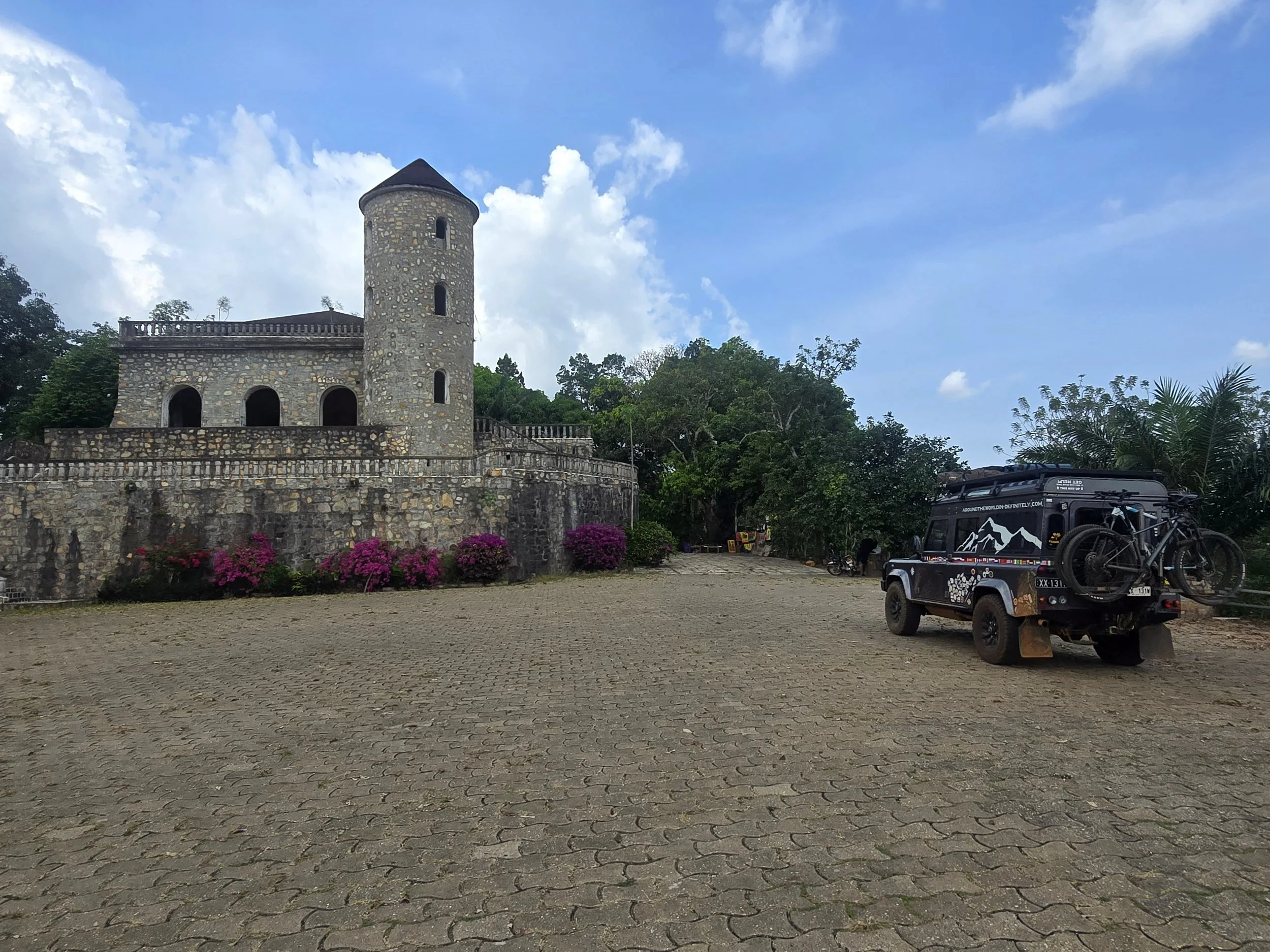
Here we saw the first signs of German influence at the Medieval style Chateau Viale built in 1944. Togo began as German Togoland in the late nineteenth century, was split between Britain and France after World War I, and the French portion became modern Togo in 1960. Today it is officially a presidential republic, though decades of family rule suggest something closer to a family business. Gnassingbe Eyadema seized power in 1967 and ruled for 28 years. On his death in 2005, the army installed his son, Faure Gnassingbe, who has remained in office since. Elections exist, at least on paper, though results are regularly disputed. Had we arrived a few months earlier, we would have coincided with a narrowly avoided coup.
Just 50 km wide at its narrowest yet stretching nearly 600 km from the Atlantic to the Sahel, Togo is essentially a corridor: palm-lined lagoons in the south giving way to dry savannah in the north. It rarely features on the global radar, though the trivia is plentiful. The Prince of Monaco fathered a child with a Togolese woman, Togo fielded not one but two cross-country skiers at the 2014 Winter Olympics, it is a significant exporter of phosphate and is one of only three countries in the world whose name contains none of the letters in the word mackerel.
Digging a little deeper, we were drawn to the Tem people and their reputation for fire dancing, a spectacle which required a five-hour detour inland. Major roads were, by West African standards, excellent but the increase in speeds did seem to correlate with the steady tally of crumpled vehicles that lined the tarmac. Roadwords near Sokode delayed us until after dark making our arrival into town, where we represented the total of the white population, somewhat unnerving. The best (read only) hotel was adequate but at least our guide showed us to take up to Kparatao.
We don’t usually drive at night, but a fire dance in daylight rather defeats the point. Following our guide’s fluorescent shirt as he sped off on a moto-taxi, we turned down a narrow, unlit alley between mud houses. Whether it was the darkness, the long day or the absence of English, the atmosphere felt markedly different. There was no real welcome – just a fire in the lane and a wooden bench against a wall.
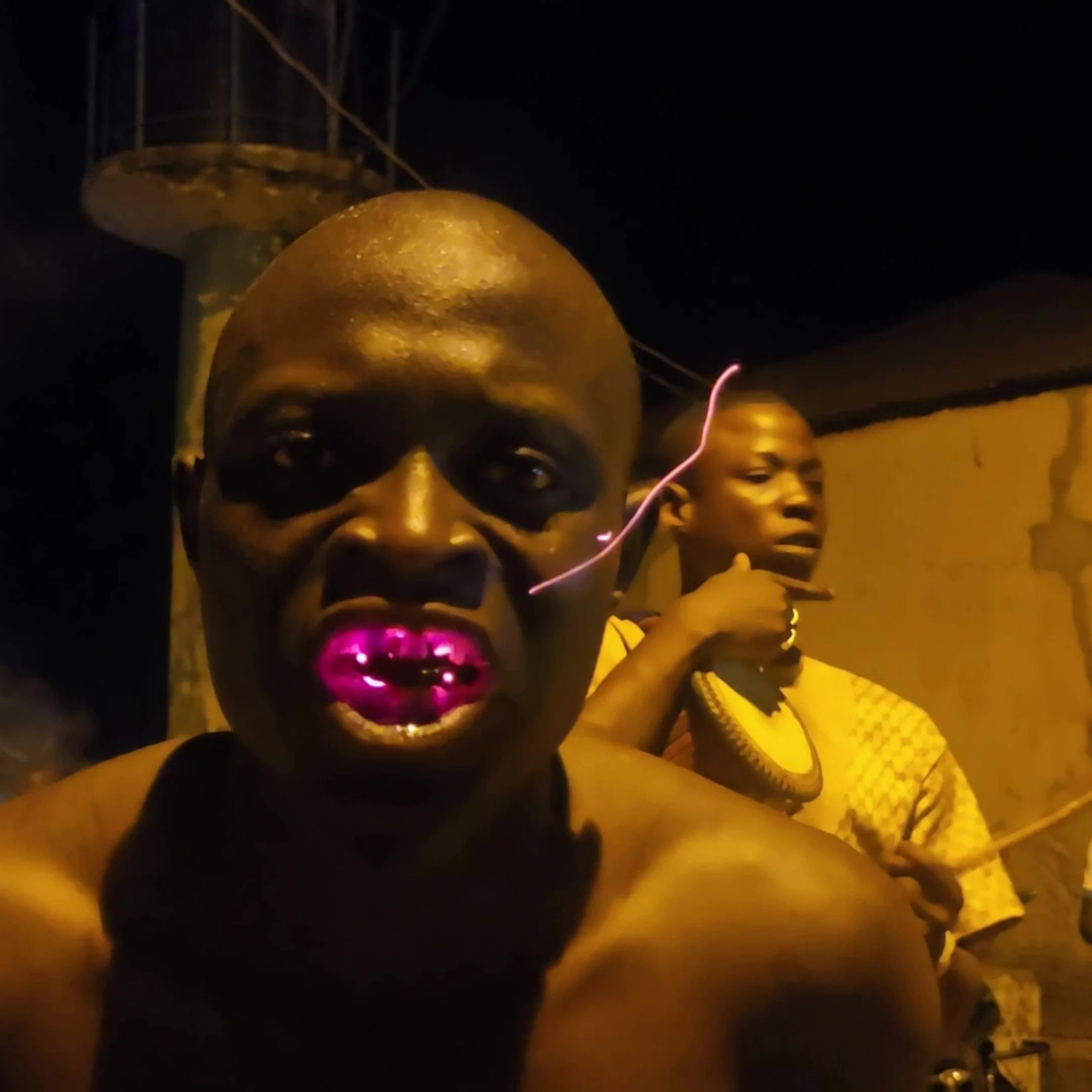
fire eaters of sokode
What little we knew didn’t reassure us. These people had a reputation as fearless warriors and witch-finders, and the house we leaned against may well have belonged to opposition leader Tikpi Atchadam – a man whose earlier political activities had resulted in the president’s soldiers shooting a tethered cow belonging to the local butcher because it was allegedly “threatening security forces”.
Slightly on edge, we watched as the drumming built into a hypnotic rhythm, pushing the dancers toward trance before burning sticks were pulled from the fire. Sceptical as we were, it was hard to see the trick: flames ran across arms, chests and backs before being placed in mouths and extinguished. The glowing ends were then bitten into in a manner similar to eating apples and the dancers advanced towards us, way too close for comfort, hissing through clenched teeth.
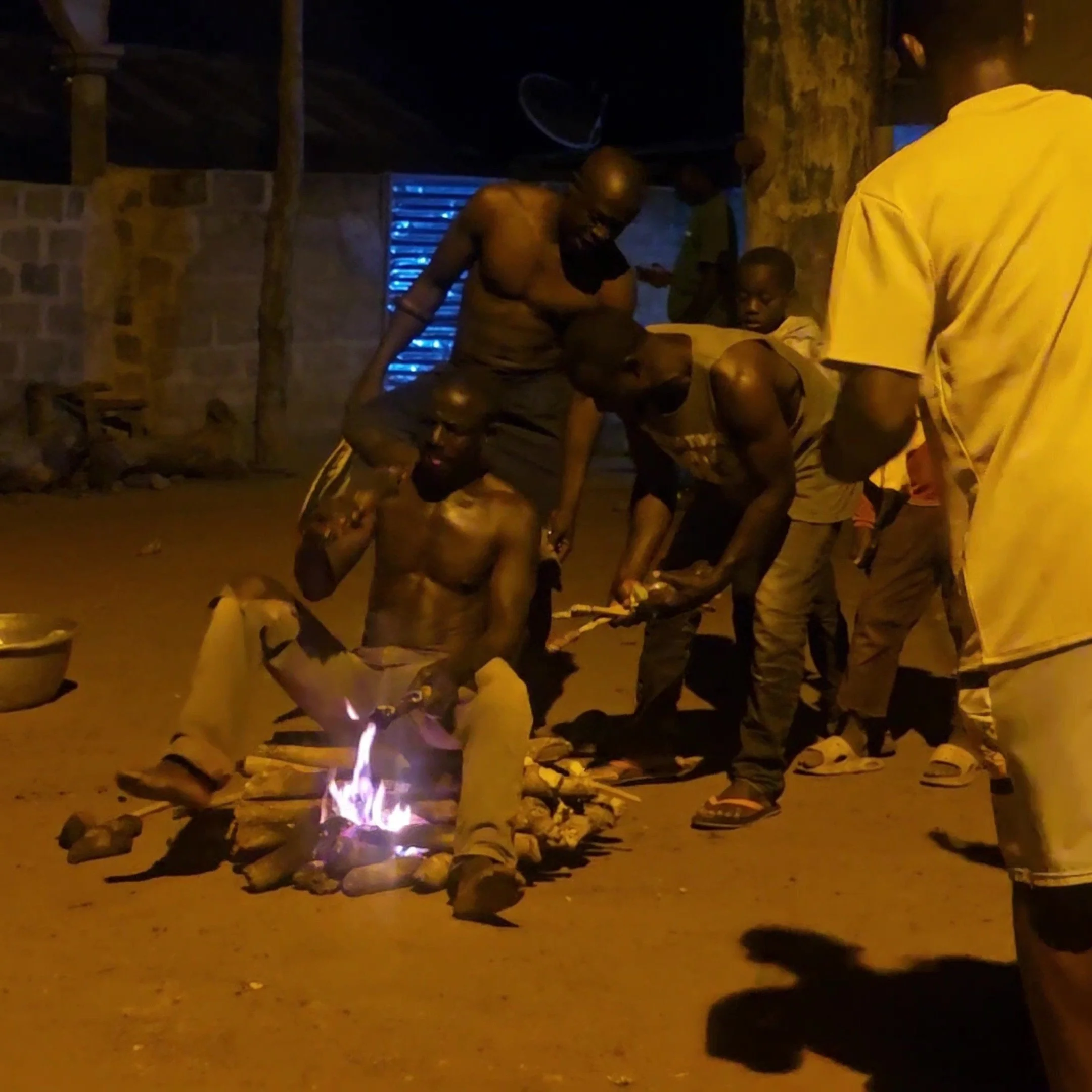
The performance was getting more memorable by the minute. I could feel the hairs on the back of my hands quietly singeing and I wondered about my only pair of long trousers as fragments of charcoal escaped on the exhale. One man calmly ate his charcoal, then sat on the fire to extinguish it, remaining there for a long two minutes before jumping up and giving his hips a brisk shake, apparently satisfied that everything was still operational. As the drumming intensified, blades appeared – swords and razor blades were drawn across torsos, tongues and even an eyeball before a young boy was laid down and slashed theatrically across his stomach.
This ritual honours a pact with the spirit of fire: protection in exchange for respect and display. Those who perform it are not thought to have learned the skill so much as inherited it. The ability is believed to pass through certain family lines, less a party trick than a responsibility – something you are born into rather than choose. The ceremony ended as abruptly as it began, and we were ushered back to Bob with surprising speed – which suited us just fine.