Cote d'Ivoire
/
PLANTATIONS OF COTE D’IVOIRE
The dirt track down from Mt. Nimba was in good condition, but we were soon back on Liberia’s pot-holed tarmac. Fortunately, we were only 40km from the Ganta (Liberia)/Danane (Cote d-Ivoire) border. We hadn’t seen another overlander since the Guinea highlands and the border crossing was no exception, in fact we seemed to be the only people intent on changing countries. That’s not to say that there weren’t a lot of people around, just that they were all occupied with trying to sell their oranges. Unlike the big sweet juicy oranges we’d loved in Algeria, these were small and green, the bruised, pitted and bitter skin already removed so that they were ready for sucking, the flesh too fibrous to bother with.
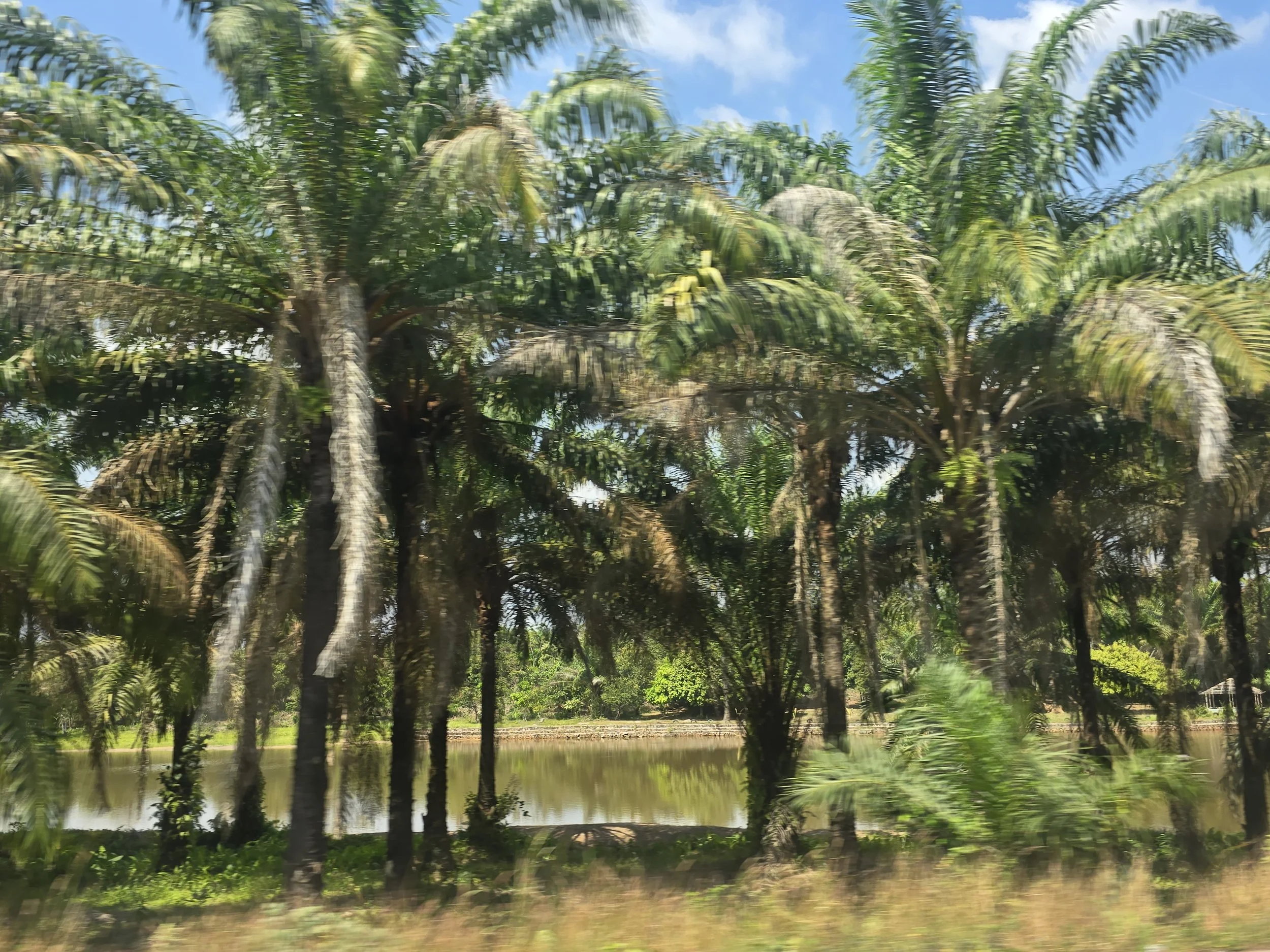
Declining to boost that economy, we went through the normal procedures of being stamped out of one country and into the next. For a small border, we were processed extremely quickly, just a slight delay whilst photographs were taken on both sides – whether for immigration records or just selfies remained unclear – but we were soon on our way to the large town of Man. After an initial stretch of rough road, we suddenly found ourselves on immaculate tarmac and something we hadn’t seen for weeks: white paint road markings. With an air of recklessness, we accelerated, whizzing past plantations of cocoa, coffee, palm oil, rubber and cashews.

BASILICA OF OUR LADY OF PEACE, YAMOUSSOUKRO
Cote d’Ivoire remains the world’s largest cocoa producer, responsible for roughly 40% of global supply – an agricultural detail that makes most European chocolate aisles quietly dependent on our passing landscape. The scale of farming is relatively recent. After independence from France in 1960, President Felix Houphouet-Boigny pursued an open-door economic policy, encouraging migration and agricultural expansion. For a time, it worked spectacularly well: during the 1960s and 70s the country enjoyed what was called the “Ivorian miracle”, fueled largely by cocoa and coffee exports. Roads were built; Abidjan grew into a modern metropolis and Yamoussoukro acquired a basilica large enough to be listed in the Guiness Book of Records as the biggest Christian Church in the world. The model depended, however, on clearing forest for plantations. By the 1980s, falling commodity prices and rising debt exposed the fragility of the system and forest cover – once among the densest in West Africa – had shrunk dramatically. A huge blow to the already rapidly declining elephant population.
The country’s very name is a reminder of the ivory extraction carried out by European traders as far back as the 15th century, but the most devastating period for the elephants was between 1970-1990 when commercial poaching and rapid agricultural expansion combined to decimate numbers. This, like many issues in Africa, is not an easy one to solve as it isn’t just about wildlife, it’s about livelihoods. When forests are protected, farmers lose land; when cocoa prices fall, people push deeper into forest reserves and conservation is an ongoing negotiation between trees, elephants, and the price of chocolate in Europe. Ethical certification schemes exist – Rainforest Alliance and Fairtrade among them – though the reality on the ground is, as ever, complicated.
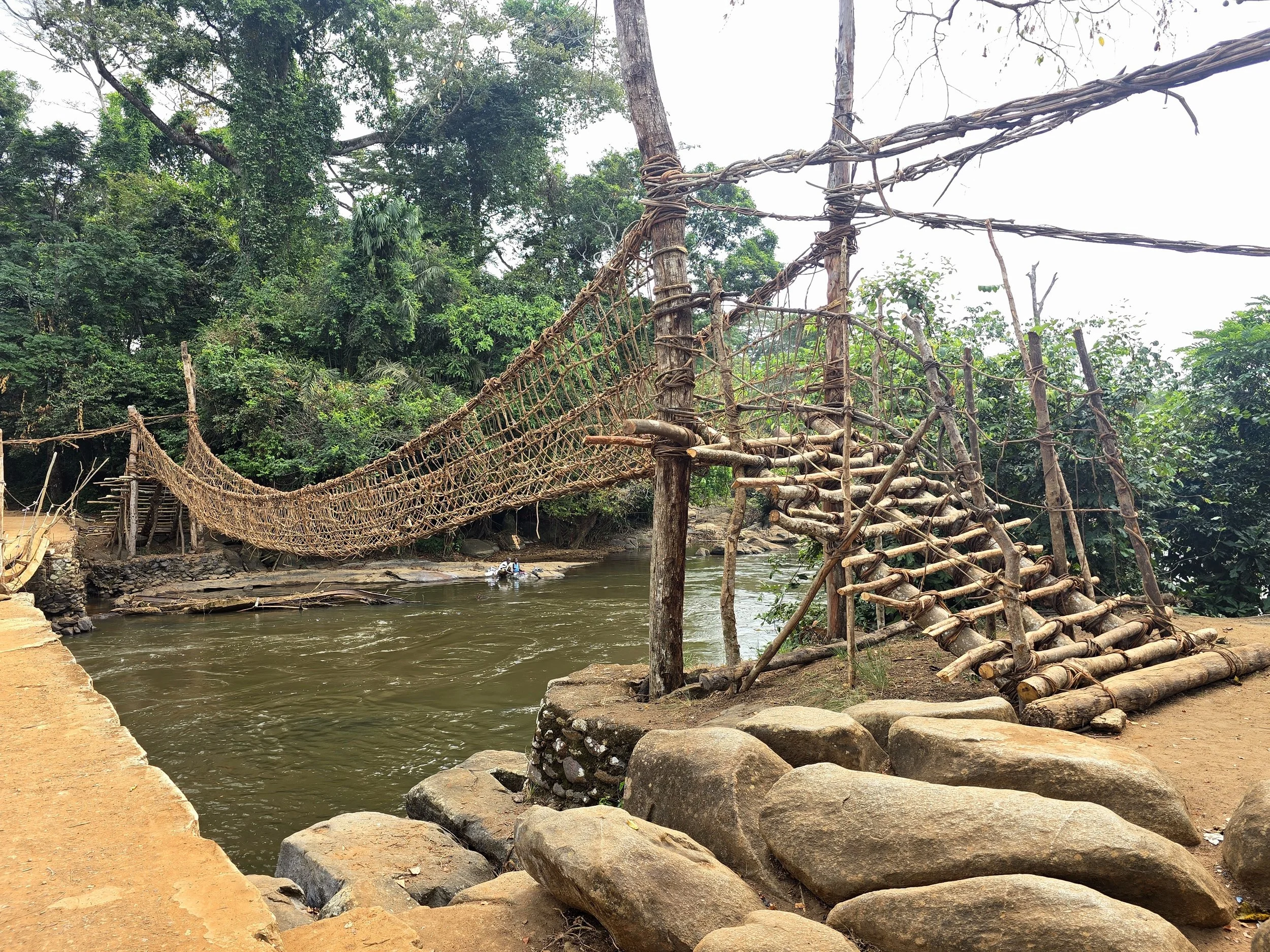
LIANA BRIDGES, LIEUPLEU
As part of our forward planning, we were aware that Cote d-Ivoire contains a remarkable ethnic density, more than sixty groups and social systems long shaped by lineage, land and the memory of ancestors. Secret rituals remain important and the visible world is often understood to be closely intertwined with an invisible spiritual one. Ornate wooden masks are not art objects in the Western sense so much as temporary identities; when someone wears a mask they are no longer acting as an individual but as a spirit or moral force. Ceremonies involving these masked figures take place at moments of transition – funerals, initiations, harvests, or periods of social tension. The drumming, dancing and singing that accompanies them are less about spectacle than about keeping the social fabric intact, reinforcing cooperation and a shared sense of belonging.
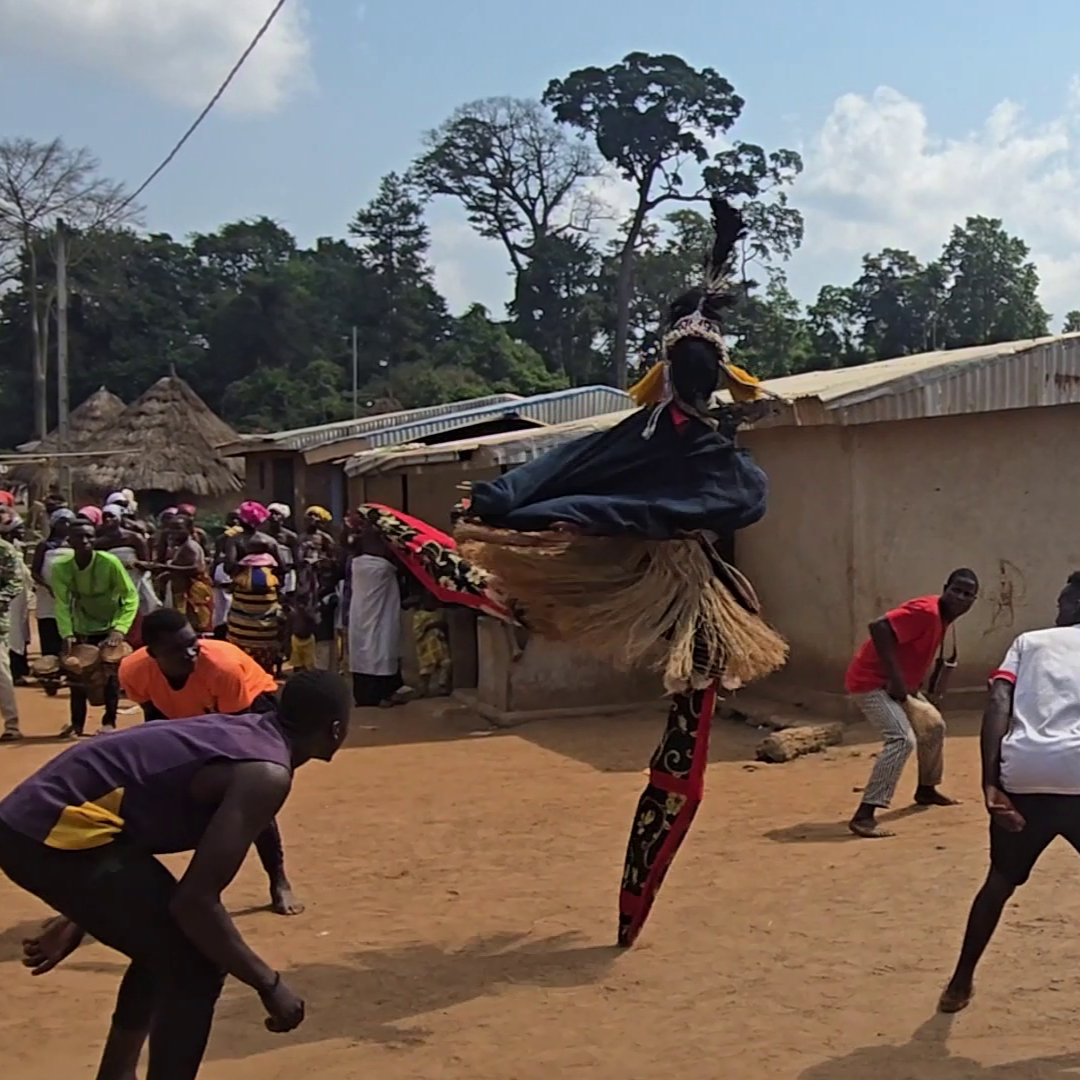
Our main objective in such rich culture was to experience as much of it as possible - something that turned out to be considerably harder than expected. The area around Man is home to the Yakouba people, part of the wider Dan cultural group, numbering several hundred thousand people spread through western Cote d-Ivoire and across the border into Liberia. Not wanting to take away from any other talents they may have, we were hoping to see them on towering stilts.
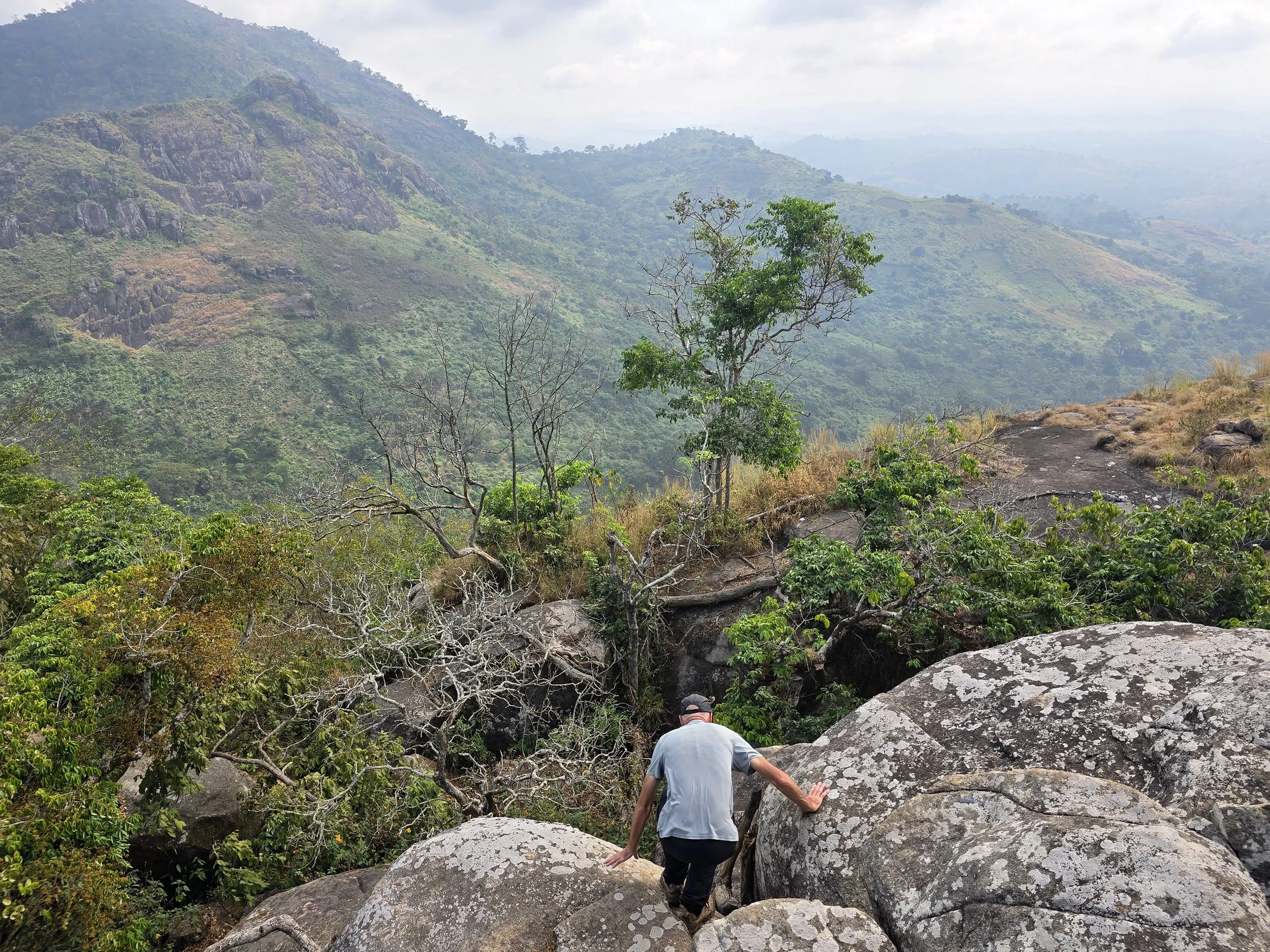
HIKING LA DENT DE MAN
We weren’t naïve enough to think that we could simply drive into a village and happen upon a ceremony in progress. Ritual events are not advertised and there are no ticket sales, the only way to access them is by using the well-established system of local guides and their contacts with village chiefs. Struggling with the language barrier, it was quickly apparent that the guides were not interested in organizing a one-off performance, they were looking for deep pocketed tourists wanting multi-day tours, ideally visiting a number of west African countries. Our efforts produced little beyond a long and expensive guided day out to a waterfall and a living liana bridge – impressive, but not quite the cultural immersion we had anticipated.
Having committed to stay in the area for several days, we filled the time by hiking up La Dent de Man, the distinctive rock peak that looms above the town. Declining to hand any more money over for the services of a guide, we promptly took a wrong turn and missed the second half of the walk, which had reportedly included a waterfall and a cooling swim.
A little despondent, we had largely accepted that any ceremonial rituals taking place would be doing so without us, when we noticed a Russian couple at breakfast with their English-speaking guide. Having planned their trip months in advance on what appeared to be a rather large budget, they had secured one of the best guides in the area who had organized a series of private performances across Cote d-Ivoire and neighbouring Benin, Togo and Ghana.
They were just leaving for a stilt dance in Silakoro, one of the best-known stilt-dancing communities in the area, and we asked – out of pure desperation – if we might join them. We offered to contribute, naively unaware that, in addition to guide and vehicle costs, they were paying in the region of 500 US$ per dance. After a brief consultation, they agreed we could accompany them, generously declining any financial input from us, settling instead for an evening meal back at the hotel. Five minutes later we were racing back towards the border, the 130 km journey covered more quickly than any other since arriving in Africa, as Bob valiantly tried to keep up with their unladen Mitsubishi Pajero.
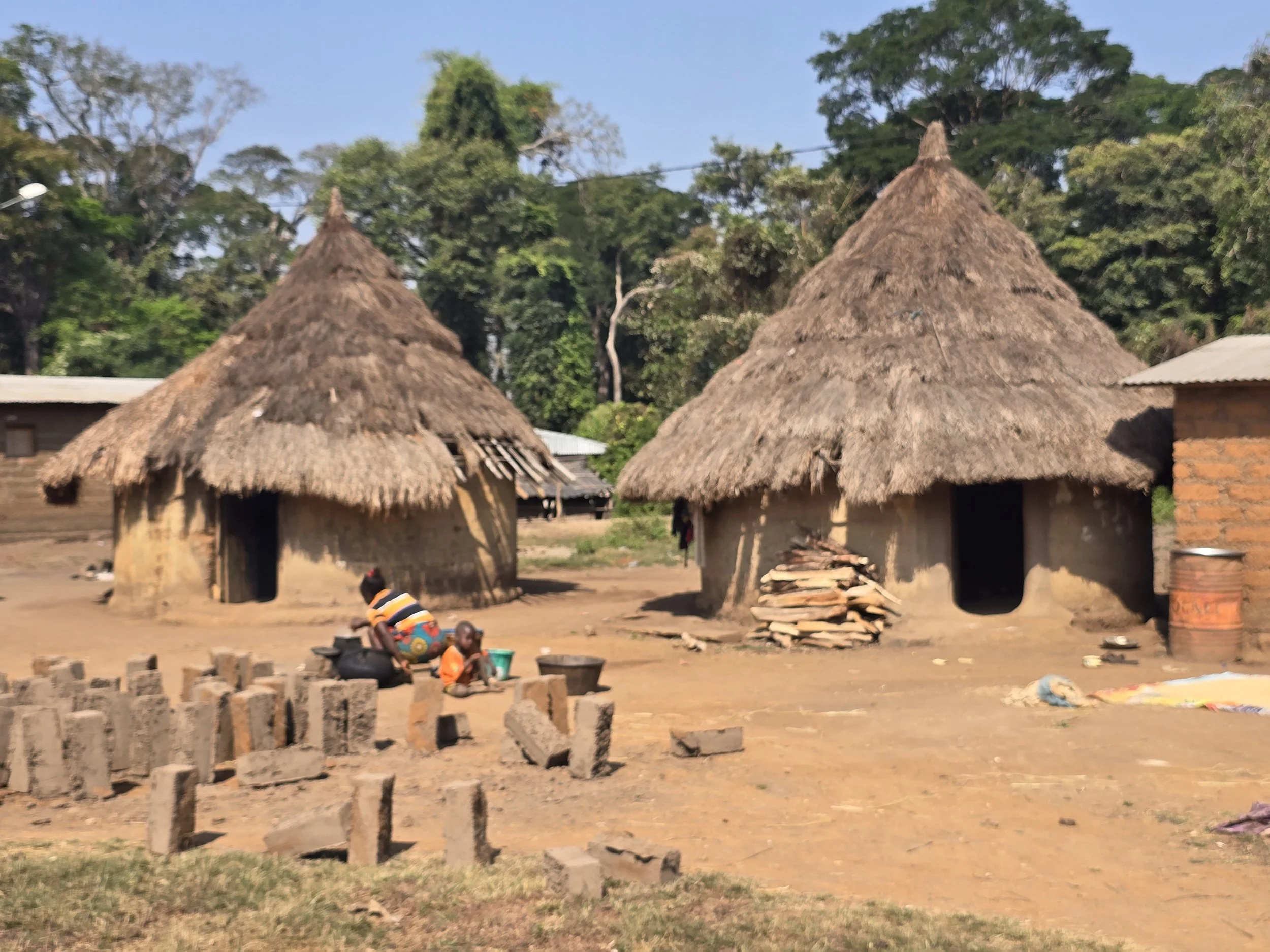
Silakoro was a dusty but orderly village. Traditional circular adobe huts stood alongside newer buildings which housed a school and small clinic. Everyone was occupied. Women cooked over small fires, pounded rice in mortars and pumped water from the community well, while men erected long poles that appeared to be the framework of a new building. Rural life here appeared highly structured, the basic components necessary to survive occupying most of the daylight hours.
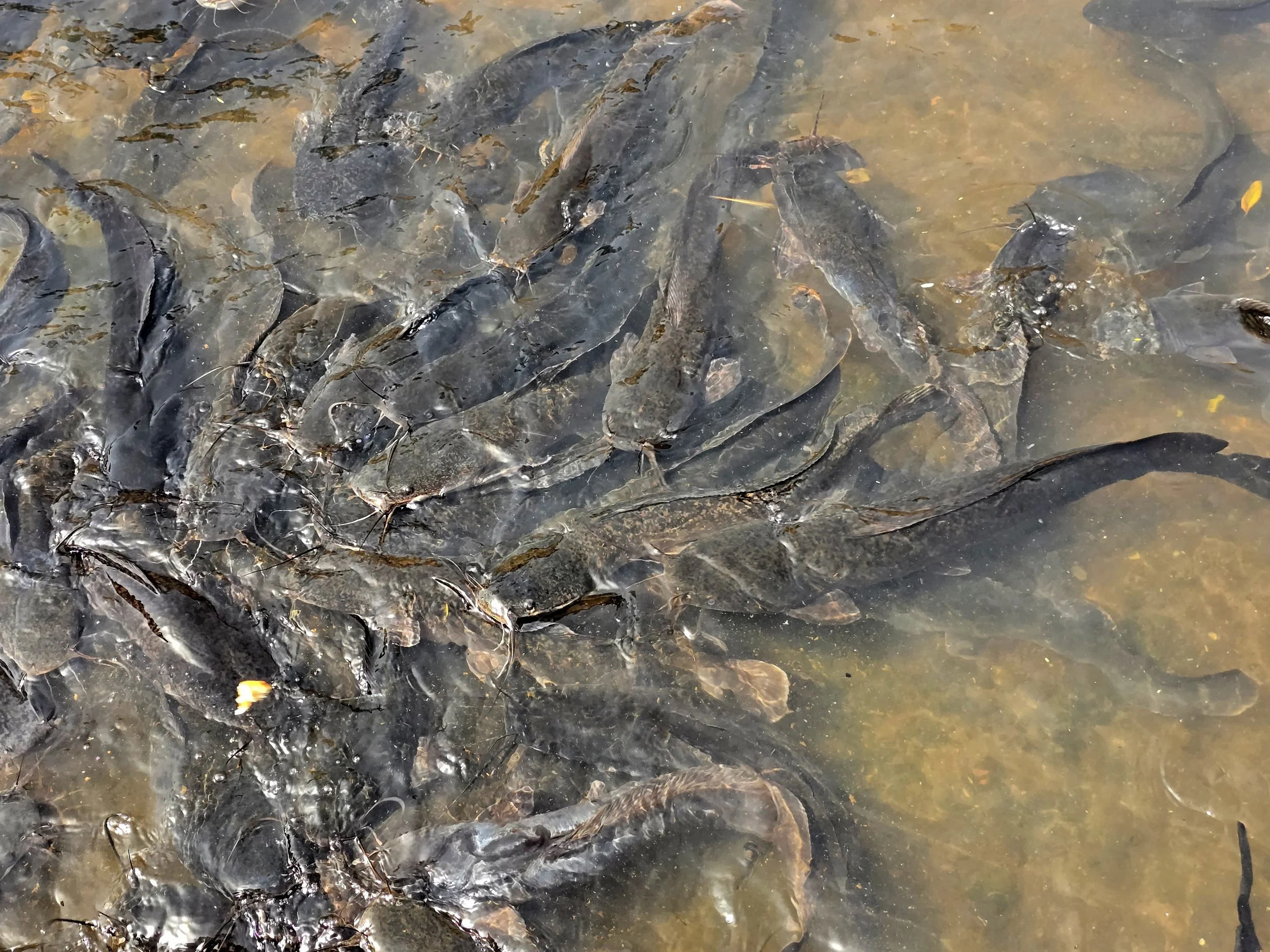
SACRED CATFISH AT SILKORO
Before the performance began, we were taken to a small pool containing sacred catfish. Such animals are venerated in various parts of West Africa, often regarded as protectors or messengers linked to the spirits. Although sometimes used in sacrifices, they are never eaten and always buried with much ceremony should anything unfortunate happen to them. They were greedy little buggers and once we had run out of bread we retreated to the center of the village.
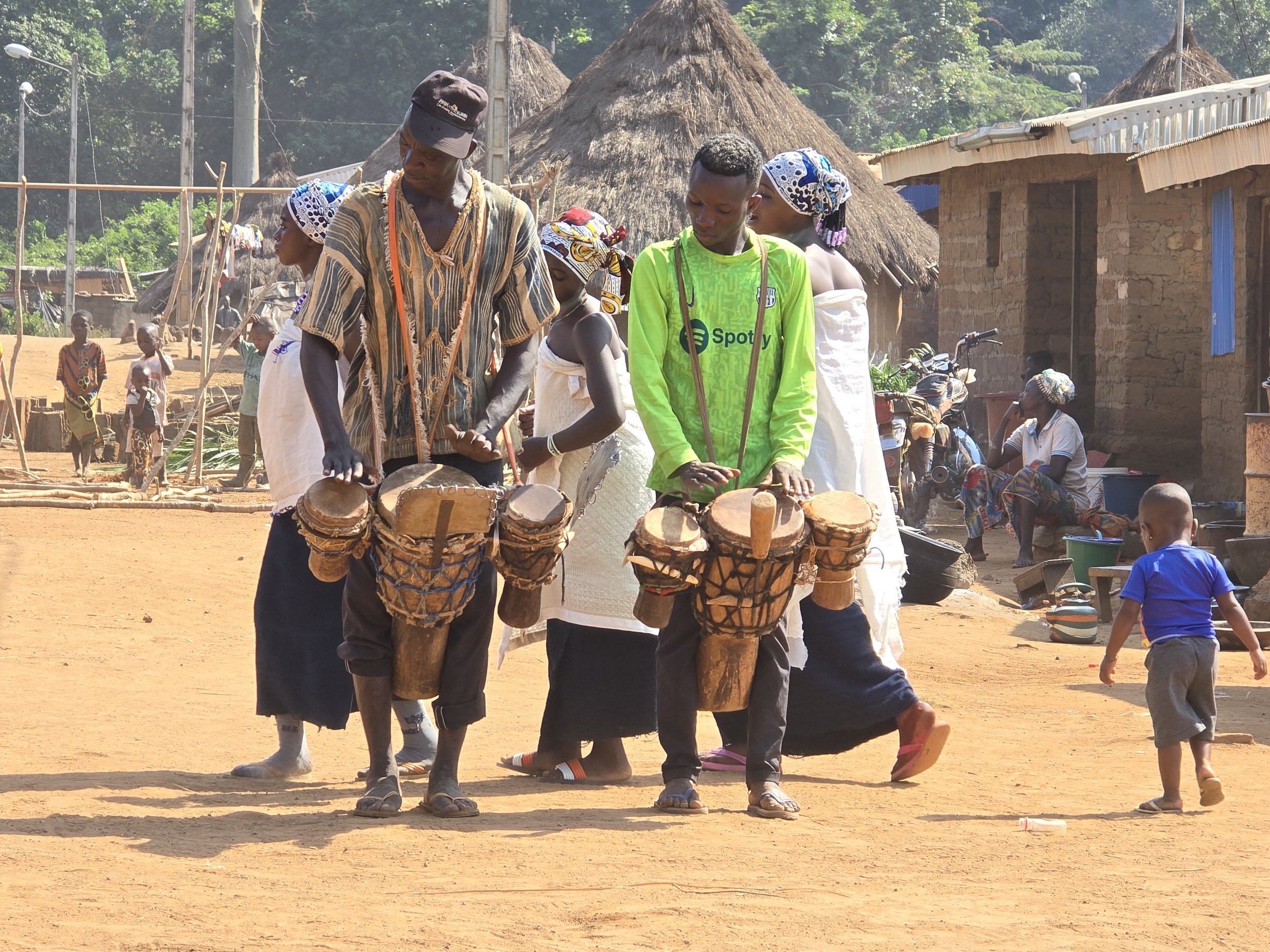
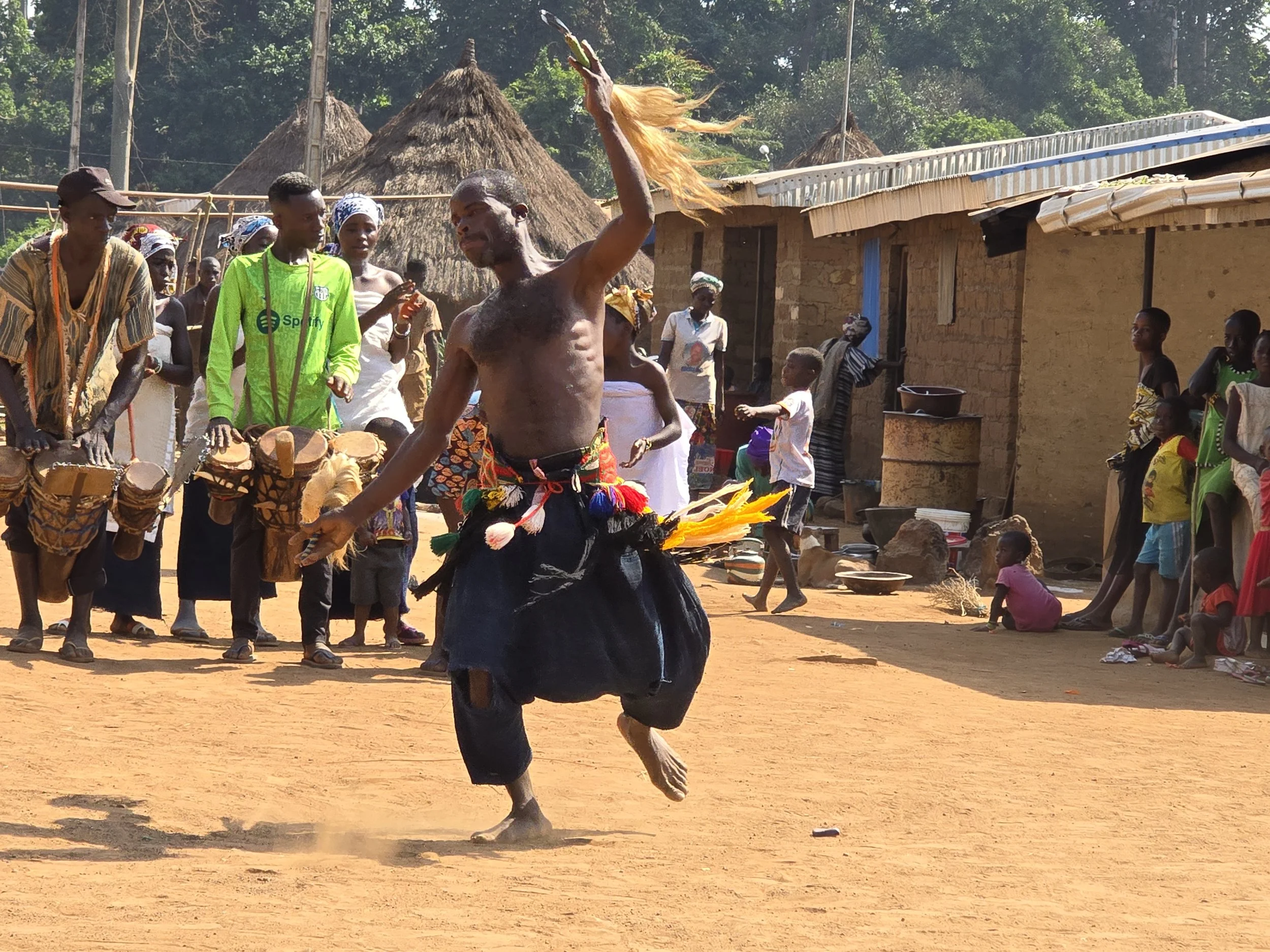
By now we had drawn a large crowd of young boys, united with the sole purpose of having their photographs taken. The resulting images were examined with intense concentration, much pointing and outbursts of laughter, before further demands were made. We might never have disentangled ourselves were it not for the sound of drums starting up. An older man and his young companion had arrived into the large central clearing and were beating out a rhythm on a multi-drum configuration hung from their necks. Quickly seated on brightly coloured plastic chairs under a straw canopy, we were about to witness elements of a Goudoufou ceremony. Yes, it was being performed because the Russians had paid for it, but the addition of a large food contribution arranged by the guide – enough for a village feast - had swelled numbers sufficient to create a lively atmosphere.
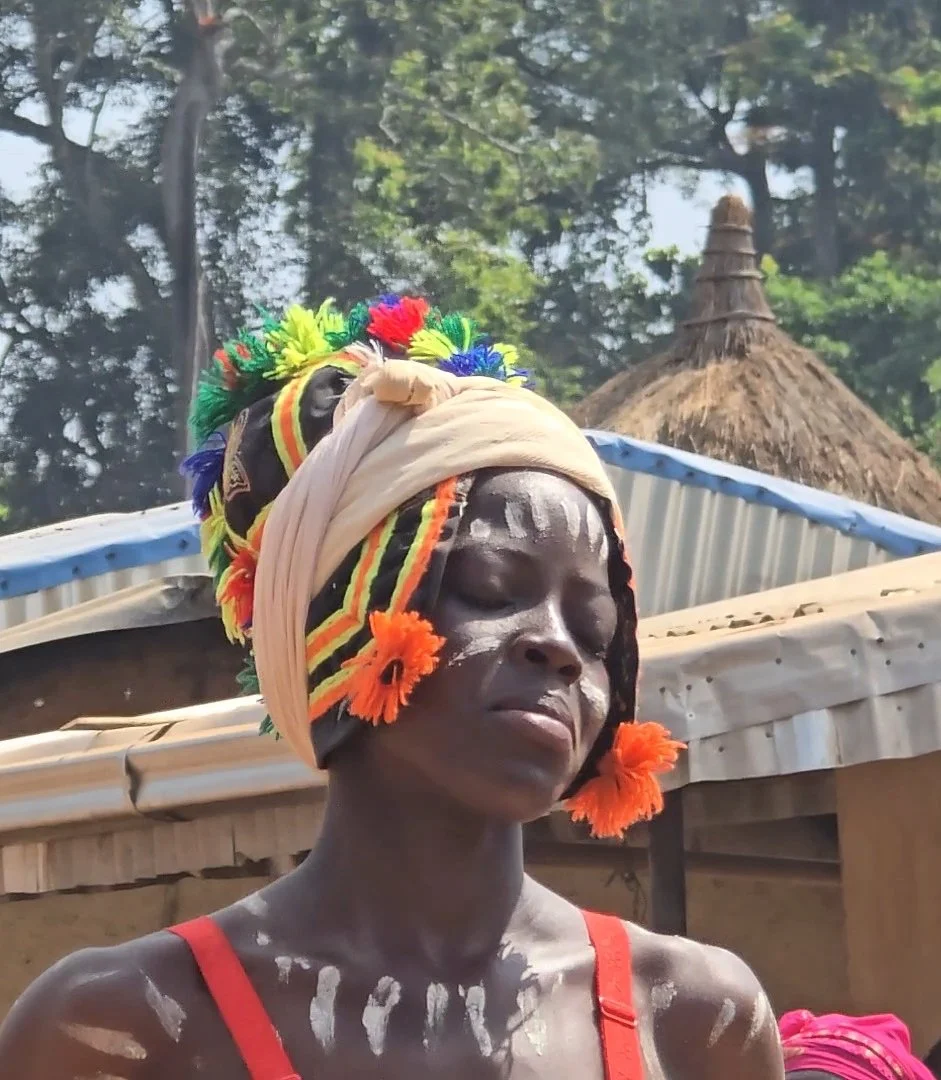
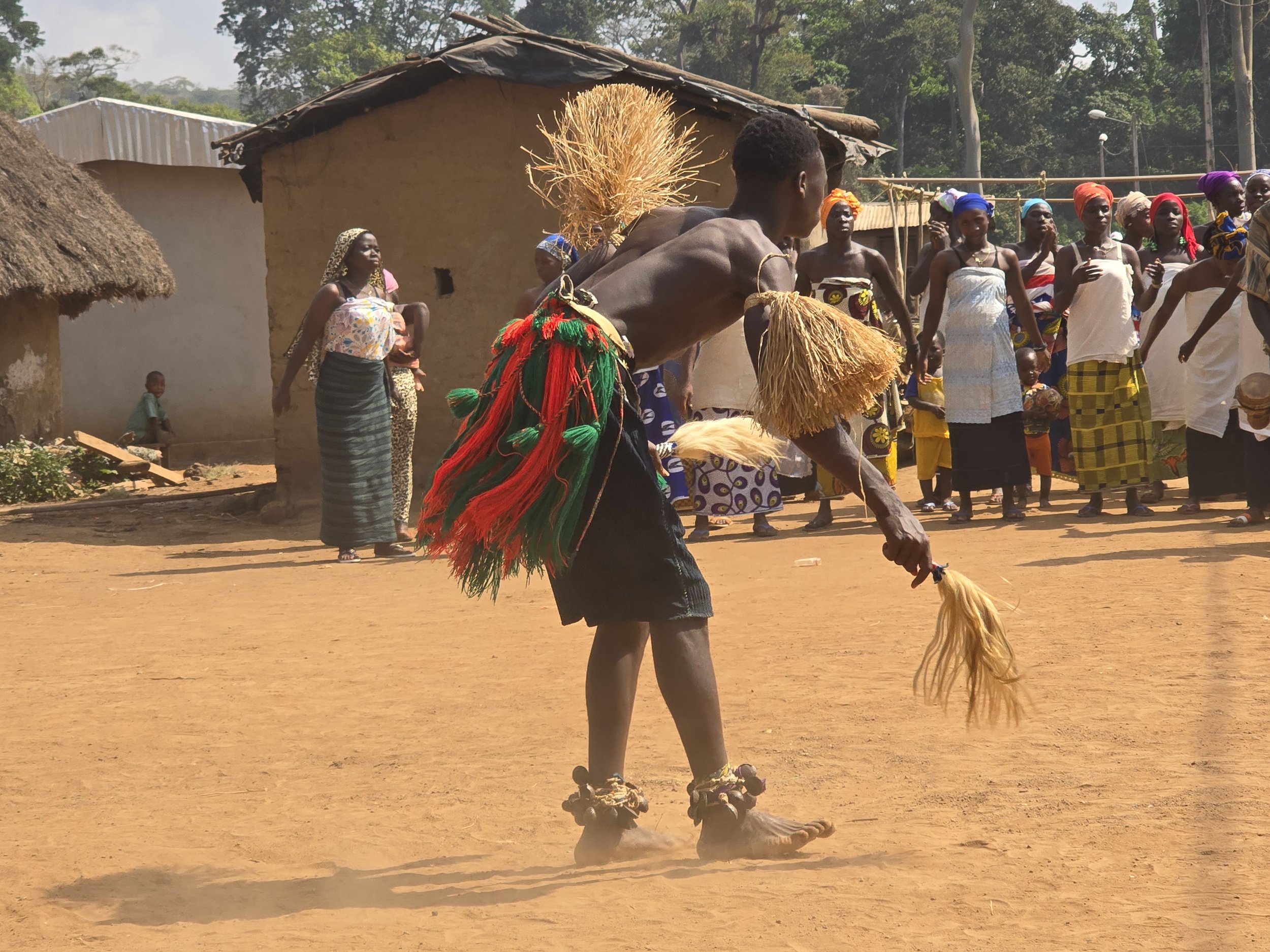
For nearly two hours the ceremony unfolded in layers of drumming, chanting, dancing and acrobatics. Voluminous costumes of raffia and layered textiles were topped with large ornately carved masks, bells jingled from ankles and flywhisks or bundles of fibers were waved and shaken. Young women dressed entirely in white, were followed by a group of powerful male dancers, their exaggerated dance steps raising energy levels and preparing the space for the stilt dancer. Towering above the crowd, his height reinforced the idea that this was an unapproachable spirit; his sinister looking mask suggesting an element of danger. Ungainly at first he paced in front of the excited crowd, his attendant spotters suggesting that his upright posture was not guaranteed. However, after a few more long strides without mishap, he threw himself into a series of leaps and spins, mostly on one leg. Whilst us and the Russians conformed to type with minimum reaction, other attendees were not so reserved, their screams of delight and alarm almost drowning out the sound of the drums.
We weren’t told the full meaning of what we were seeing, it being a closely guarded secret, but initiation into adulthood and a rite of passage to connect with the divine seemed likely. The whole event had an unmistakably other worldly atmosphere. For the duration of the ceremony, they were not men in costumes but spirits moving among the living – a distinction everyone present seemed to accept without question.
Leaving the village to their feast we headed back to Man, assuming the day’s programme was complete. It was not. After a quick lunch we set off again, this time a lot more sedately, along a badly rutted forest track that took us 60km in the opposite direction to a small Guere community at Diourouzon.
The Guere are part of the wider Kru-speaking people. Traditionally located in a region of dense forest and historically limited road access, their interaction with the outside world has been minimal. Even today, some ceremonies are known only locally and performed infrequently, which explained why our guide seemed quietly pleased that the village had agreed to receive us, although given the huge wodge of cash the Russians were handing over, not altogether surprising.
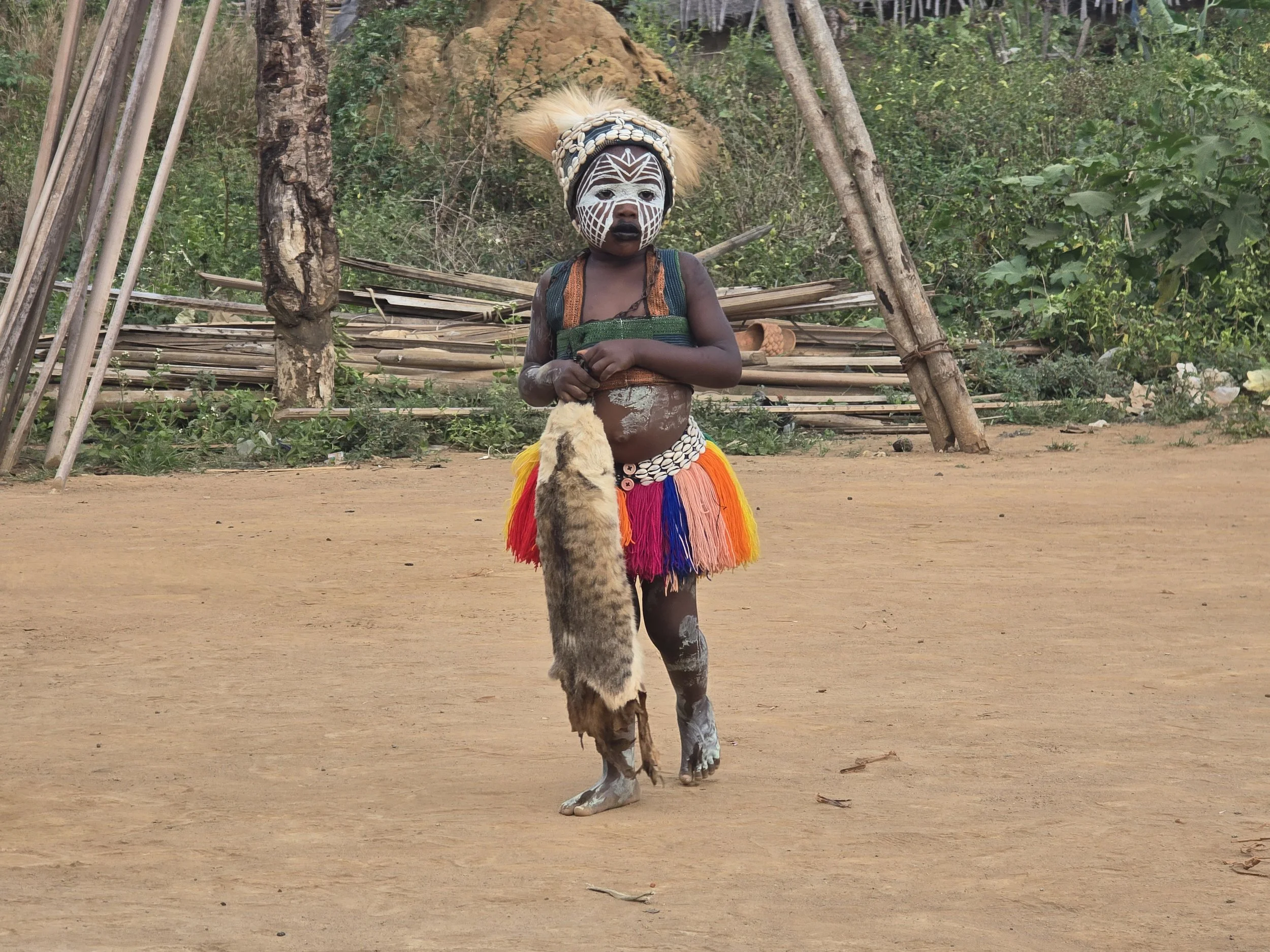
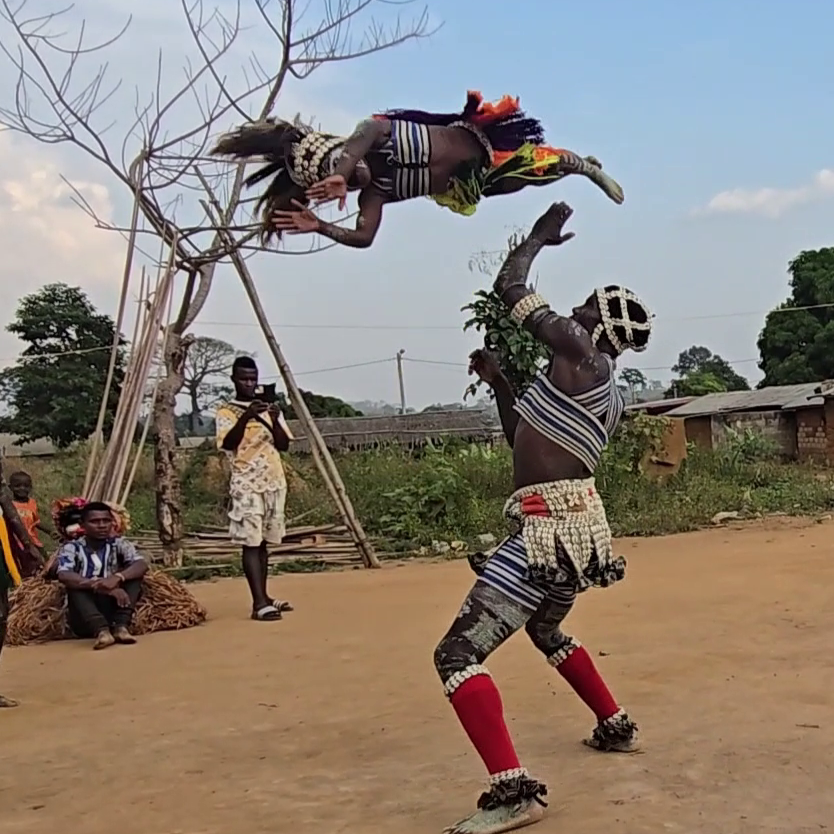
The ceremony we were about to witness was known as the Dance of the Jongleurs, aka snake dance or dance of the knives. As we all deliberated over the shadiest spot to sit, the musicians were already beating hollowed wooden cylinders with thin sticks accompanied by a metal rattle. Four young girls then appeared, their intricately painted faces unnaturally composed, suggesting a trance-like state. A state that was reinforced during the performance by their being suspended upside down above the intensified playing of the instruments.
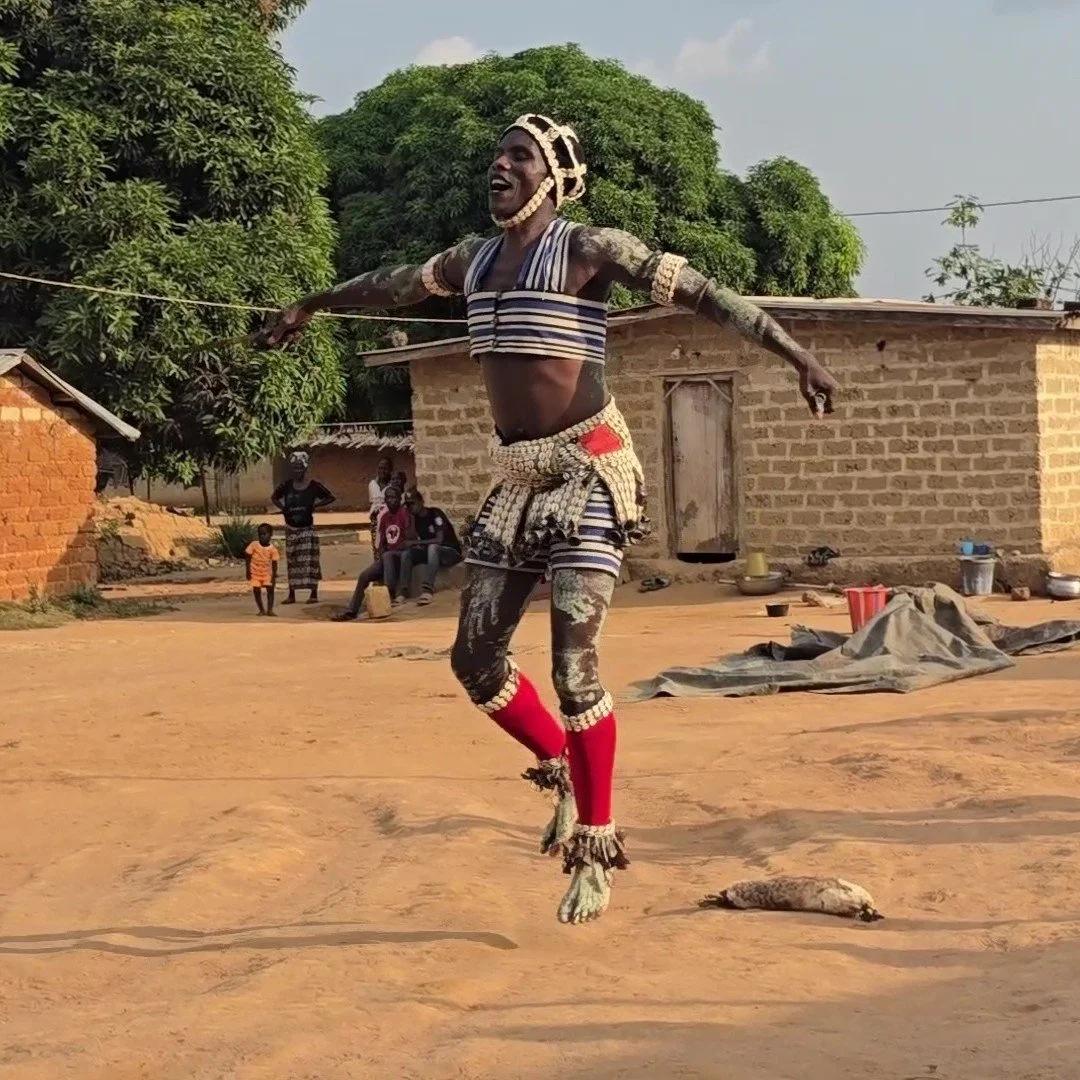
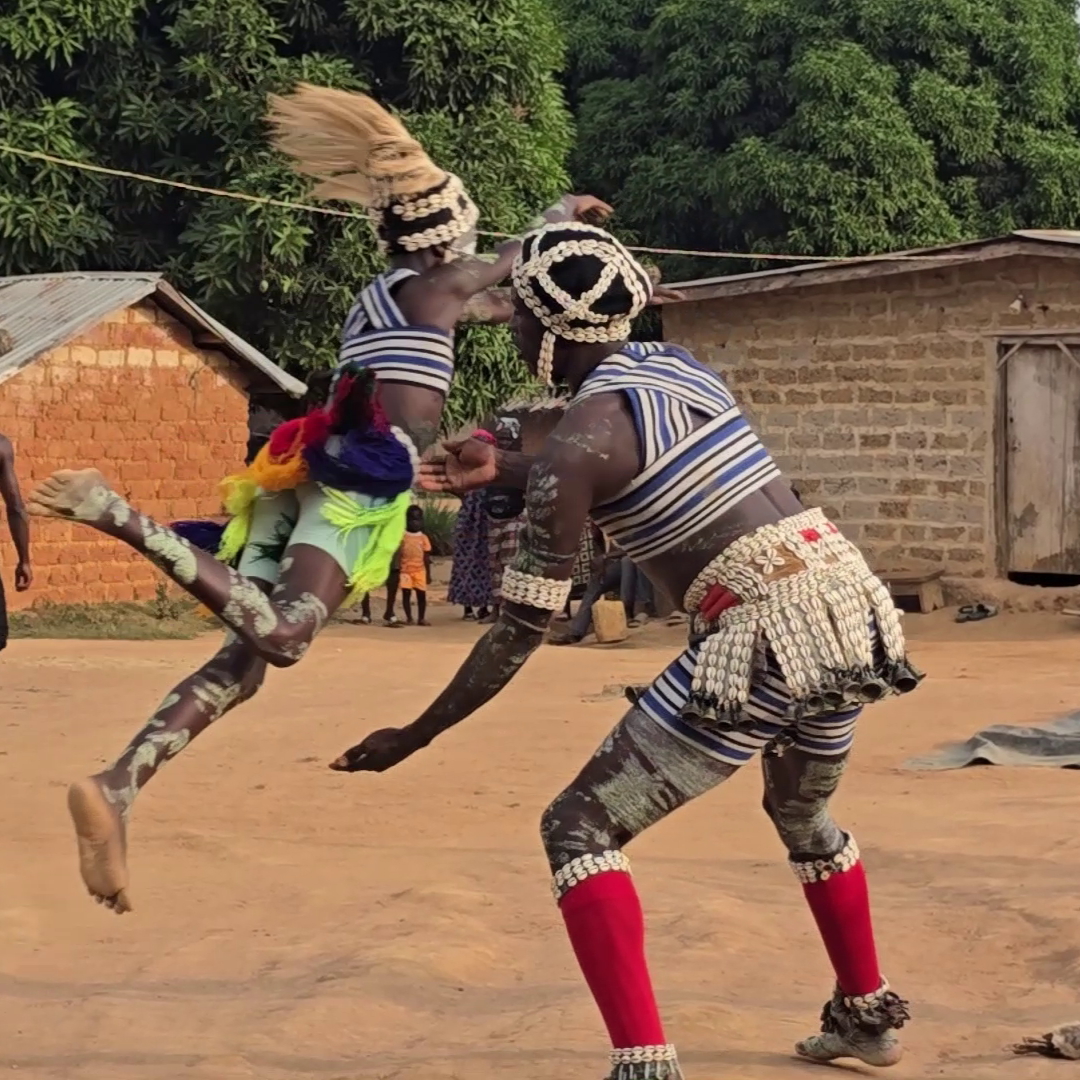
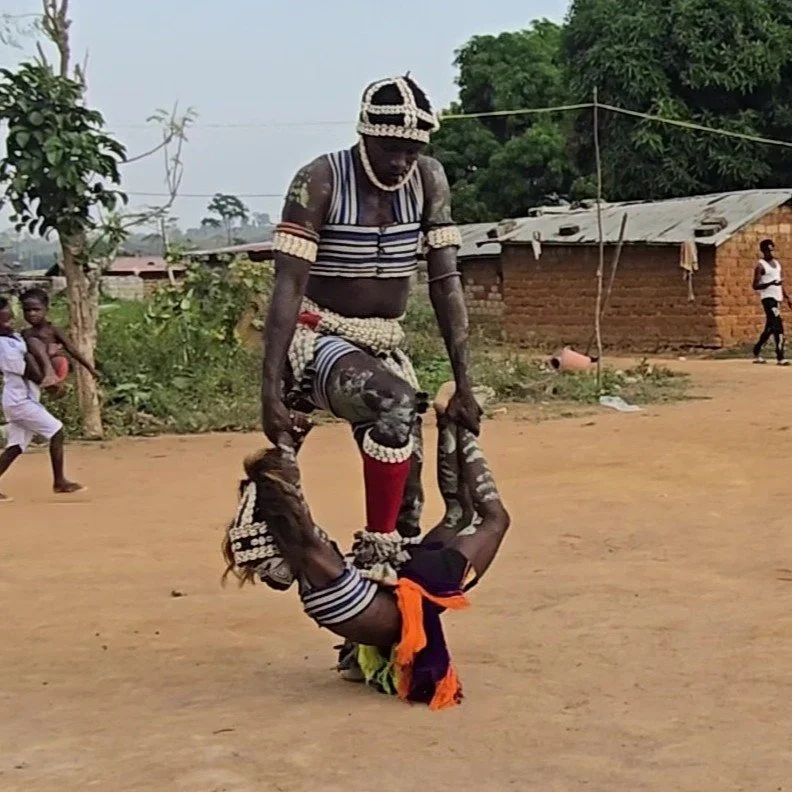
The jongleur, father of the girls, should have looked ridiculous in his outfit of knee-high red socks, a short skirt and skull cap made of cowrie shells and a stripey crop top, but the reality was an imposing figure, not a costumed entertainer but someone marked for a specific, inherited role. He and his daughters were the only members of the community able to perform this particular ceremony, the training for which is conducted from an early age, in secret, in the forest.
After the ceremonial dead rabbit had been placed on the ground, the girls began a sequence of gymnastic movements and balances before their father stepped forward. Brandishing two long knives, he caught one girl after another as they leapt into his arms, before being tossed in the air or draped around his torso. The posture of the girls alternated between being completely limp and rigid as a board, their barely open eyes unchanged throughout.
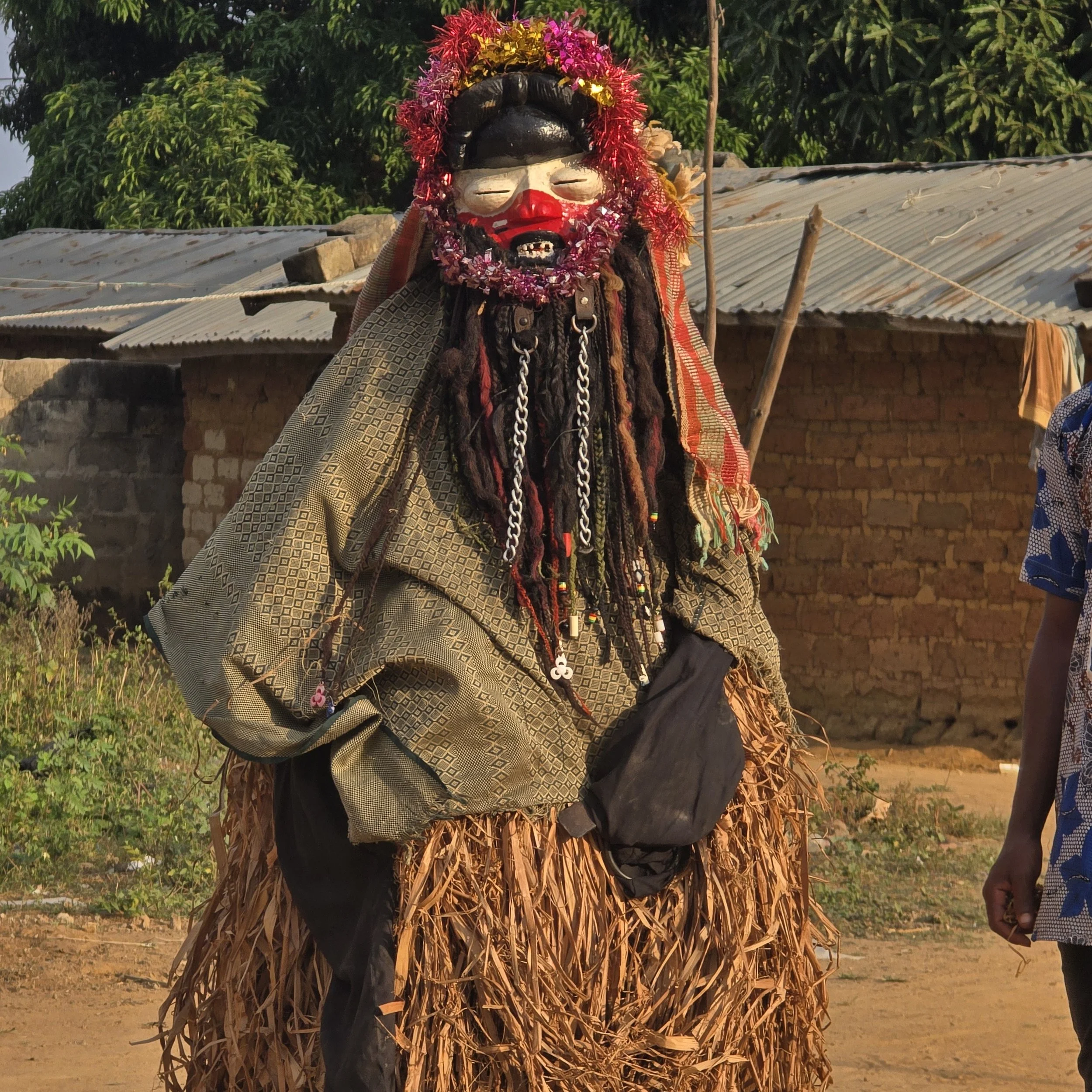
The Guere people believe in a Creator-God who communicates with humans only through intermediaries; masks. These masks are known as Gla, dancer masks and have different roles within their societies. Some are associated with justice, some with initiation, others with protection of the community as well as conflict resolution and social regulation. The Gla dance that followed the juggling featured a large and vividly painted mask, with metal chains hanging from its chin. We weren’t privy to what this particular one presided over but were informed that the presence of a guardian was two fold; one to guide the spirit – whose vision inside the mask was extremely limited – and, as the guide put it, to intervene if the spirit became “too energetic”, an explanation delivered with admirable seriousness.
There wasn’t too much dancing going on, rather a lot of pointing and staring before the mask threw itself on the ground and started rolling around in a manner suggesting either deep spiritual engagement or exhaustion in the afternoon heat. It was at this point that our guide tactfully suggested it was time to leave.
With two great performances under our belt, we left Man the following morning, heading cross country to Yamoussoukro, the official capital of Cote d’Ivoire. Once a small village, it was transformed during the long presidency of Felix Houphouet-Boigny, who was born there and decided, with presidential efficiency, that it should become a capital. The result is a city of wide boulevards, monumental buildings and a presidential palace guarded, somewhat improbably, by crocodiles. But, despite all this, the real business of government and commerce still happens in Abidjan, 240km away on the coast. Lacking any real commercial usefulness, Yamoussoukro is left feeling grand, spacious and somewhat under-occupied – as if built for a crowd that never quite arrived.
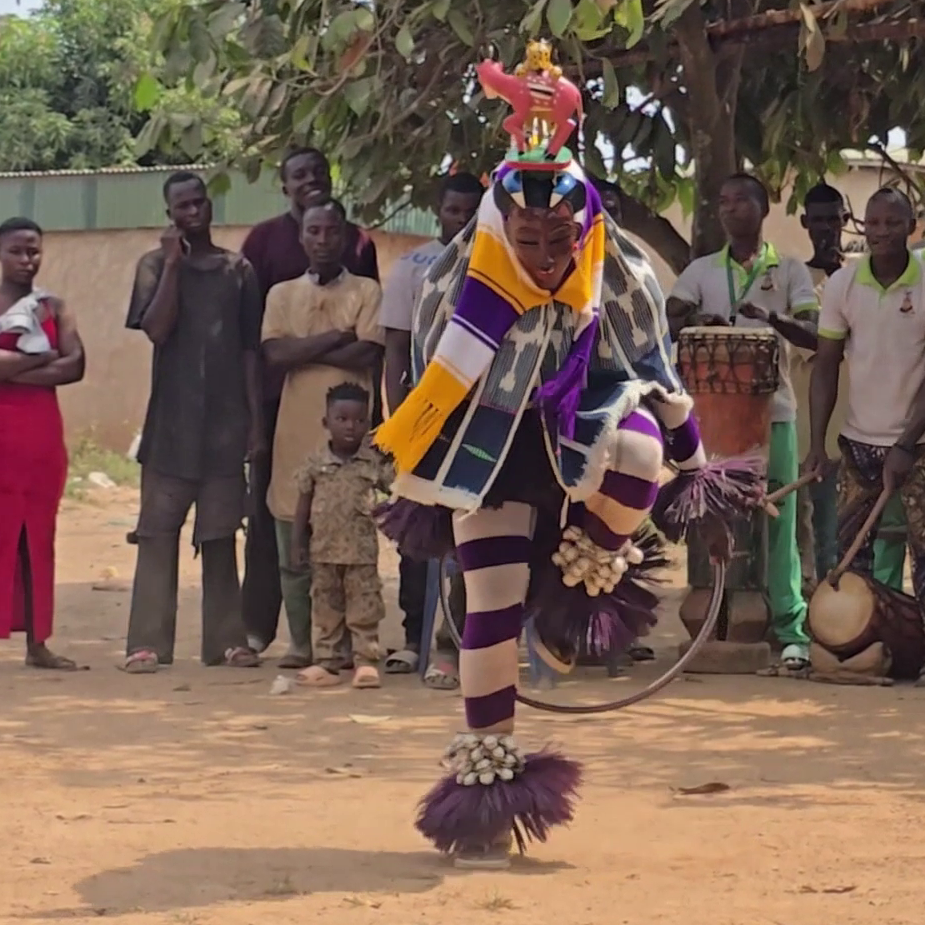
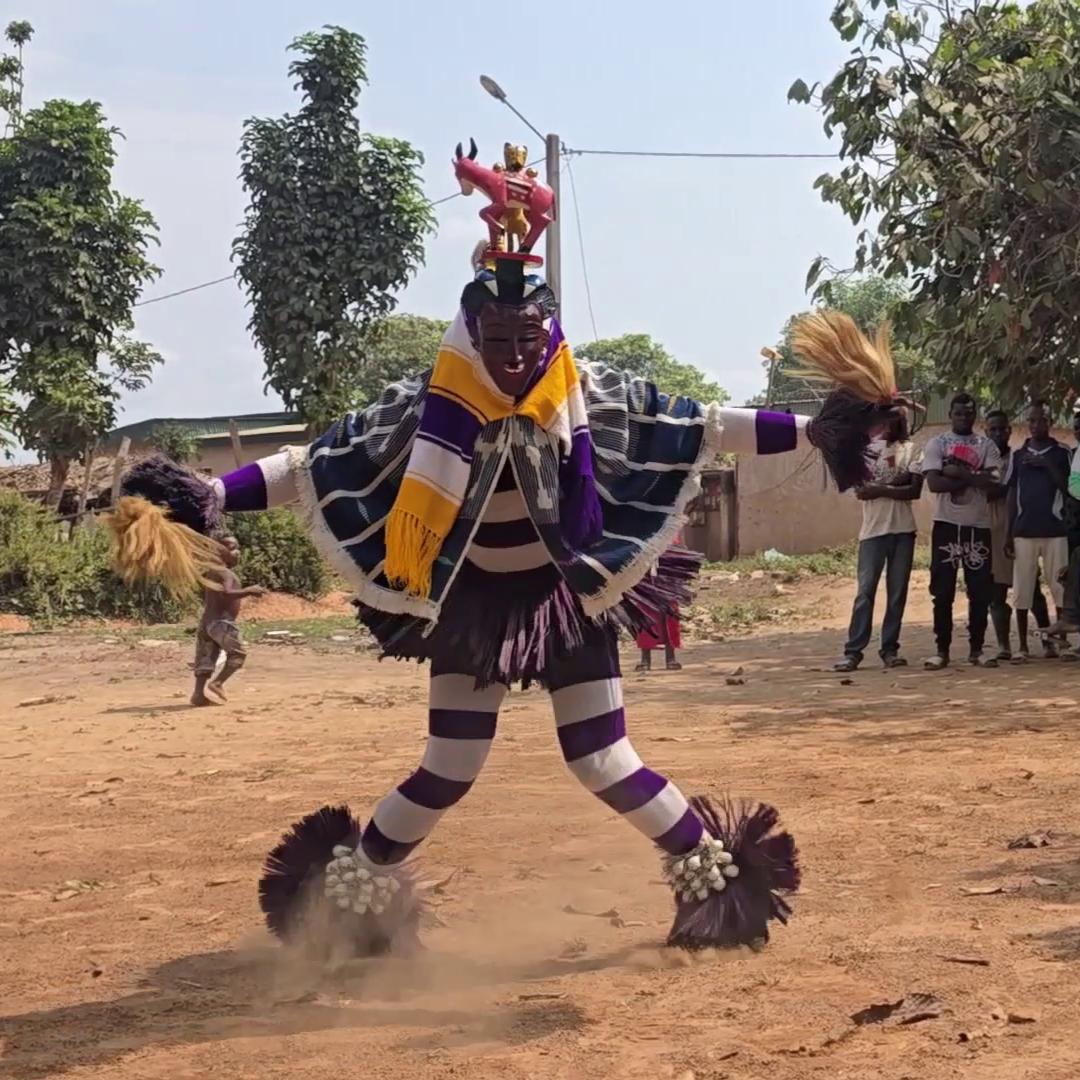
Taking advantage of the slightly faded grandeur of the Presidential Hotel – whose entire top floor is the Presidential suite - we resumed negotiations with guides, all of whom were based in Abidjan. This meant that hiring one meant effectively sponsoring a small logistical expedition: several hours’ drive each way, accommodation, meals, fuel, interpreter fees and performance costs. But, with a decent payday on the horizon, our guide and interpreter did arrive punctually the following morning in a vehicle that was far removed from the price that we had paid for it. With no air-con, dust and fumes coming through the open windows and sweaty backs sticking uncomfortably to the plastic seats, we were relieved to arrive in Baoufle, Guro territory. We were here for the Zaouli dance, one of West Africa’s most famous and most difficult due to the fast footwork required. Inspired by a woman in the mid-20th century, the dance is a homage to female beauty, each village having its own designated male performer who on average trains for up to seven years to master the form.
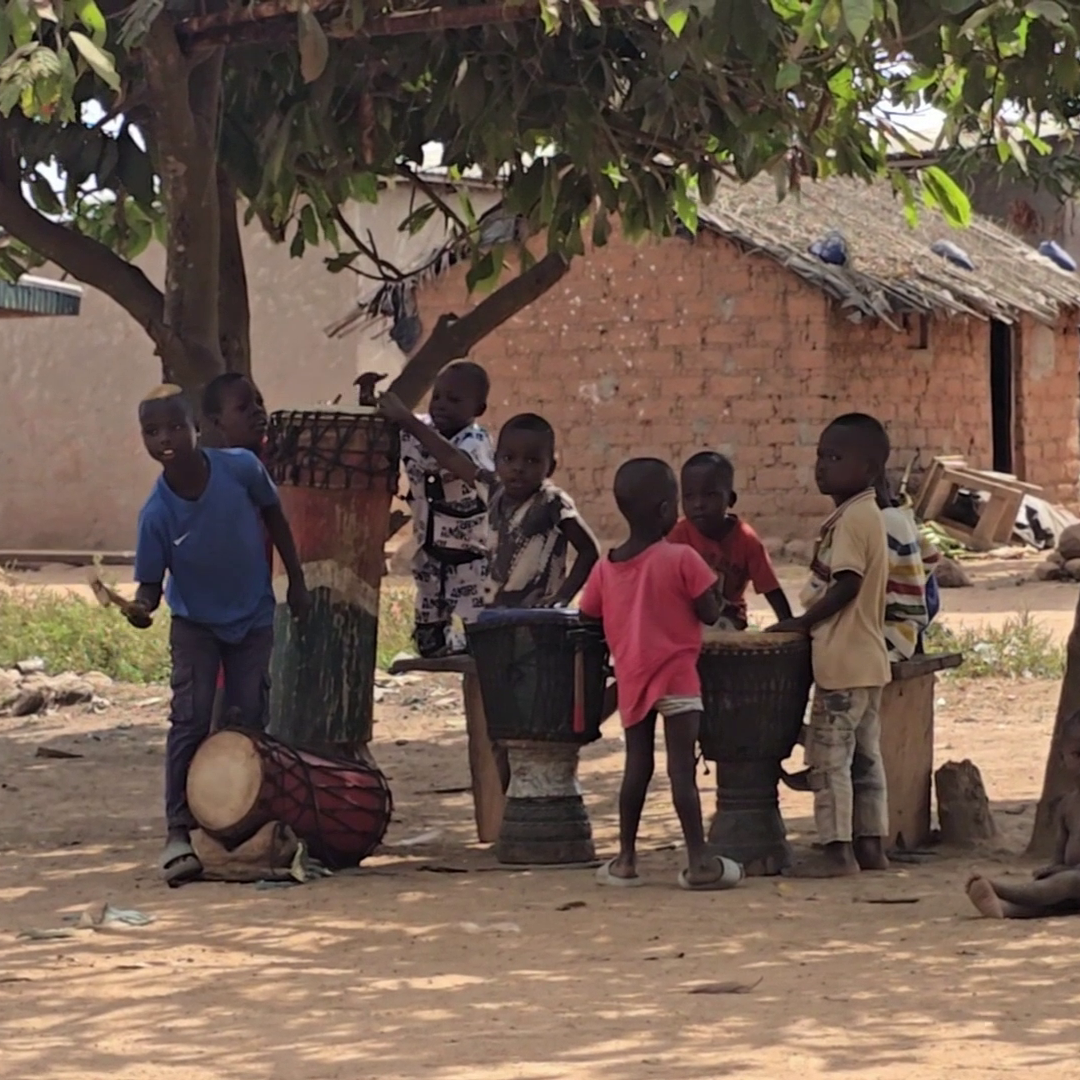
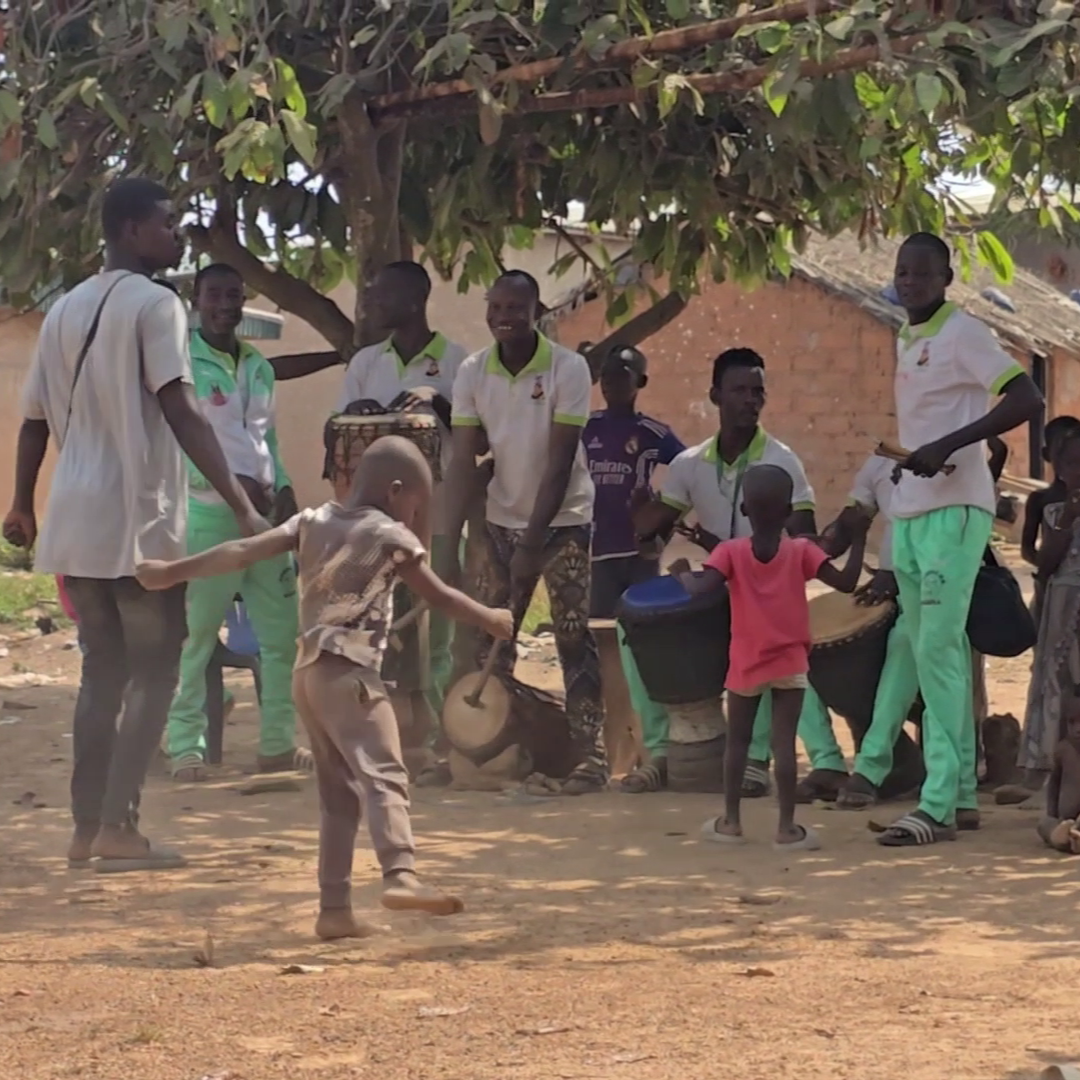
The warm-up act was delivered by rag-taggle group of village children who, barely able to reach the top of the drums, still managed to produce an impressive beat. Even though the performance was arranged just for us, the entire village soon gathered to watch making us feel as though we were attending a party.
Covered in brightly coloured layers of cloth, stripey tights with layers of seed pods at his ankles. The mask was unquestionably female, with an unusual headdress: a large cat attacking an antelope This could have represented the cat as the Guro people dominating their rivals or it may just have been to add height, something we were starting to realise was helpful when communing with spirit. Spiritual connection aside, this was the dance we most wanted to see and we weren’t disappointed. Regarded as one of the hardest dances in the world, the speed and precision of the footwork was mesmerising. The dancer’s upper body, mask and headdress remained perfectly composed, while his legs and feet executed rapid and intricate steps. It was a masterpiece of execution, a timing and co-ordination that could only have been achieved after years of disciplined training.
cacao pod
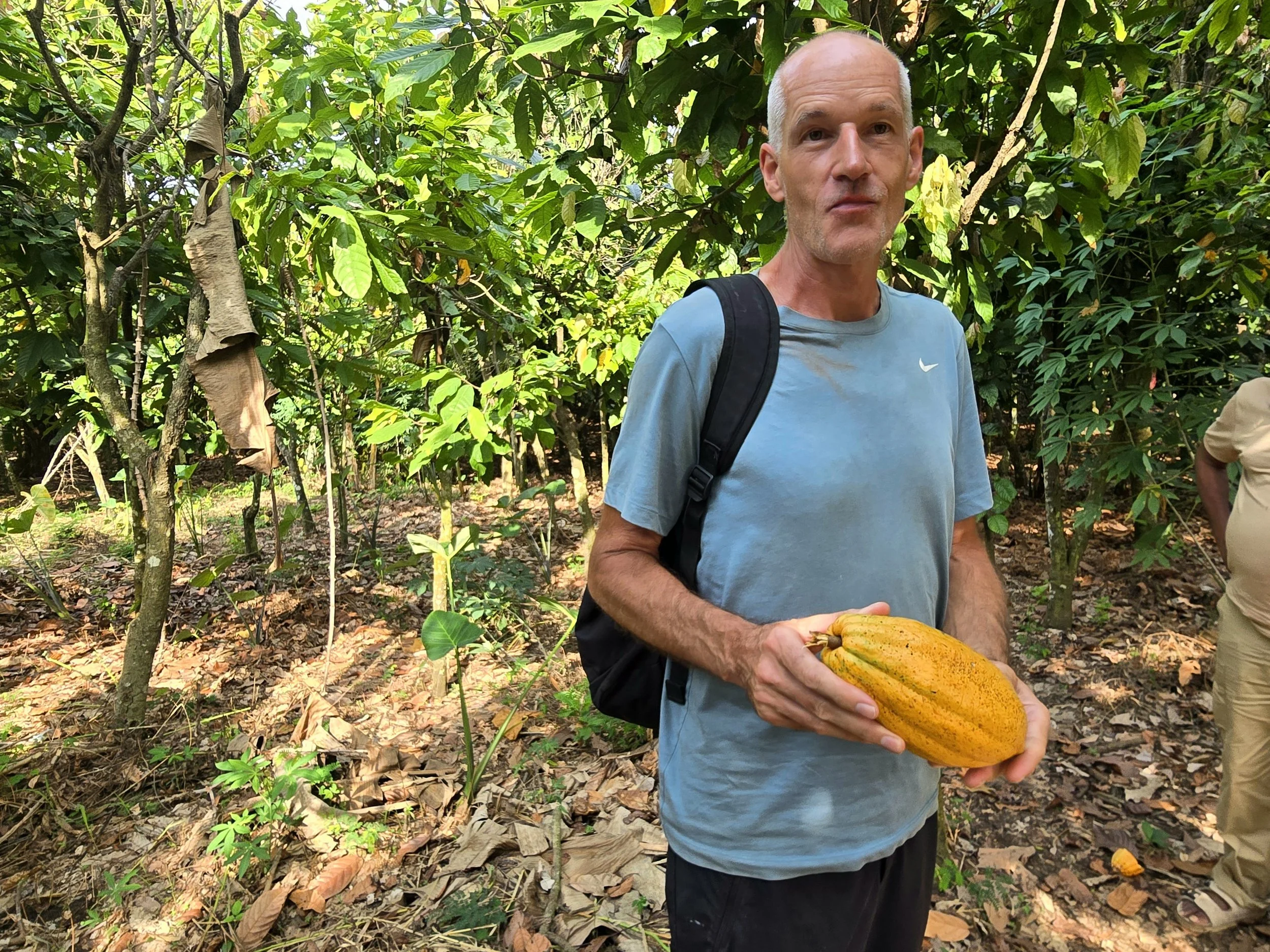
Our guide had generously offered to throw in a couple of extra treats. The first, a trip to a cacao plantation, many of which were established by the French prior to independence in 1960. Anticipating a structured guided tour following by extensive tasting, pulling over at the side of the road and being shown the inside of a cacao pod probably wasn’t the highlight of our day.
The next morning, we set off to meet the Baoule – Cote d’Ivoire’s largest ethnic group, accounting for roughly 23% of the population – and to observe the Goli masquerade, widely considered the country’s most dominant traditional dance form. It is performed to bless the community, deter misfortune and keep the forest spirits suitably appeased. A full ceremony can last all day. We were attending the condensed version.
baoule weaver
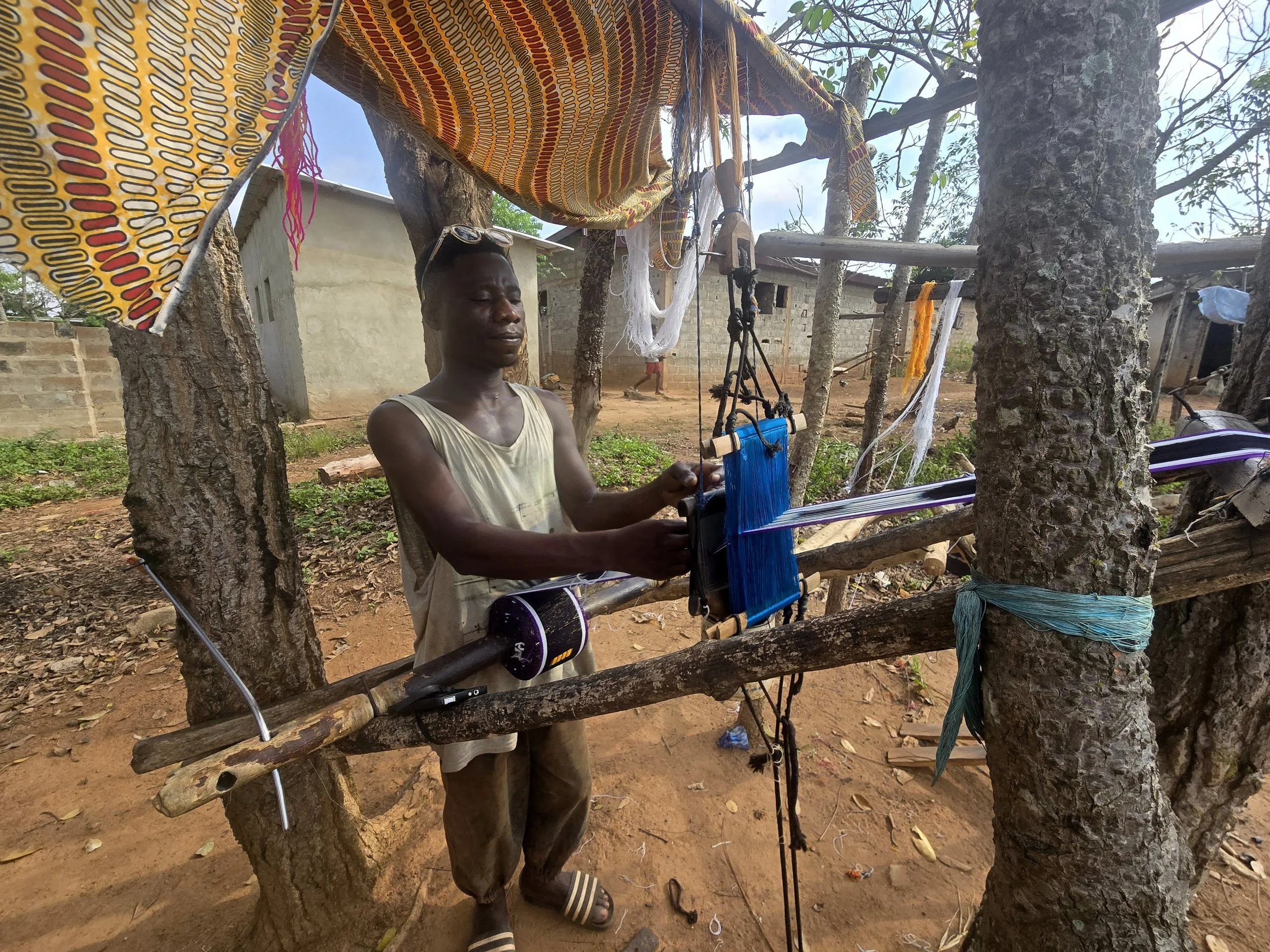
The Baoule are also respected weavers, producing long, narrow strips of cloth that are stitched together for larger garments. Wooden looms were set up on a scrubby allotment, each loom connected to long lines of thread running the length of the patch where they were tensioned by heavy rocks. The overall effect was that of a rural laser-beam course, one that had to be carefully navigated in order to reach a small clearing behind the village. Seated under the shade of a Baobab tree, we waited while a young boy attempted to subdue the dust by flicking water from a bucket with the back of his hand. It was optimistic.
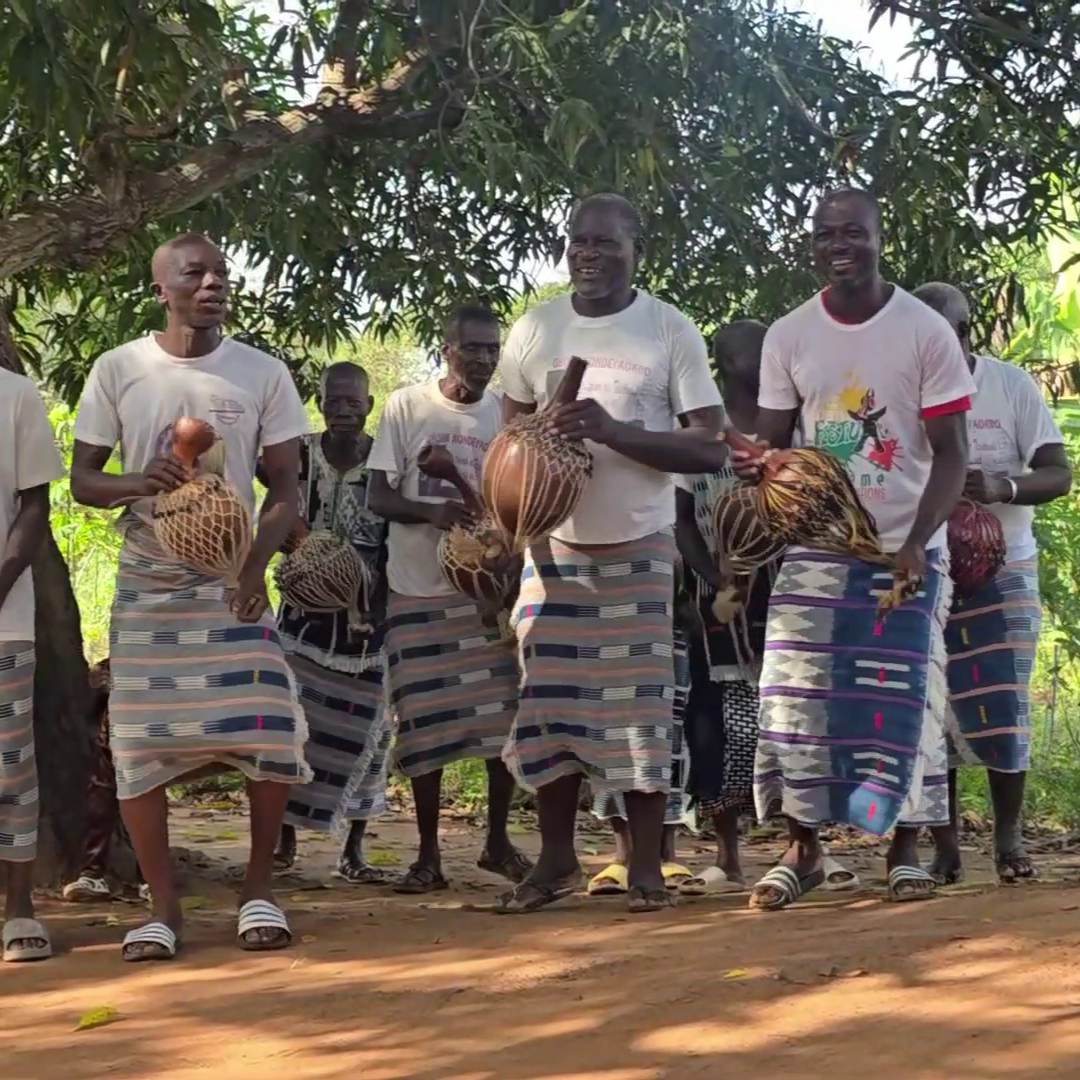
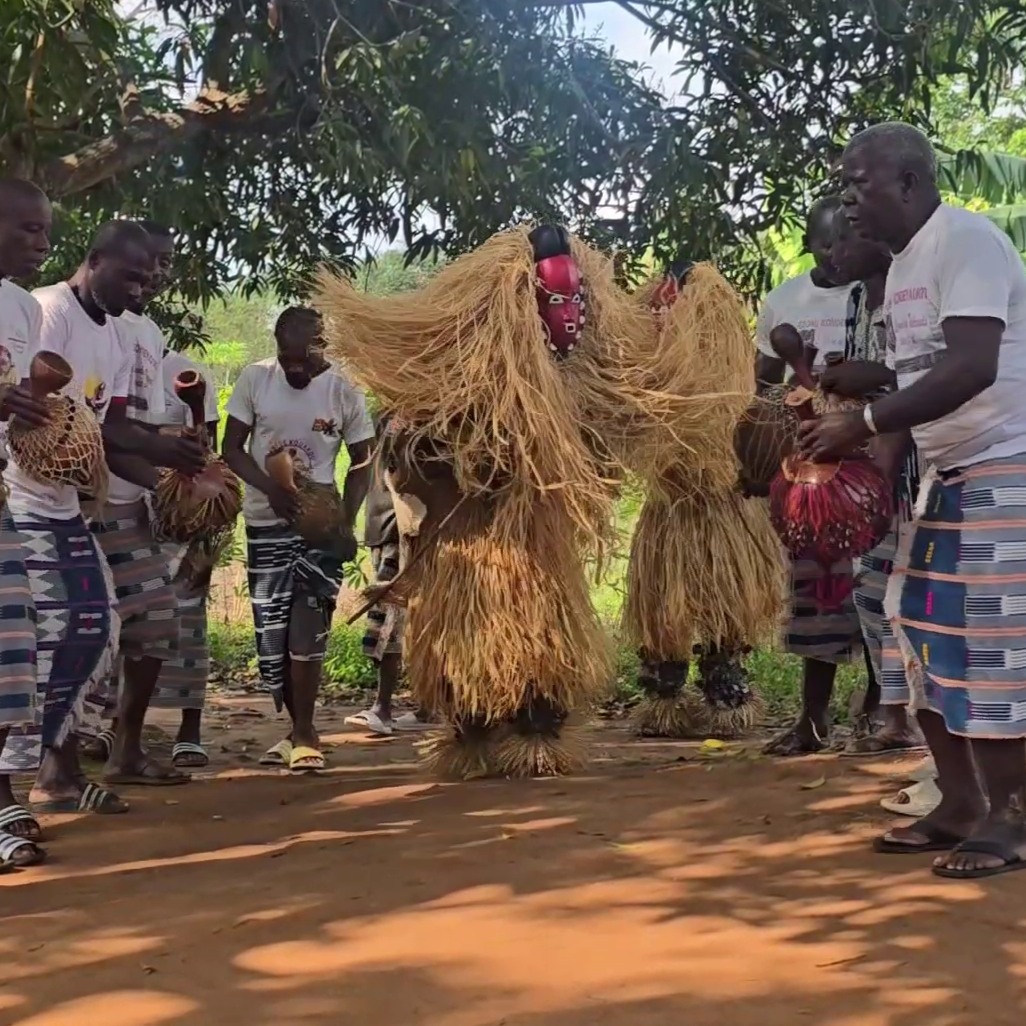
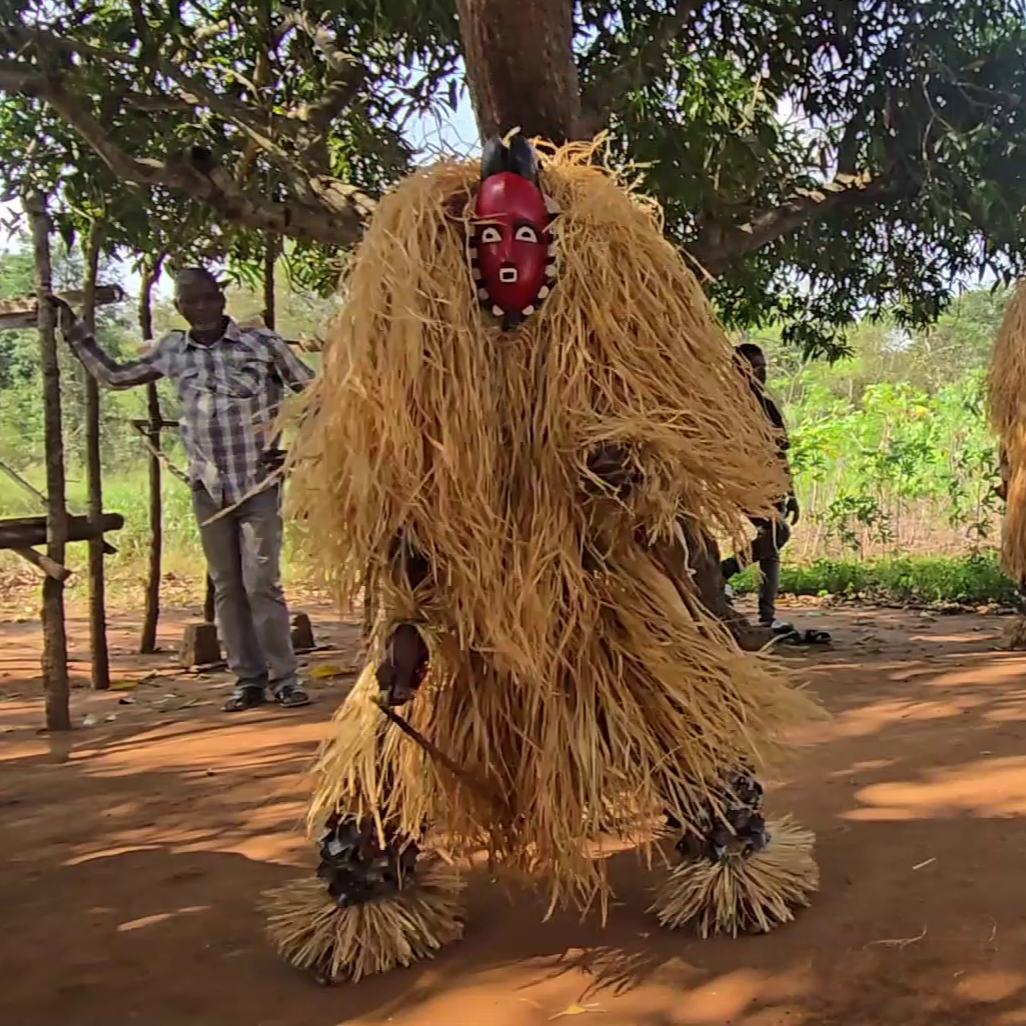
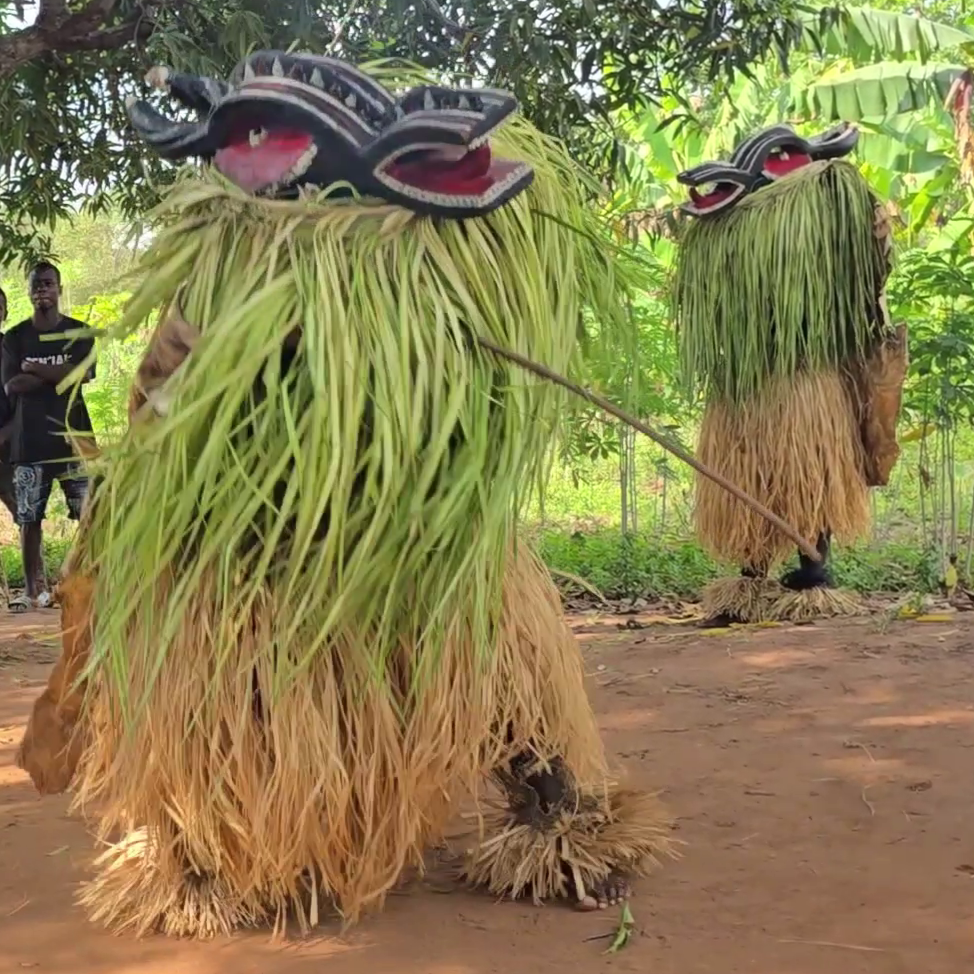
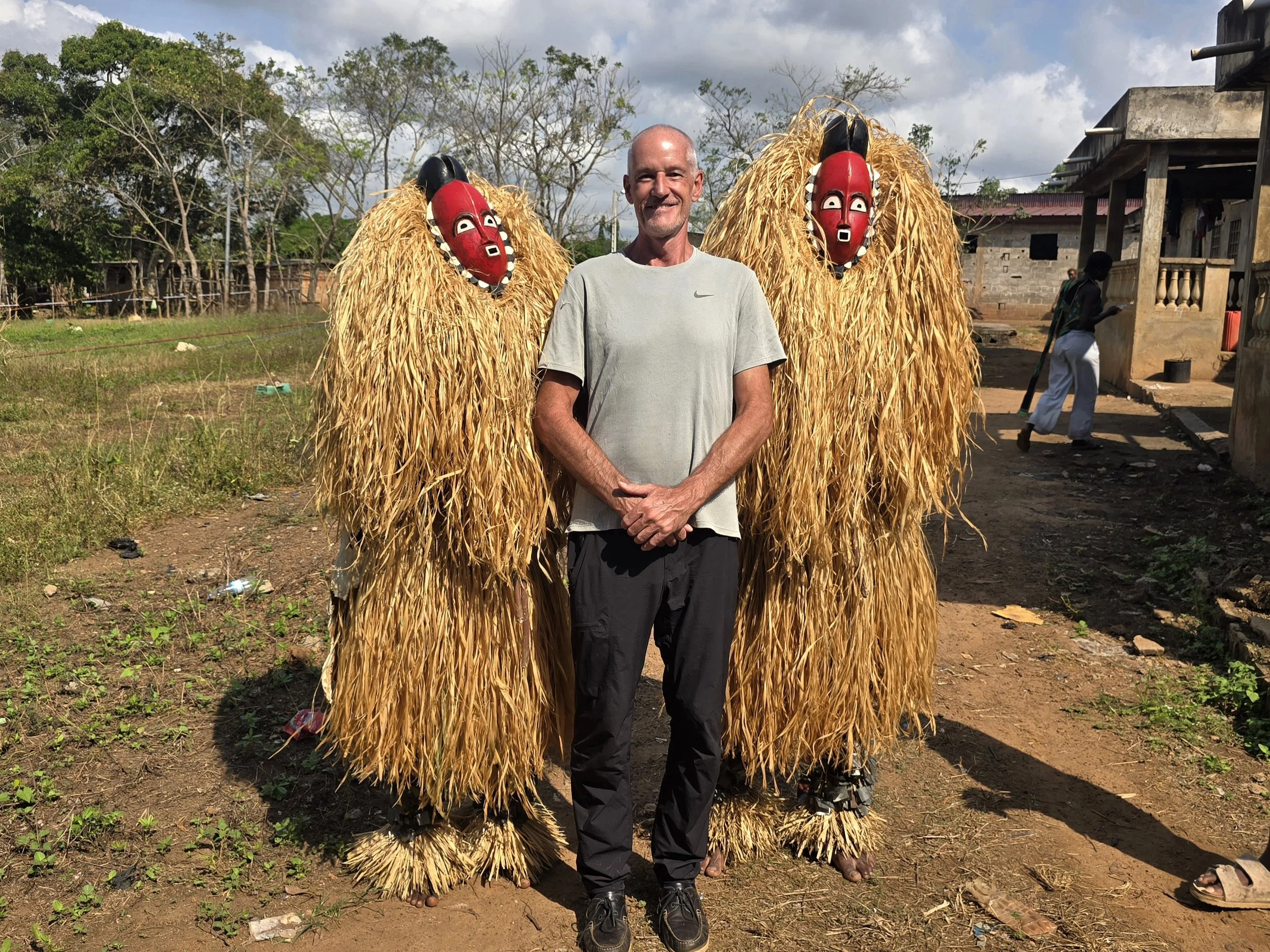
A line of men in white T-shirts and blue -and-white striped cloth wrapped around their waists opened proceedings. Shaking their toha – large calabashes wrapped in netting and filled with pebbles they produced a steady, insistent sound. The Goli dancers followed, looking like giant haystacks enveloped head to ankle in raffia and what looked like a cow hide draped across their backs. The first pair representied the female aspects of spirit, wearing kpan masks – round and human-like. They were followed by the male aspects, whose masks were huge crocodile faces with antelope horns.
What followed had the unmistakable structure of a ritualized dance-off. One mask advanced, stamped, spun, then struck himself firmly across the back with a long stick before retreating. The partner mask responded in kind. What appeared to be self-flagellation was an act demonstrating strength, endurance and fearlessness. The masked figure no longer an individual but a spirit force beyond ordinary human vulnerability – a useful distinction when hitting oneself with a stick.
Entertaining as it was, the true purpose of the ceremony is to allow the power embodied by the mask to circulate through the community, reinforcing cohesion and a positive social hierarchy-
Hoping that some of the force had quietly transferred to us, we returned to Yamoussoukro where our guide had arranged one final cultural highlight: a visit to the vast Foundation complex built in honour of the country’s founding president. Unfortunately, this lasted a lot longer than a quick look at a cocoa pod and our stamina for listening to a detailed account of his ancestral lineage – accompanied by photographs of relatives both deceased and still very much alive – waned somewhere around the third cousin.
Yamoussoukro, beyond its novelty, offers limited distraction, and we were keen to head further inland. There was, however, one small complication. As we rolled out of the hotel grounds, we discovered that Bob had no brakes!!