Benin & Nigeria
/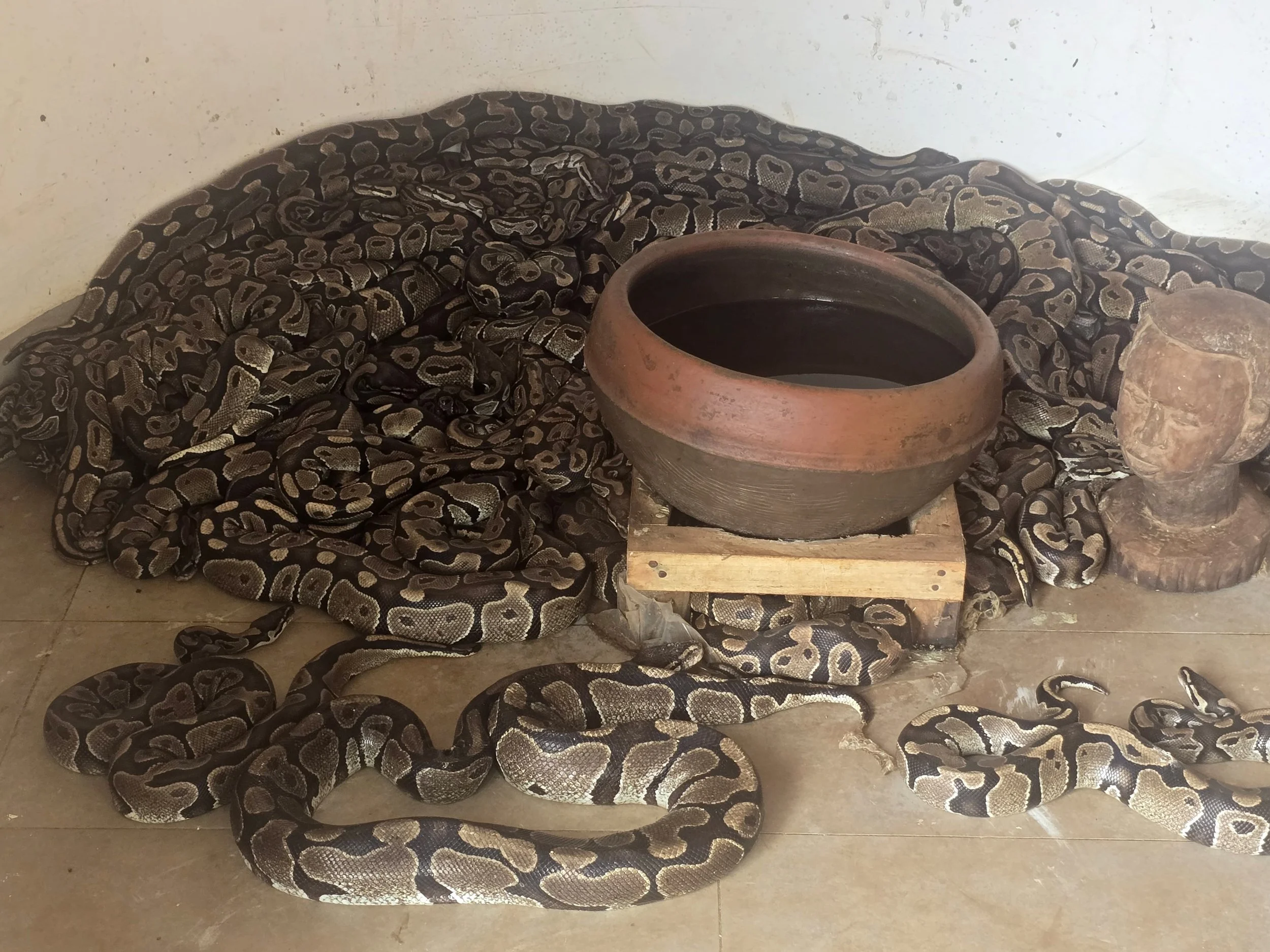
sacred pythons, benin
Our timing at the Tohoun border into Benin was a little unfortunate. We pulled up behind a bus heaving with locals but, being embarrassingly white, were quickly ushered into the VIP room where we sat on a cracked sofa listening to the dying floor fan as our passports were processed and numerous ledgers laboriously filled in.
It was a three-hour drive to Cotonou, not the capital (that honour belongs to Port Novo), but very much the economic centre. From here we flew to UK for routine medical check-ups and to acquire a mini Starlink. We had chosen to fly out of Benin due to the ease of re-entry; a refreshingly efficient evisa platform at a cost significantly lower than some of its neighbours. As it turned out there were other advantages that we hadn’t been aware of.
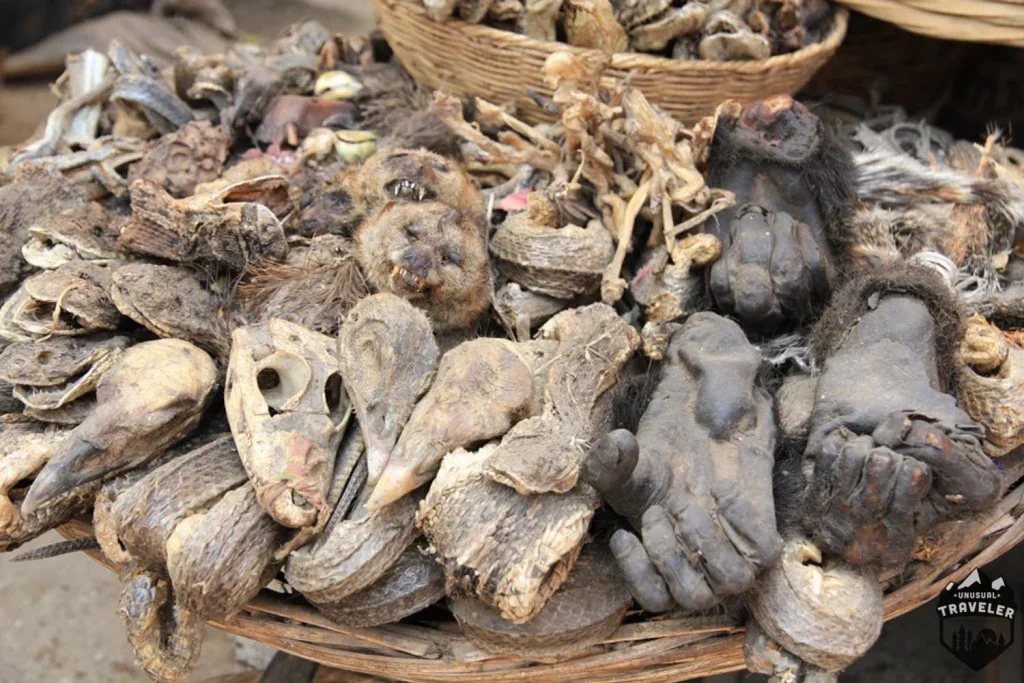
voodoo fettish market
Since taking office in 2016, President Patrice Talon – who made his fortune in cotton and apparently has more money than most people could spend in several lifetimes – has pushed economic reforms and modernization. Roads have improved, the port has expanded, industrial zones have appeared and more than 1,600 km of solar street lighting is well underway. The renovated airport handles fewer than half a million passengers a year and was so quiet that, on our return, had we not left one of our bags to continue a leisurely solo tour of the carousel, we would have been sat in a taxi within ten minutes of landing. The taxi drive just 10 minutes to the main hotel area.
Modernisation aside, Benin has long been “the spiritual centre of Vodum”. More than a religion, Vodun is a worldview encompassing art, medicine, music and philosophy. A trip to the local market just as likely to be for a dehydrated bit of crocodile snout, a hippo’s foot or a pigs’ penis as for a couple of onions and a kilo of rice. Whether voodoo dolls exist remained unclear, but a temple writhing with sacred pythons and a reading from a Fa priest proved an effective introduction to a religion followed by over 60% of the population.
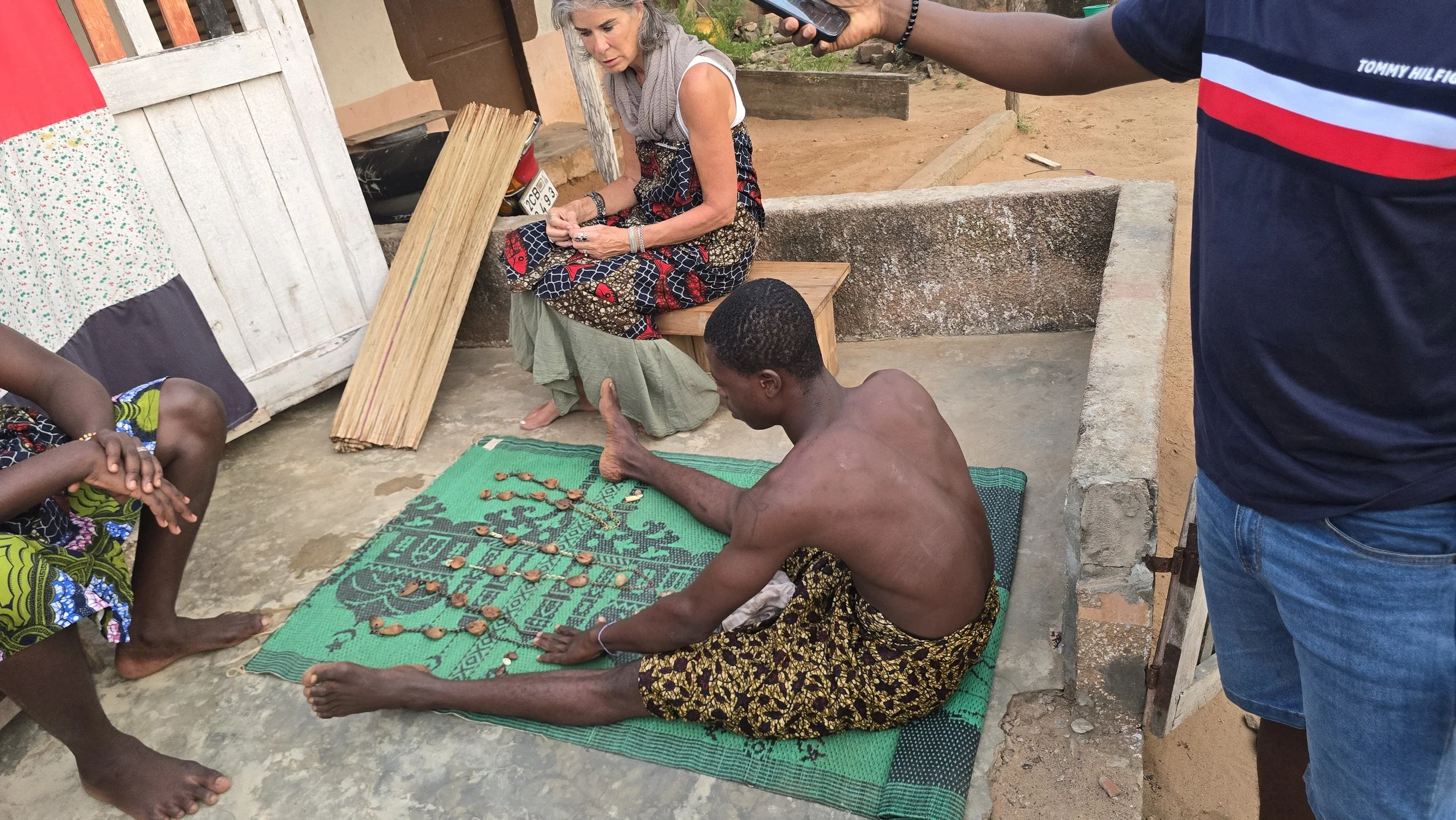
fa priest reading
Sitting outside a small, whitewashed hut, I watched as an apprentice priest swirled his strings of eight wooden beads while murmuring invocations. The lay of the beads once cast onto the ground were supposed to reveal answers to any problem I might have. Perhaps I should have paid for the fully qualified version as, after several inaccurate attempts at identifying what my problem was, it was suggested that the best way forward would be to pay for some chickens, soft and hard drinks (presumably enough for a community party), after which a blessing could be bestowed upon me. Sensing an attempt to take advantage of my deep-rooted issues, I declined as politely as possible and we quickly withdrew before any dolls could make an appearance.
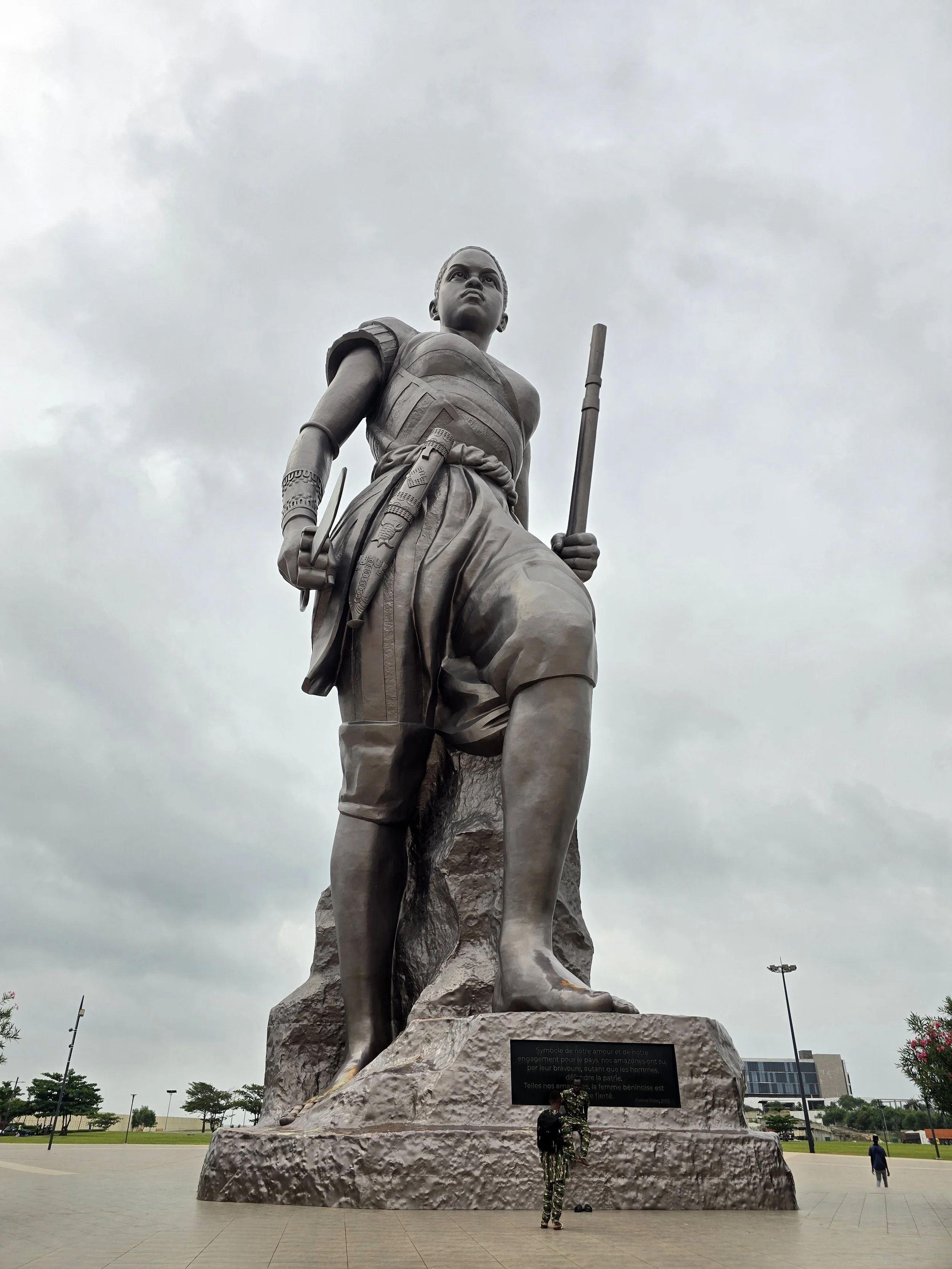
amazon soldier
As part of the on-going modernization, a large modern square now stands where an estimated 1 million slaves were sold before being shipped overseas. Bronze sculptures (not yet unveiled) do their best to portray the horrors that took place under the watchful eye of Dom Francis de Souza, the most powerful slave trader on the West African coast.
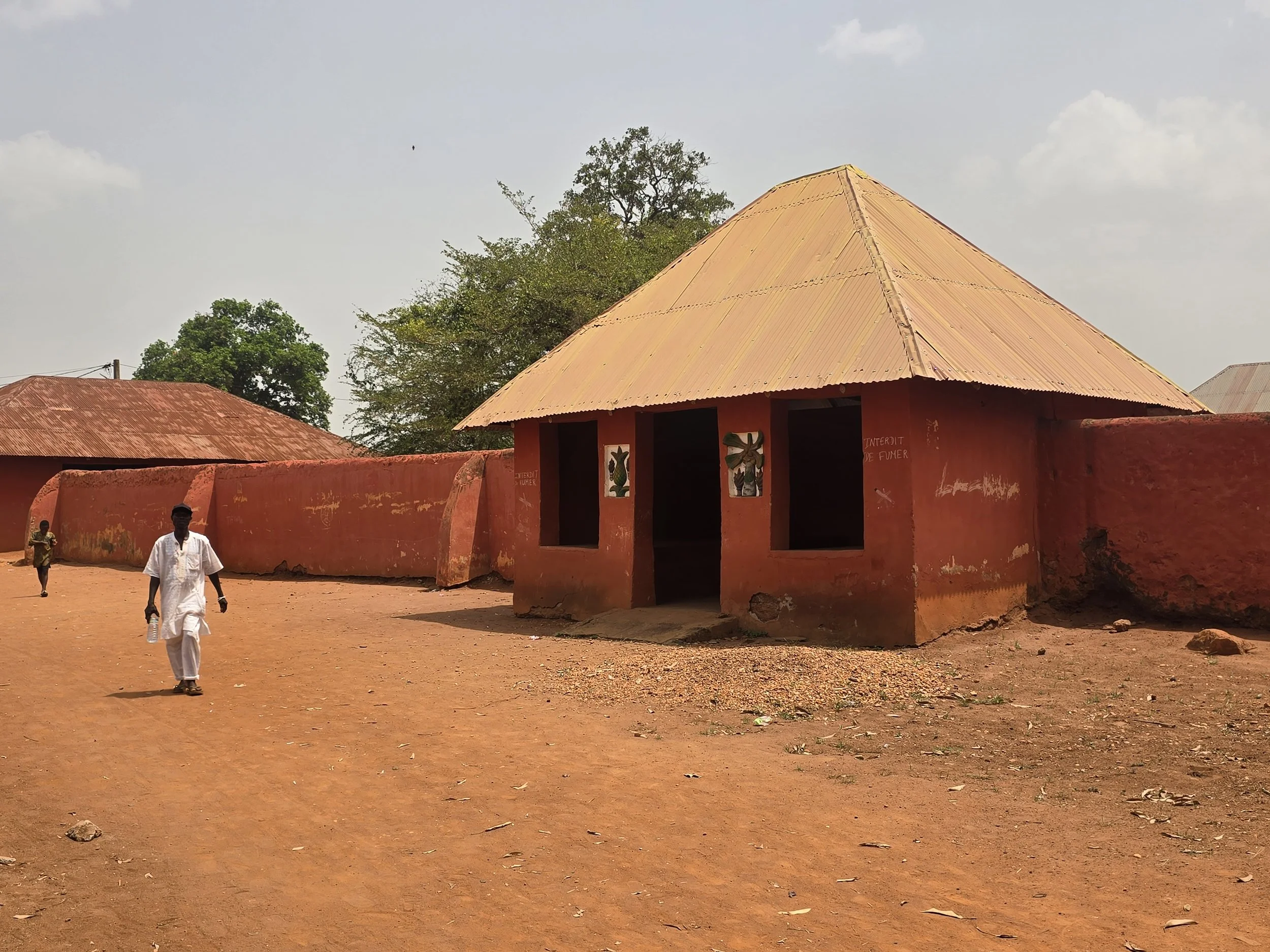
dahomey palace, abomey
The slave trade was prolific in Benin, fueled by the powerful Kingdom of Dahomey which supplied victims from regional wars. Between the seventeenth and nineteenth centuries the Kingdom dominated the region. From the capital at Abomey, a succession of kings ruled from a sprawling complex of mud palaces that covered an area of 40 hectares and housed a court of around 10,000 people. Two surviving 19th-century Unesco-listed palaces are still there, as is the arena where the elite corps of female soldiers’ - the “Amazons” - trained.
Twelve kings ruled over roughly 250 years and, if the stories are accurate, displayed some unusual eccentricities. Harems overflowed with thousands of wives, servants were neutered, thrones were mounted on the skulls of defeated chiefs, and a royal flywhisk was assembled from a human cranium attached to a horsetail. Kings were buried with two wives and considerable treasure, the grave diggers were killed to protect the burial location and if the executioner failed to remove a head with a single swipe he was also dispatched.
Each year, the coastal city of Ouidah comes alive for the annual Voodoo Festival, a multi-day spectacle of music, masks and ritual. This had finished weeks before we arrived but, with the help of a couple of local guides, we were able to attend some private performances. The best known and most memorable of these was the Zangbeto. Masked figures, completely concealed inside towering cones of raffia, serving as a spiritual police force, protecting against evil, crime, and social disorder.
The Ogu community had set up a row of chairs for us on one side of a large sandy square, the musicians were bunched up to the right of us, the village children impatient and excited on our left.
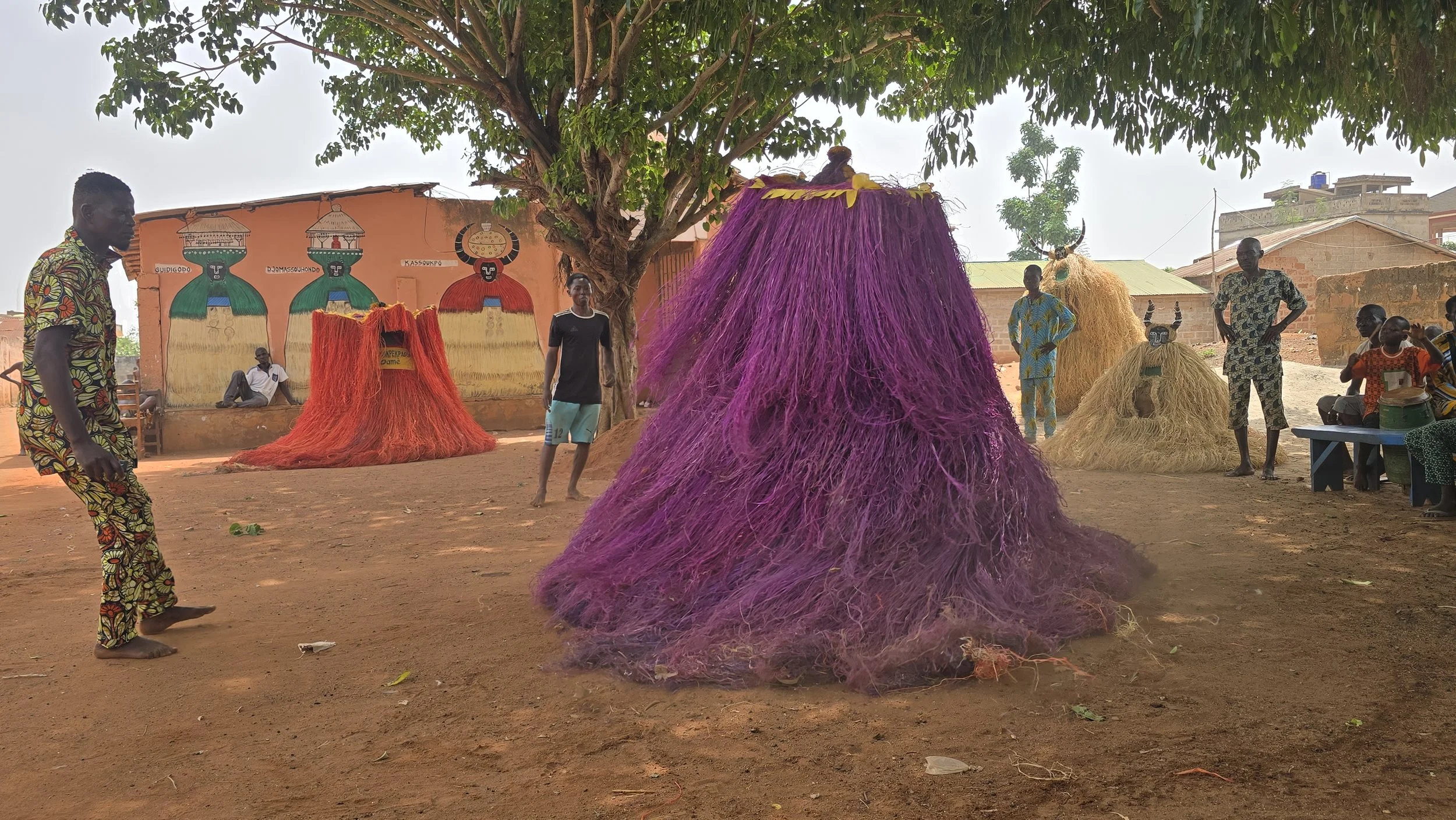
zangbeto
Five Zangbeto whirled into the arena. Fuelled by intense rhythmic drumming, the hypnotic spinning of the giant haystacks was regularly interrupted as they charged towards the children. Screaming pandemonium then ensued until the spirit returned to the arena. But, the highlight of any performance is the reveal. As the drumming stops, attendants tip the heavy costumes over to show the interior and the form the spirit has taken. We were treated to a small statue of a man with an impressively vibrating penis, a spinning ball, and finally – to general satisfaction – a live baby crocodile.
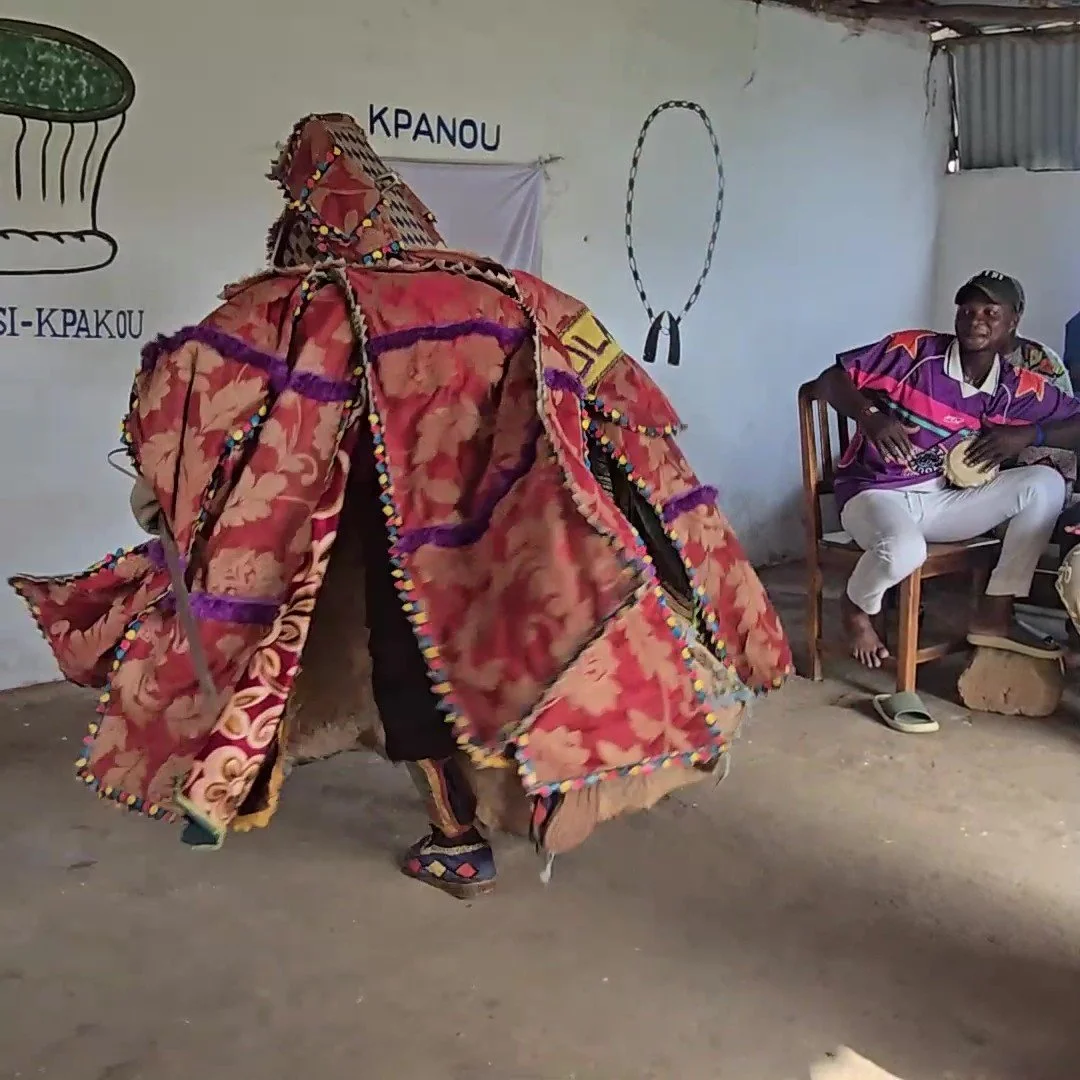
egungun
The Egungun – a secret society of the Yoruba people – also received us in their small village hall. Concealed under layers of vibrantly coloured fabric, male dancers entered the building, mediums serving as a bridge between an ancestor and their descendants. Rapidly spinning towards a trance-like state, their costumes fanned out creating a “breeze of blessing” and purifying the air in readiness for the spirit. The arrival of the ancestor certainly upped the ante as direct contact is forbidden and said to bring certain death. The claustrophobic space, which now housed three overly-excited Egungun, a dozen musicians and ourselves pressed hard against the side wall, shrank as the only salvation between us and eternity was a small man with a stick, running up and down in front of us, attempting to beat back any twirling ancestor from coming too close.
The man with the stick was multi-tasking. He was also responsible for preventing the Egungun escaping. With a reputation of becoming violent and menacing, loose on the streets the Egungun are feared due to their penchant for harassing and beating people as they run amok. After several attempts to exit through the open doorway, the spirit finally succeeded and as the man with the stick raced from the hall in pursuit, it seemed a good time to leave.
Across this part of West Africa there has been no shortage of imagination when it comes to communicating with spirits. Each masquerade has been entertaining, but as we get closer to Nigeria the atmosphere has felt a little heavier and more intense. Perhaps it is pure imagination, or maybe it is simply the knowledge that we now face one of our biggest challenges yet.
Nigeria - the nemesis of many overlanders and, for us, the final country of Western Africa. A nation of enormous human momentum pushing against finite land, fragile infrastructure, and unevenly shared wealth. It is often viewed as the most challenging country to cross, not because it’s uniformly dangerous, but because it combines a few risk factors in one very large and very busy country.
The main concern is security. Boko Harem has been operating long-running insurgency in the North-East, kidnappings by loosely structured armed gangs are commonplace in the North-West, recurring violent clashes between farmers and nomadic herders are ongoing in the north, and militancy and unrest is ongoing in the south. Avoiding these areas results in a clear corridor through which the country can be crossed.
With a route identified, there are other aspects that need consideration. Nigeria is the most populated country in Africa and the 6th most populated worldwide. Twice the size of California (the most populated state in US with 40 million people), over 234 million (equivalent to 2.92% of the total world population) live there. Imagine then, the sheer volume of traffic; according to the 2025 Mid-Year Traffic Index, the capital Lagos is ranked the world's most congested city.
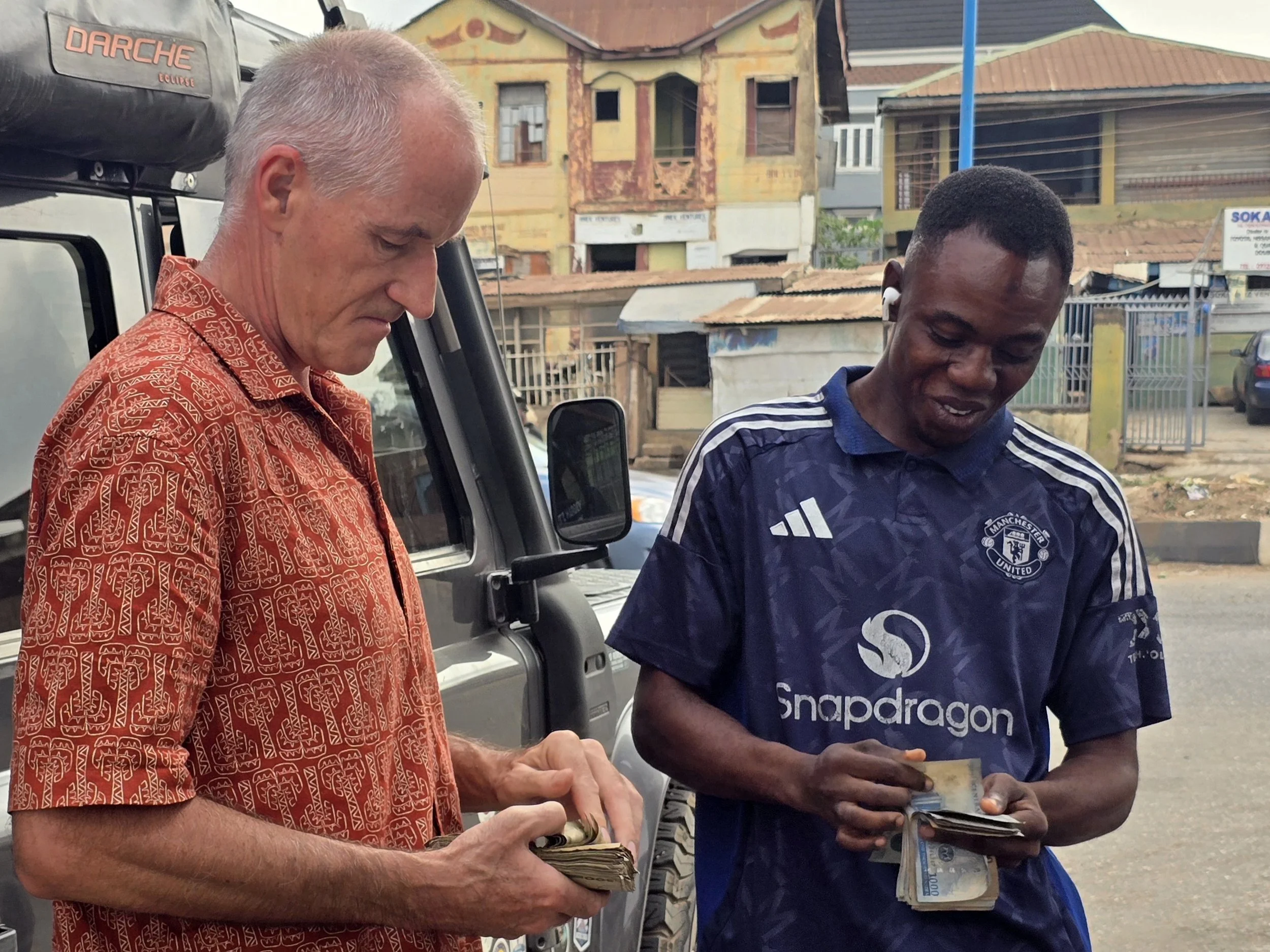
cash is king, nigeria
Less concerning, but worth taking on board are checkpoint frequencies, fuel shortages, and extremely limited card payment facilities. Cash is king; the Nigerian Naira is issued in note denominations of ₦5 (US$ 0.0037) to ₦1,000 (US$ 0.74). ATM’s have daily limits of ₦20,000 (US$ 14.79), but they are hard to find and often out of service.
On the plus side, Nigeria recently launched its new e-Visa system for short-stay visas. Prior to May 2025, the visa had to be applied for from the applicant’s home country, supported by copious amounts of paperwork including a mandatory letter of invitation. Although one of the more expensive visas at US$ 275, online approval was almost instantaneous, so one less thing to worry about.
The big question for us was how did we want to travel across this complex, intense country. We have read many blogs where the approach has been to drive pretty much non-stop during the day, stopping at night in guarded compounds, the objective being to cross as quickly as possible. This was certainly an option, but we wanted to get a sense of the country and its people despite the limited opportunities.
Not needing anything that Lagos may have had to offer, we shunned the main Seme-Krake border crossing, opting instead to enter Nigeria at the border at Idiroko, a border long synonymous with smuggling that proved to be fast and friendly; the only delay being the examination of our Malaria tablets. From there we took reasonably good roads to Abeokuta and Olumu Rock.
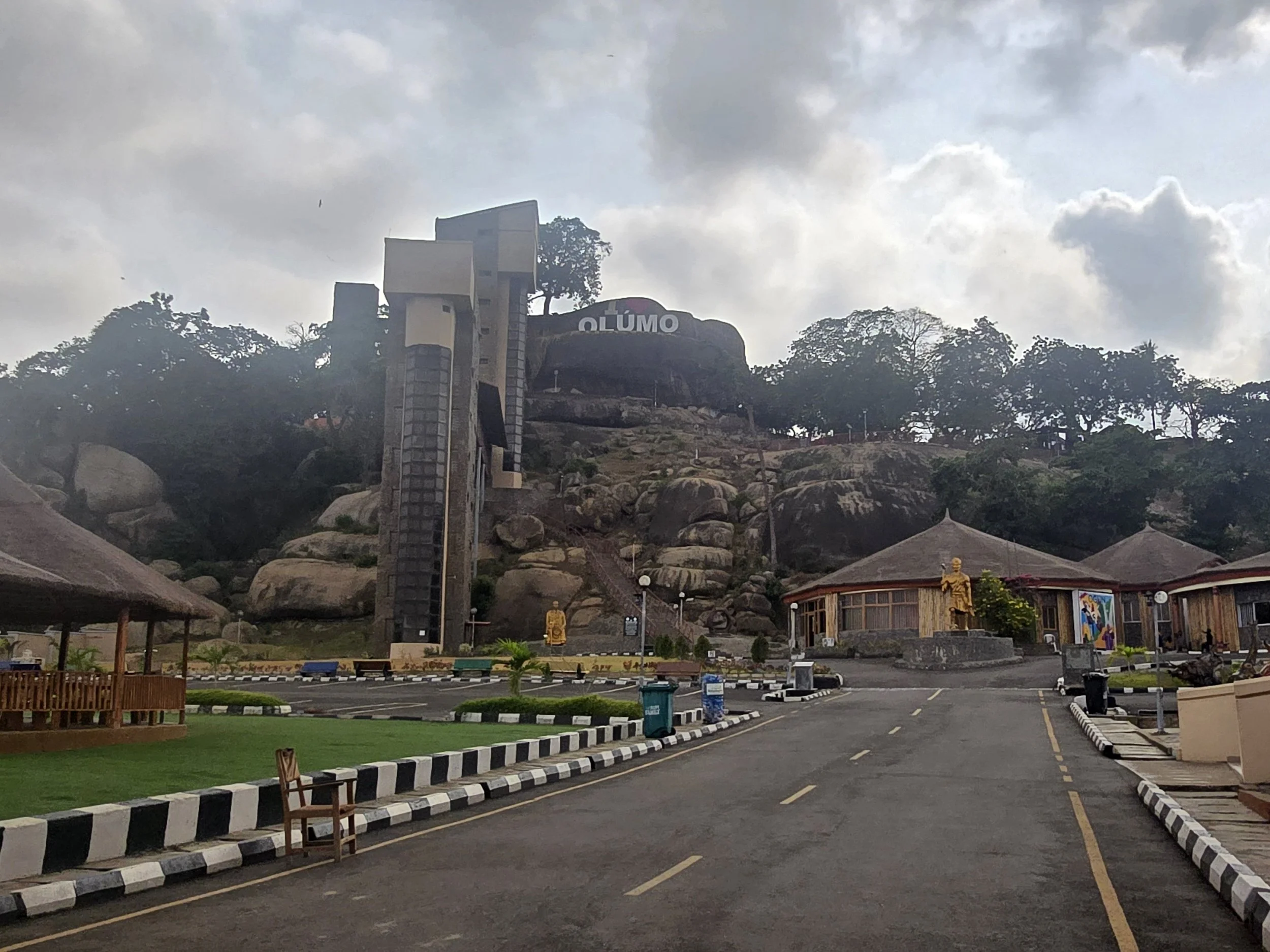
olumo rock, abeokuta
If Nigeria ever decided it needed a natural lookout tower, Olumo Rock would be the obvious choice. Rising out of the city of Abeokuta like a giant misplaced boulder, it looks as though someone dropped a small mountain and forgot to tidy up. Long used by the local Egba people as a fortress and hiding place during intertribal wars, spiritual significance is still maintained with shrines and a resident priestess who maintains traditional practices. It also gave the city its name: Abeokuta roughly translates to “under the rock.” Not subtle, but accurate.
Traditionally, reaching the top involved scrambling up narrow paths and squeezing through crevices, an option that is still available alongside an optional staircase and, slightly improbably, an elevator inside the rock which does take a little of the siege mentality out of the experience. At the top you’re rewarded with a slight breeze and the quiet satisfaction of doing something other than driving.
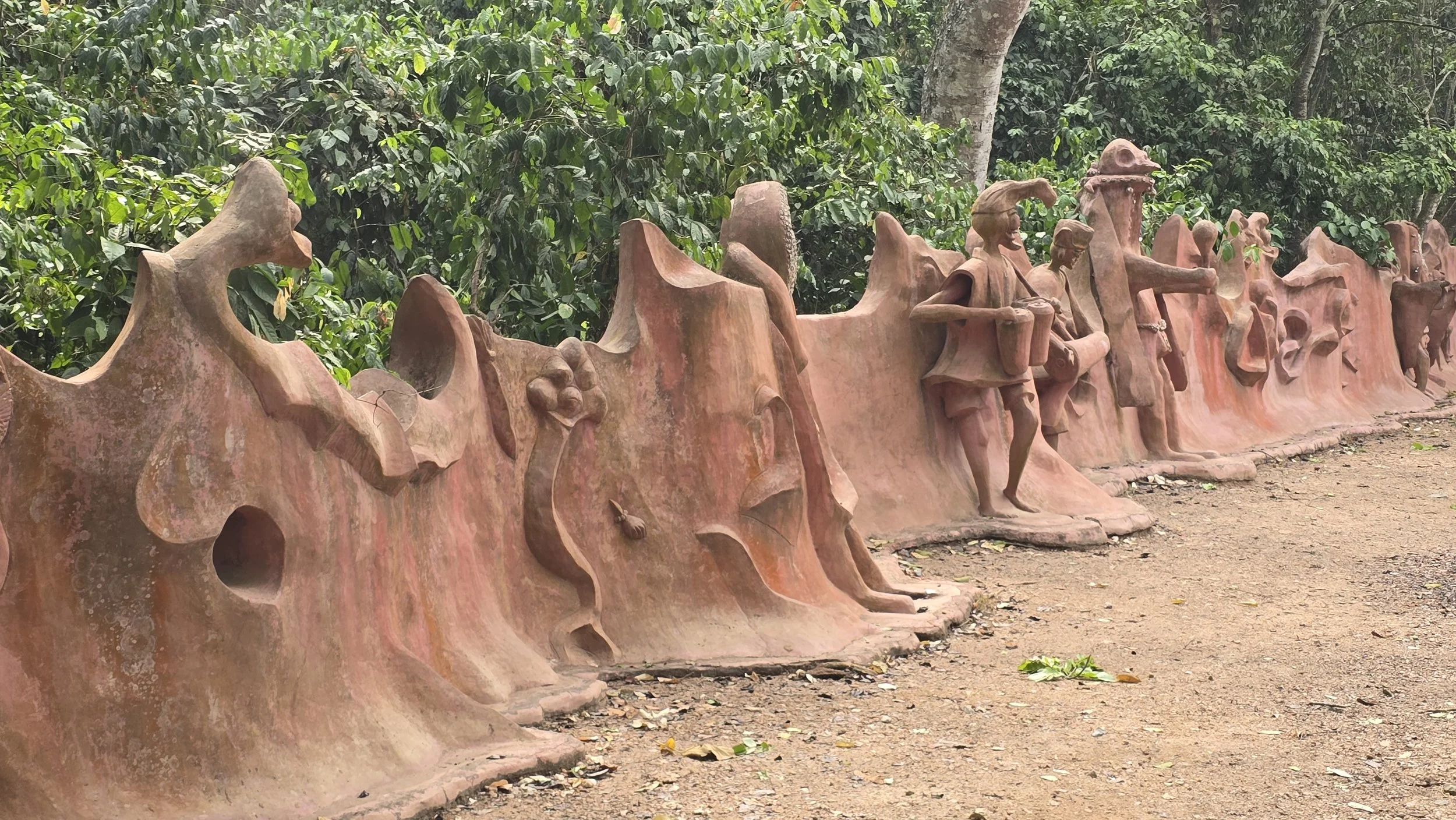
sacred grove, osun-osogbo
With tourist sites virtually non-existent, our next stop was the UNESCO World Heritage Osun-Osogbo Sacred Grove, one of the last surviving patches of sacred forest in a heavily populated area. It sits on the edge of Osogbo along the banks of the Osun River, and for centuries has been dedicated to Osun, a Yoruba river goddess associated with fertility, protection, and water. Within the forest are winding footpaths through thick vegetation that lead to an abundance of shrines, clay sculptures of gods and spirits, and earthen altars and offerings.
Whether fortunate or not, our timing didn’t align with the Osun-Osogbo Festival, when thousands of Yoruba undertake a spiritual pilgrimage to gather in the forest.
Tales of the never-ending chain of checkpoints turned out to be accurate but rarely were we asked to stop. On approach, barriers were removed and we were waved through with huge smiles – Nigeria is certainly not lacking in friendly people. The only incident where we were “asked” for money was when we slightly over-ran a red light, easy to do as it was a rather surprising addition to a road infrastructure that was chaotic at best.
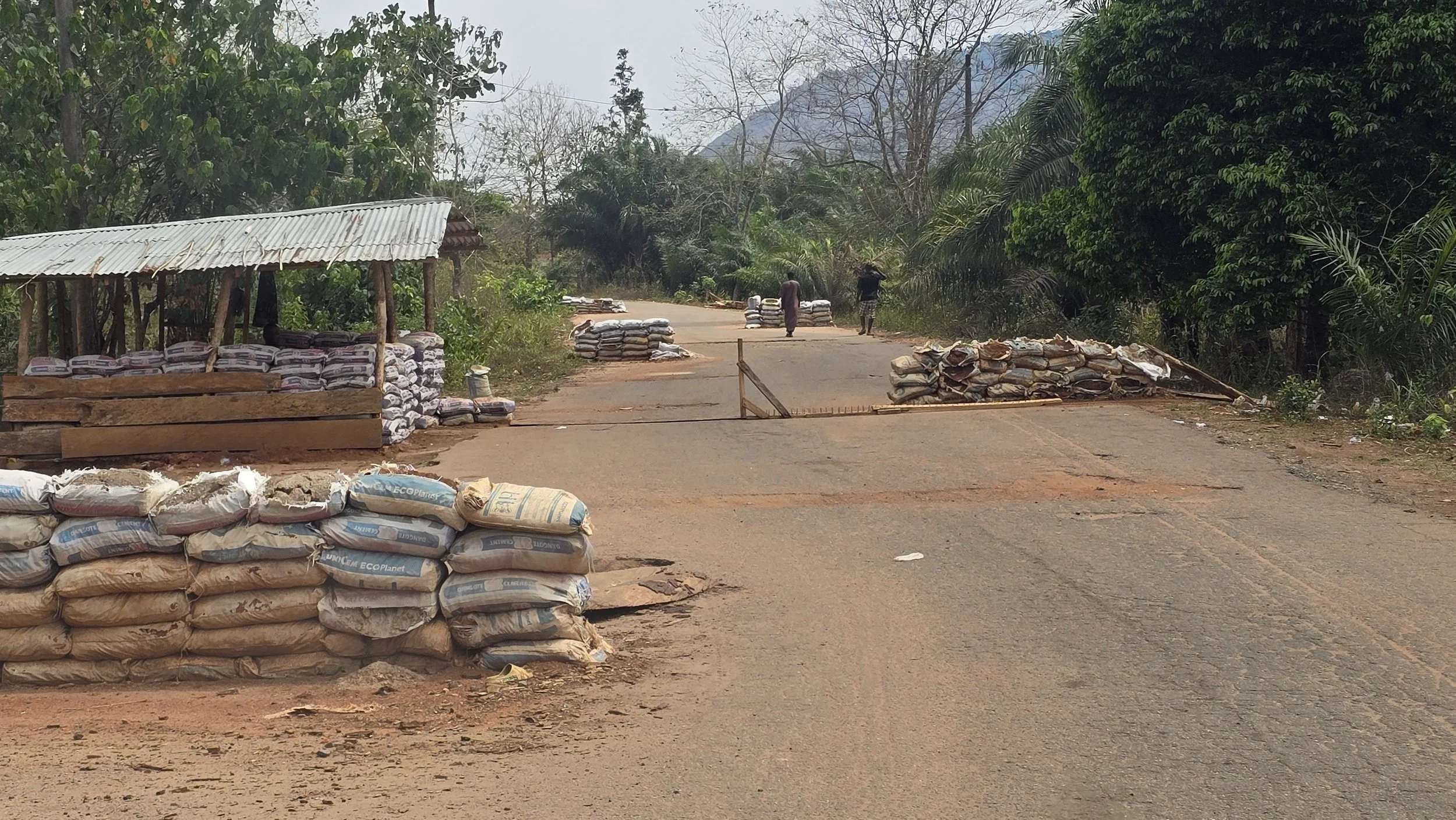
nigeria’s many checkpoints
Straddling an invisible line, it took about 20 seconds before we were surrounded by young men. A thick plank of wood was wedged under the front tyres and blocks of concrete were pushed up against the rear. A uniformed “official” then appeared wanting to get into the car. This was a novel one for us but given that we didn’t want to stay where we were for the foreseeable, Ian jumped out, the official jumped in and I was ordered to drive down a side road and reverse into a clearing off to the side. In all of our African travels we have tried very hard not to go along with dubious requests for money, a practice that overlanders coming through after us would not appreciate. However, in this case, wanting to get the guy out of Bob as quickly as possible, we handed over the equivalent of 8 Euro and order was restored.
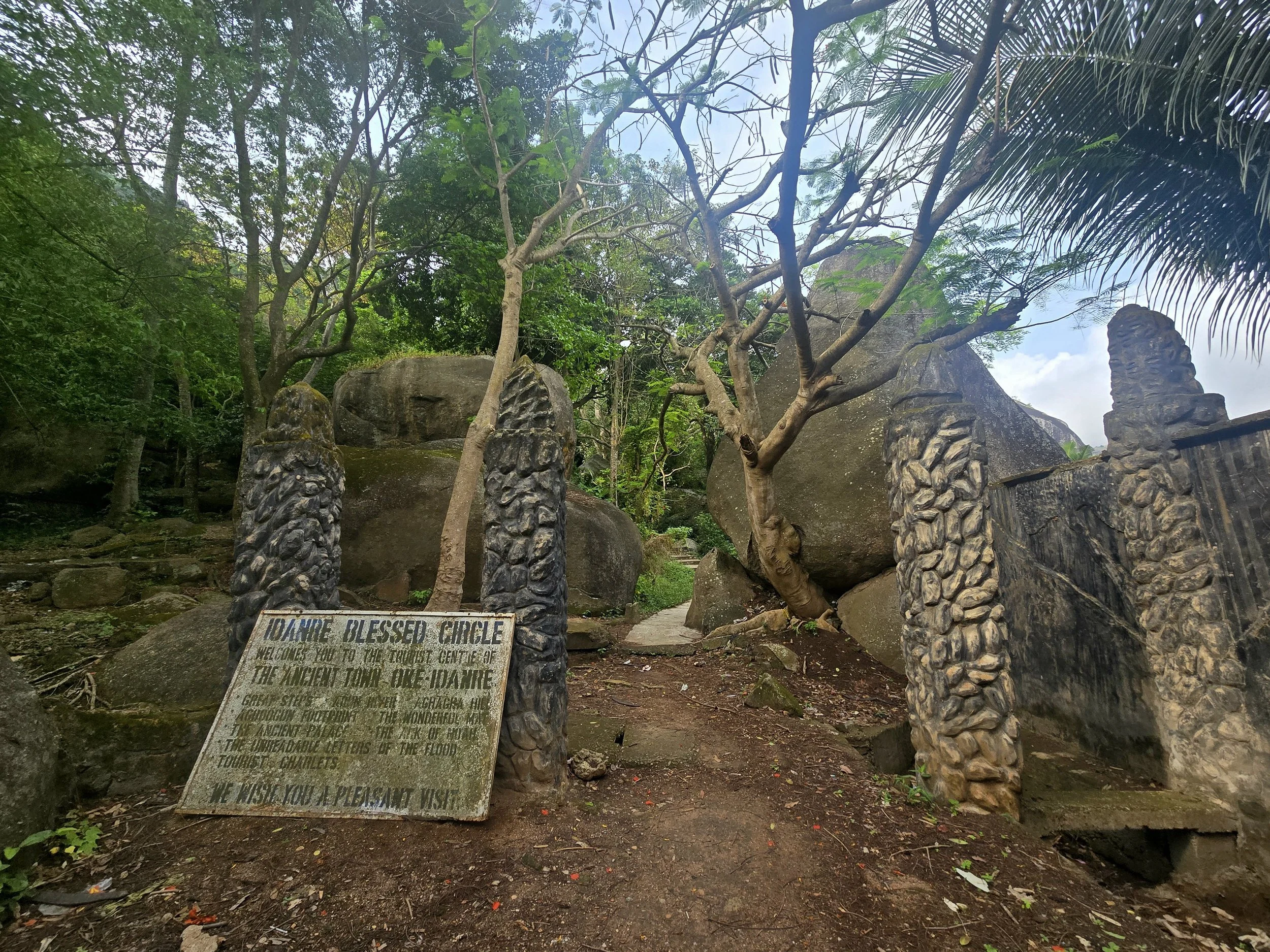
idrane hills
Still on the subject of checkpoints, we have dealt with ropes, sandbags, tyres, oil drums, metal barriers and lengths of wood. Nigeria had a couple of new approaches. One was a large tree trunk on wheels, the other a plank of wood – also on wheels – with long, vicious, metal spikes sticking out.
Clutching at straws for points of interest, we detoured to the Idanre Hills, a cluster of steep granite domes around a town bearing a slightly forgotten feel with run-down and abandoned guesthouses, underused viewpoints and a climb of 682 steps to the inspirationally named hilltop settlement of Oke-Idanre (Idanre on the hill). The two-day detour and stay in the Presidential Suite of the Goshen Trust Hotel – which didn’t include toilet paper or a toilet seat – was questionable, but this was one of the country’s highlights …..
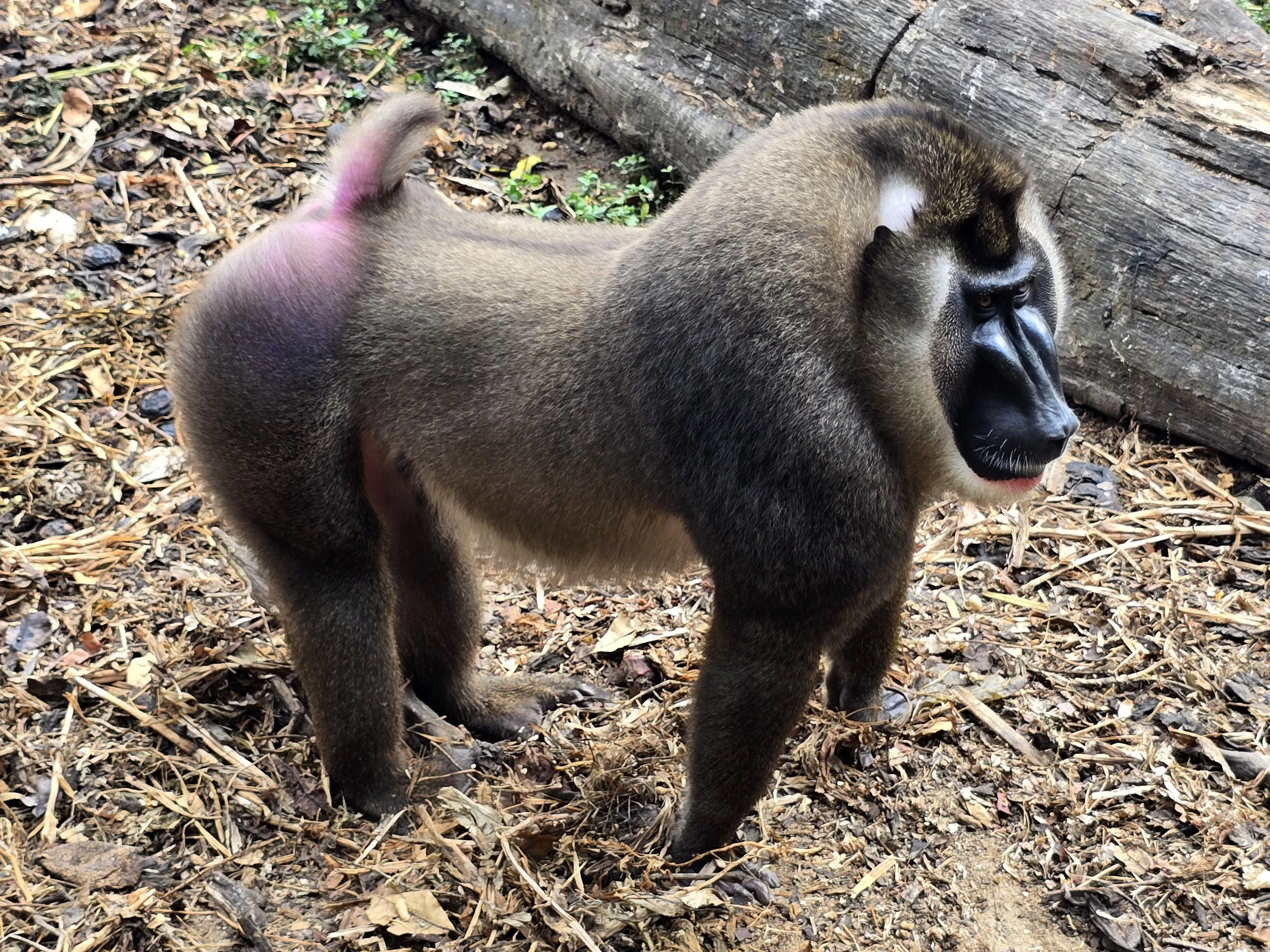
drill primates, afi mountain ranch
….. which was thankfully topped by the Afi Mountain Drill Range, a wildlife conservation centre in the Cross River forested highlands of Nigeria, near the border with Cameroon. The drill monkey is one of Africa’s most endangered primates with less than 4,000 left globally, over 600 of these at the ranch; the only place in the world to see drill groups in their natural habitat. Heavily hunted for bush meat (along with the Cross River Gorilla whose numbers are now less than 300), the Pandrillus Foundation functions as a rescue centre, breeding and rehabilitation site, and a research base for primate behaviour.
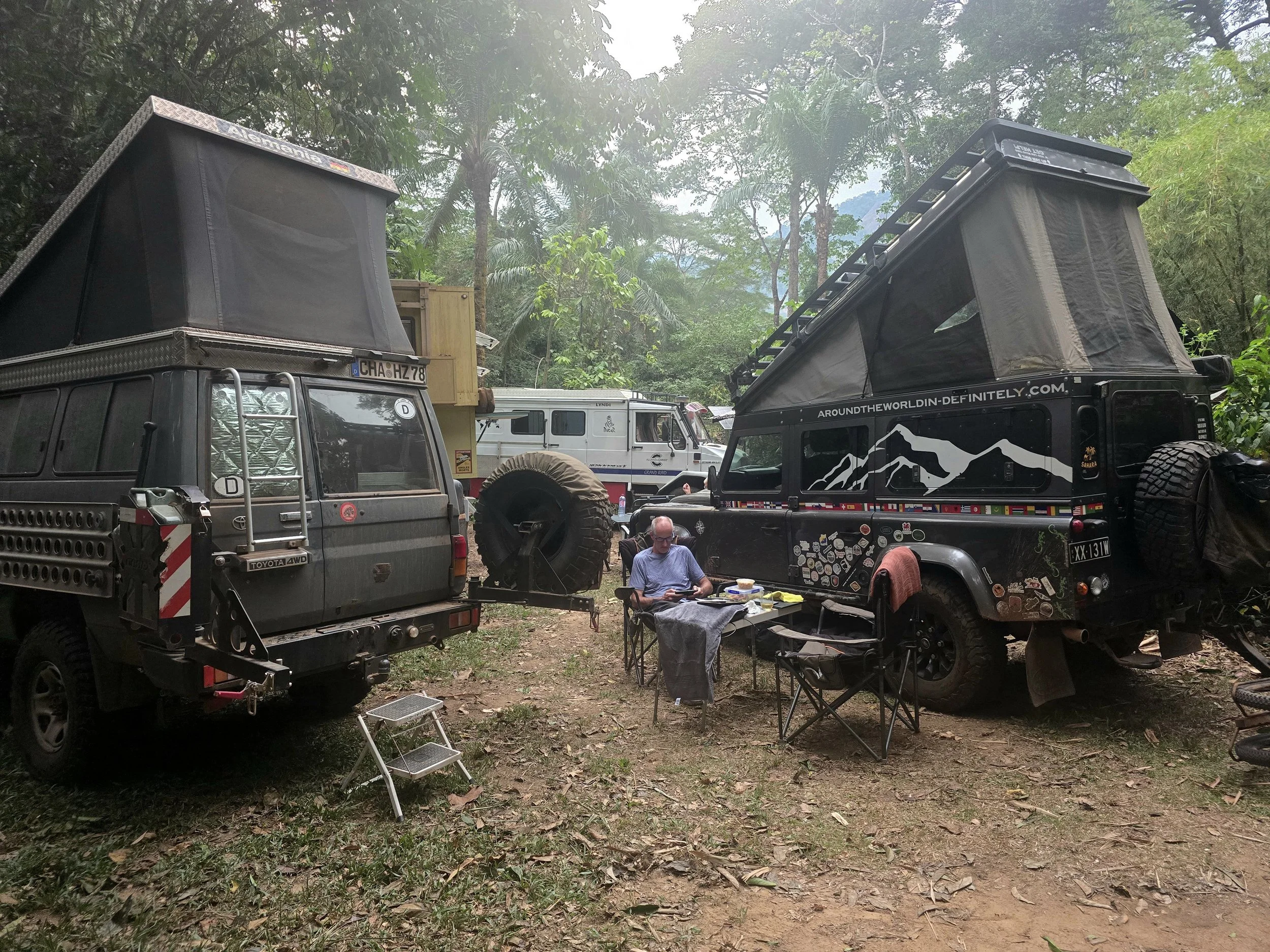
rare sight, other overlanders
Accessed by a truly awful dirt track, the only visitors tend to be overlanders who are welcomed with opened arms on the one hand and relieved to be away from the chaos of Nigeria on the other. Indeed, it was here than we met other overlanders (all German) and where the main topic of conversation was how to get out of Nigerian and into Cameroon.
With many of the borders closed or unsafe, overlanders are left with two options. A military convoy leaves the border town of Ekok (usually on Wednesdays and Saturdays) driving 280km through the troubled area of Anglophone Cameroon to the southern town of Kumba. The alternative is over the Mambilla Plateau, a mountainous region that acts as a natural border between the two countries, via the notorious Banyo track - 145km of challenging 4x4 driving.
My guess would be that less than 20% of overlanders take the Banyo track, many being deterred after hearing accounts from other overlanders who have been generous enough to share their horror stories via Utube! Having trawled the internet ourselves whilst weighing up the pros and cons of both routes, the Banyo track ultimately came out on top. We would be escaping the intense heat and non-stop cacophony that is Nigeria; some fresh mountain air combined with some peace and quiet was too hard to resist. Our new Starlink Mini was mounted and working, a recent half-day 4x4 driving instruction back in the UK had brushed up my low range and diff lock skills and Bob was feeling great after recent repair work in Accra.
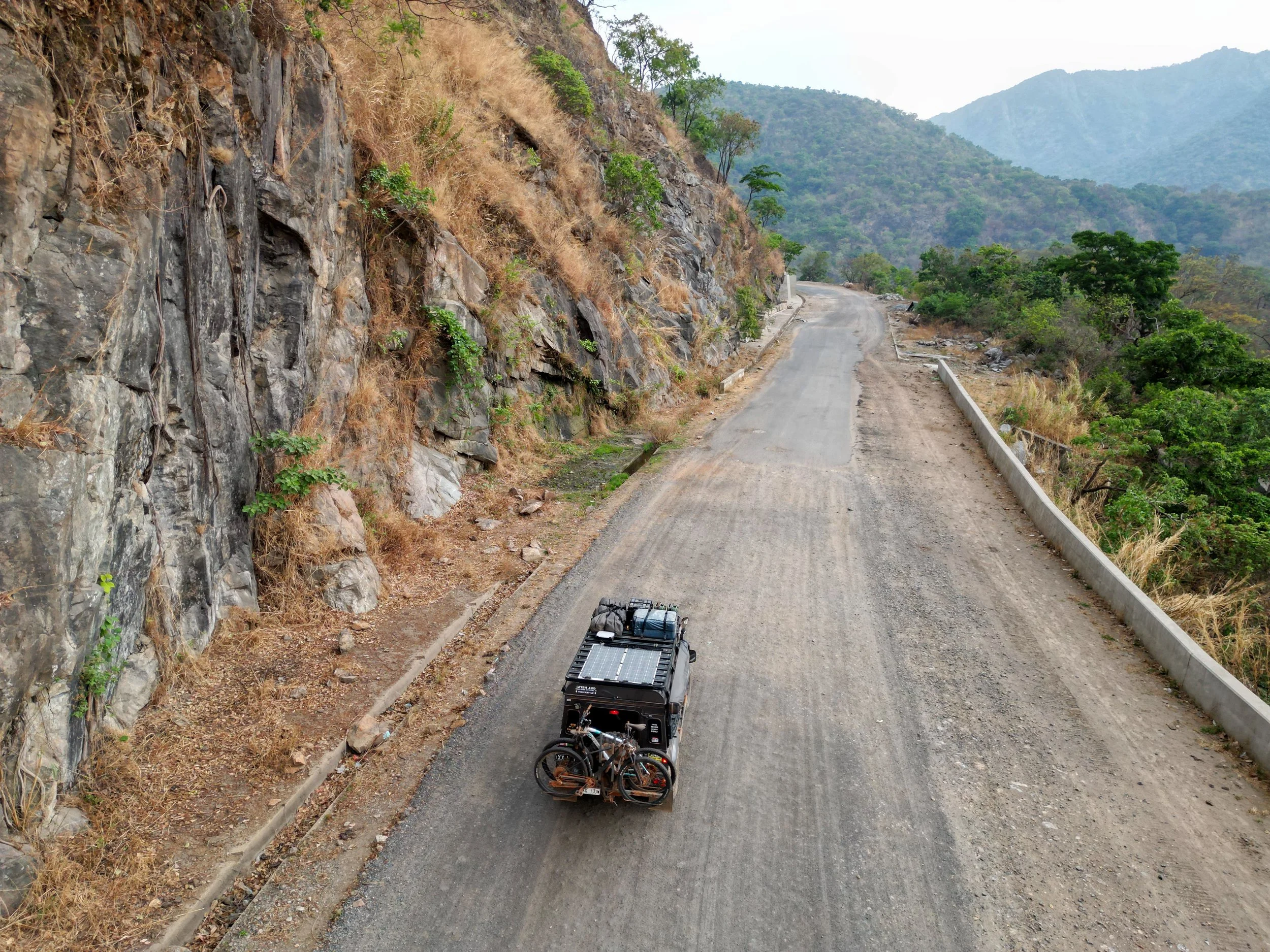
uphill towards the banyo track
Leaving Afi Ranch, it took three days to reach the high village of Nguroji. The roads were a mixture of tar and gravel, with an unexpected thunderstorm on the last section demonstrating how quickly conditions can change from a scenic uphill drive to loss of visibility and traction on the steep bends. The storm didn’t last long and not wanting to spend the night in the village we detoured 4km to the Mountain Forest Project, a research camp accessed by steep, narrow tracks and a rickety wooden bridge. Despairing of ever getting there, we finally reached the gates of the project with an entourage of about 15 village children who had run all the way behind us. As we handed out pencils and notebooks, one of the older boys burst into tears as he haltingly thanked us for the opportunity to practice writing his name in English.
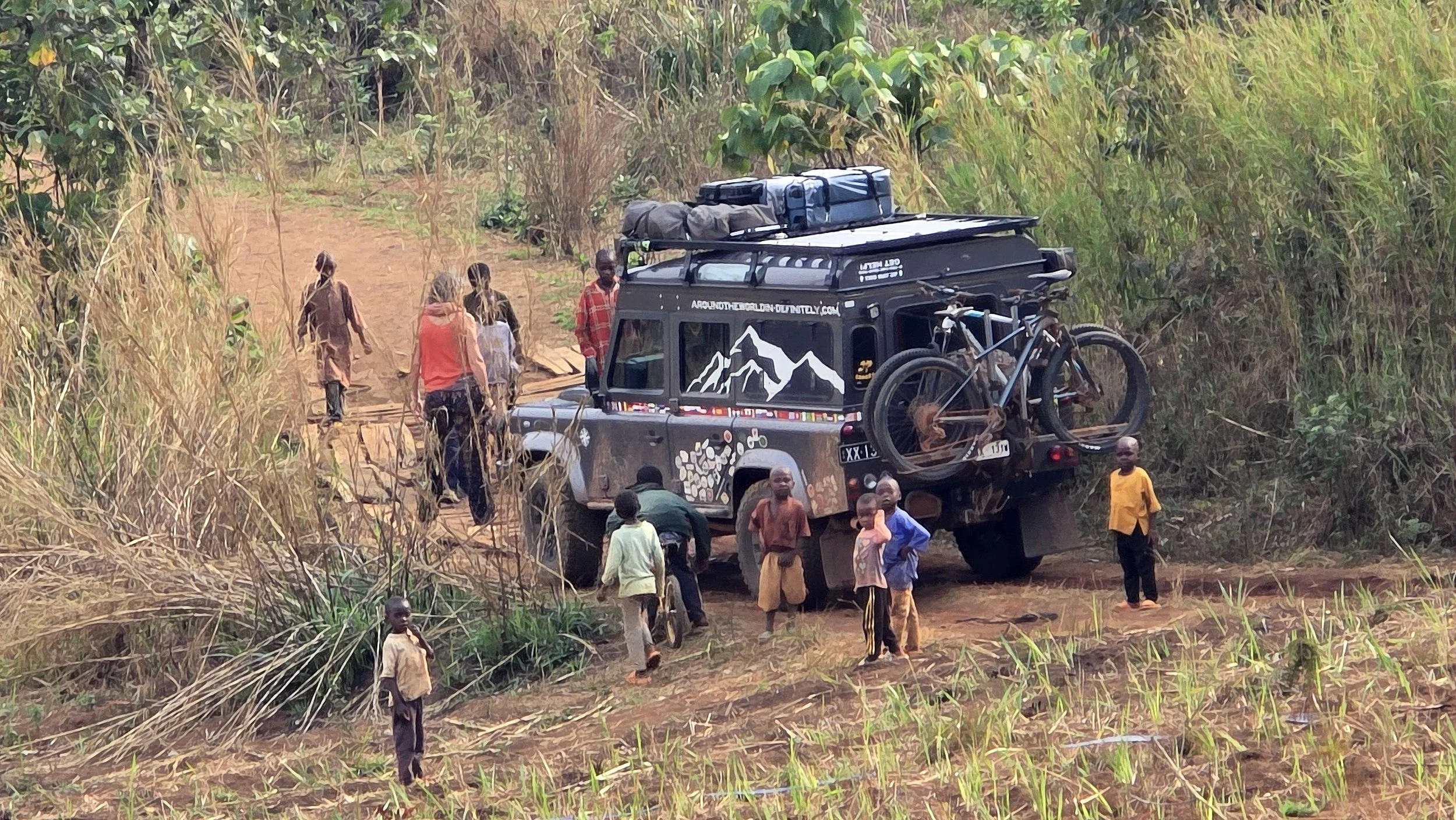
children of nguroji village
Tempting as it was to remain at the camp for more than one night, our concerns about the weather and deteriorating road conditions had us back at the village and at the beginning of the Banyo track early the next day. The rainy season was due to start and as difficult as the track would be under dry conditions we reckoned it would be impossible for us to get through once the dirt surface morphed into a muddy hell.
The weather gods smiled on us and we covered 100km before wild camping off to the side of the track overlooking rolling grassy hills. The track had definitely been challenging with its ruts, moguls and long steep inclines littered with large rocks, but Bob hadn’t faltered once and we were grateful that we had no horror stories of our own to tell. Apart from the occasional local motorbike, we hadn’t seen any other vehicles on the entire track which did make us wonder whether continual deterioration had now made it impassable for many. Staying out of the deep ruts in wet weather would have been impossible and the ground clearance needed would be more than most vehicles (including Bob) could manage. The isolation of the region was welcomed but no cell phone reception or passing traffic yet another issue to be considered.
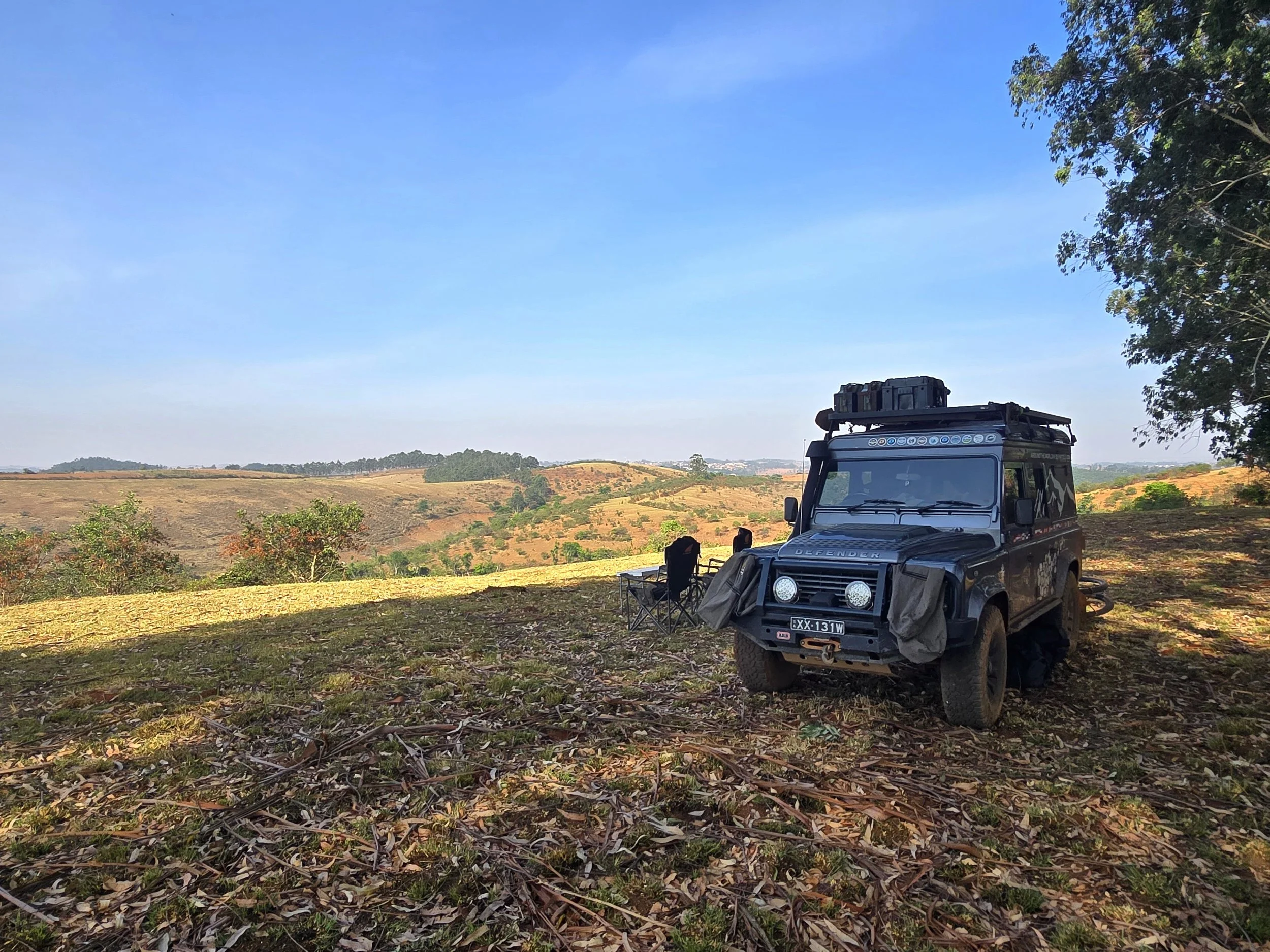
scotland or nigeria?
The track continued much the same the following day and we arrived at the border village of Kan-Lyaka around midday. There was a small hut housing an immigration officer who stamped us out of Nigeria and a teenager sat on a bench under a tree who did the same with our Carnet and, just like that, our adventures through Western Africa come to an end.